How to Raise Alligator Snapping Turtles? A Detailed Guide to Efficient Artificial Breeding Techniques
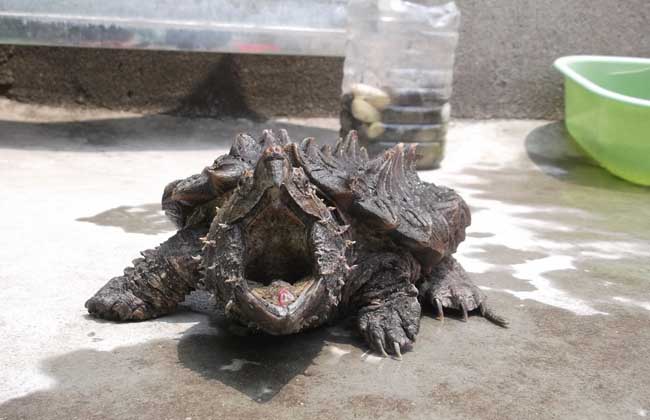
The alligator snapping turtle, also known as the meat turtle, can reach a body weight of 5 to 11 kg. It has a gentle temperament and does not actively attack people. The alligator snapping turtle is native to the Americas. Under artificial rearing conditions, its average annual weight gain can reach 1000 grams, and its meat yield is high, twice that of ordinary turtles. The alligator snapping turtle is a new species introduced in the past two years. Through these years of introduction, breakthroughs have been made in artificial breeding technology for seedling breeding, adult turtle breeding, and the raising of adult turtles into parent turtles. The alligator snapping turtle is relatively suitable for intensive farming and also suitable for family-style farmer breeding, making it a very good species for farmers to prosper.
The alligator snapping turtle has the characteristics of fast growth and delicious meat, and has the highest meat yield among similar turtles, with a meat-to-bone ratio as high as 85%. It is an omnivorous animal that mainly feeds on animal-based food, but also eats vegetables and other coarse grains, so pelleted feed can also be used during the breeding process. The muscle of the alligator snapping turtle contains a large amount of amino acids essential to the human body and also contains unsaturated fatty acids, so its nutritional value is very high. Its market price is 4 to 5 times that of soft-shelled turtles. One kilogram of alligator snapping turtle can sell for about three to four hundred yuan on the market, so the economic benefit is relatively significant.
Biological Characteristics
1. Morphological characteristics: At first glance, the alligator snapping turtle closely resembles a crocodile. Its head is triangular and cannot be fully retracted into the shell. The mouth opening is large, reaching behind the eyes. The snout is pointed, and the eyes are round and lively. Adults are mostly brown (juveniles are black). The back has three ridges, and the ridges are divided into multiple mound-shaped sections with unit ridge protrusions, and there are stripes radiating outward from the top of the ridges. The rear edge of the carapace is serrated. The plastron is small and light yellow, with cross-shaped stripes in the middle. The limbs are thick and strong and cannot be fully retracted into the shell. The claws have long grooves, and the toes are webbed. The tail is long and pointed, with spine-like protrusions.
2. Living habits: It is an aquatic turtle species that likes to inhabit fresh water and often lies hidden in mud, sand, and weeds in the water. In the wild state, it often digs holes and lives in groups in winter. It likes quietness. Once startled, it will immediately flee. When it finds it cannot escape, it will turn to attack the enemy. Its survival temperature is 3 to 45°C. It is frequently active at 20 to 35°C, with optimal growth at 28 to 31°C. Activity decreases at 15 to 17°C, it hibernates below 10°C, and enters deep hibernation below 5°C.
3. Growth characteristics: The growth rate of the alligator snapping turtle is much faster than that of ordinary turtles. According to experimental observations, from a newly hatched juvenile turtle, after 5 months of rearing, the body weight can reach 250 to 500 grams. A 500-gram turtle stocked in spring can reach 2000 grams by late autumn. In the southern region of China, heating measures can be taken in winter to promote continued growth, resulting in even greater annual weight gain. In the southern region of China, it can be raised at natural temperatures. In the northern region of China, it can be raised in greenhouses. In winter, insulation measures can be taken to keep the water temperature at around 28 to 31°C, such as using geothermal water, to increase the growth rate of the alligator snapping turtle and increase economic benefits.
4. Reproductive habits: Under artificial breeding conditions, the alligator snapping turtle can reach sexual maturity and lay eggs in the third year. Except during hibernation, mating can occur throughout the year under moderate temperature conditions. May to August is the peak egg-laying period. Female turtles mostly lay eggs at night, and can also lay eggs during the day in rainy weather. Before laying eggs, the female turtle comes ashore and looks for a suitable location to dig a hole. After the hole is dug, she lays the eggs into it. After laying, she scrapes soil to cover the hole entrance, flattens it with her claws, and presses the bottom plate flat over the hole entrance. The entire process can last 2 to 3 hours, or even longer. One female turtle can lay anywhere from a few eggs to several dozen eggs per year, averaging around 30 eggs. The number of eggs laid is determined by the individual size of the female turtle.
Alligator Snapping Turtle Breeding Techniques
1. Construction of Turtle Ponds
A newly built turtle farm should be located in a place with good water sources, a quiet environment, and convenient transportation. The main body of the turtle pond includes: the turtle pond itself, feeding platforms, land areas, water inlet and drainage systems, overflow outlets, etc. The land area is mainly used as a resting place for the turtles. In parent turtle ponds, the land portion is used to build egg-laying grounds.
The turtle pond is a brick-and-cement structure, and the inner surface is smoothed with cement slurry to prevent the turtles' skin from being scratched. It is generally rectangular, longer east to west and wider north to south, but can also be built round. The size is adapted to local conditions, with a depth of 50 to 80 cm, and the deepest part should not exceed 120 cm. An 8 to 10 cm anti-escape overhang edge, also called a rolled edge, is made around the pond.
The bottom of a rectangular pond is set with a high-low sloped gradient, and the bottom of a round pond is set in a wok-bottom shape to facilitate sewage discharge. The feeding platform is 1/3 submerged in water and 2/3 exposed above the water surface, inclined at 30° to the water surface. In fact, the underwater part is also called the guide slope, and the above-water part is the feeding platform. If it is a parent turtle pond, the above-water part of the feeding platform also serves to guide the turtles to crawl toward the egg-laying ground. It is more reasonable to set the feeding platform on the north side of the turtle pond facing south. The width of the feeding platform is about 2 m, and its length is 80% of the pond side length. The egg-laying ground is 2 to 3 m wide, with a length consistent with the feeding platform, and is filled with fine sand 20 to 30 cm deep. A rain shelter is built above the egg-laying ground, which helps the turtles lay eggs on rainy days. The diameter of the water inlet and drainage pipes should be at least 10 cm to speed up water intake and drainage, and at the same time help discharge sewage thoroughly. Note that the drainage outlet must be set below or near the feeding platform, because there is the most filth near the feeding platform, and turtles like to excrete near the feeding platform after eating. The overflow outlet is set at the highest water level above the wall of the turtle pond to facilitate the discharge of organic suspended matter and flood discharge during the rainy season. After the turtle pond is completed, it must be repeatedly soaked in clean water for at least 1 week to remove alkalinity. After that, it should be disinfected with 150 ppm quicklime, and stocking can only begin after replacing with new water.
2. Breeding of Alligator Snapping Turtles
(1) Selection of parent turtles: Parent turtles generally use wild original stock, requiring health, no external or internal injuries, age over 5 years, and size over 2.5 kg, preferably 4 to 5 kg. If artificially bred alligator snapping turtles are used for breeding, healthy turtles over 4 years old and over 6 kg in size must be selected as breeding turtles. Whether sexually mature female parent turtles are in good egg-bearing condition can be checked by visual observation, hand feeling, light transmission, and other methods. Male parent turtles are lively and active. Both female and male turtles should move agilely. When their heads are lightly touched, alligator snapping turtles should immediately open their mouths, make a hissing sound, and reveal their fierce nature. If the legs and feet of a parent turtle retract forcefully when pulled by hand, it indicates relatively good physical condition. Carefully observe whether the turtle's head and neck are flexible and free, check whether the neck is swollen, open the mouth to see whether there is a fishhook in the throat tube, and a metal detector can be used to check whether there is a fishhook inside the turtle's body. The male-to-female ratio depends on the size of the turtles. Taking wild turtles as an example, generally for small parent turtles around 2.5 kg, the ratio is 2:1; for medium-sized parent turtles around 4 kg, 3:1 is appropriate; for larger parent turtles over 5 kg, a ratio of 4:1 can be used entirely.
(2) Cultivation of parent turtles: To promote gonadal development of parent turtles, maintain a quiet environment, keep water quality excellent, discharge sewage and add fresh water in a timely manner, carry out necessary disinfection of turtle ponds, parent turtles, and water bodies, and use microecological preparations so that beneficial bacteria occupy a dominant position. Disinfectants and microecological preparations must not be used at the same time. Commonly used drugs include non-residue quicklime, chlorine dioxide, PVP-I, norfloxacin, enrofloxacin, etc. Commonly used microecological preparations include photosynthetic bacteria, EM, etc. Use fresh animal bait, such as trash fish, small shrimp, snails and mussels, earthworms, etc., and strictly prohibit feeding deteriorated bait. Animal bait can be soaked and disinfected with table salt. If they are wild parent turtles, feeding should mainly be at night, accounting for 70% of the daily feeding amount, with the remaining 30% fed in the morning, and gradually domesticated to feeding during the day. If not domesticated, that is also acceptable, but it increases nighttime workload. For artificially bred parent turtles, feeding can be carried out once in the morning and once in the afternoon during the day, with 40% of the daily ration fed in the morning and 60% in the afternoon. Parent turtles have relatively high nutritional requirements for feed, so vitamins and minerals can be added to the feed by injecting the nutrient solution to be supplemented into the bait fish. Green additives beneficial to gonadal development of parent turtles can also be used, such as traditional Chinese medicine, enzyme preparations, bioactive chromium, and microecological preparations.