How to keep snapping turtles? Breeding methods and precautions
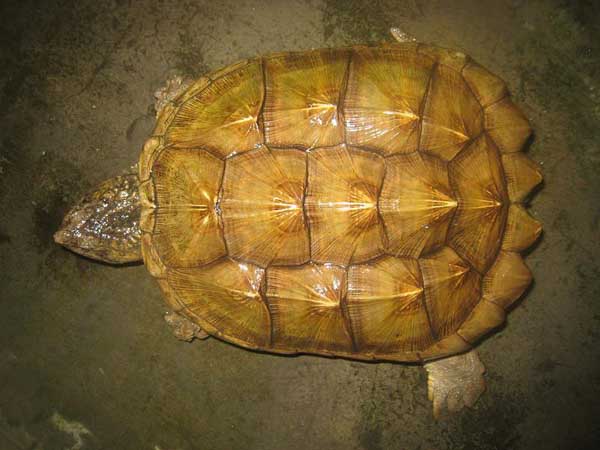
How to keep snapping turtles? Because snapping turtles are relatively aggressive by nature, adult snapping turtles should not be kept together with other turtles. If they are small snapping turtles under 8~9 cm, they can temporarily be kept together with other turtles, but in late spring or late autumn they must be separated, because this period is the peak feeding season for turtles, and for snapping turtles with an extremely large food intake, eating together with other turtles is very dangerous and can easily injure the other turtles.
Housing environment
Get a tank, the bigger the better, preferably a rectangular glass fish tank, though a large storage box will also do. Aquatic turtles live in water, and the water depth for keeping turtles is generally just slightly higher than the turtle's shell; there is no need for it to be too deep, and at most it should not exceed 2 times the height of the turtle's shell. It is best to provide a stone that rises above the water surface so the turtle can climb up onto it to bask. In summer, take care to prevent algae from growing in the tank; you can buy an algaecide, which is generally available at aquarium stores.
You can spread some small stones or large cobblestones on the bottom of the tank, but if you do, water changes will be very troublesome. Beginners are advised to use a bare tank, that is, with nothing spread on the bottom, and do not put aquatic plants in the water.
Preparation of water for keeping
Use tap water that has been left to sit for more than 2 days (to remove chlorine). It is best to prepare 2 plastic buckets for letting the water sit, which will be enough for water changes. It is recommended to change the water once every two to three days, and each time only change part of it; there is no need to change all the water in the tank unless the water and the area around the tank are very dirty.
When changing part of the water, use a small plastic tube to siphon out the dirty water at the bottom by the siphon principle, then add the same volume of new water (that is, tap water left to sit for 2 days) to the tank. Turtles kept with this water-changing method will not get white-eye disease or shell rot. If you find it troublesome, you can use a filter, the kind used for keeping fish. If used together with nitrifying bacteria, it can provide the turtle with a relatively stable water quality environment. In summer, water changes should be more frequent.
Feeding method
Turtles eat in the water, so when feeding, just put the food directly into the water. Turtles are generally fed pork, beef, small shrimp, small fish, and the livers of poultry and fish. These foods need to be chopped or torn into pieces, but these animal-based foods very easily pollute the water quality, so it is recommended to take the turtle out to feed it.
Beginners are advised to feed turtle food, which is more worry-free, and professional turtle food has a better nutritional balance and does not easily pollute the water quality. In summer, when the temperature is high, turtles metabolize quickly, so you can feed once a day, but it is generally recommended to feed once every two to three days. Turtles do not need to be fed too frequently; they are animals with very slow metabolism. Feeding once every few days is no problem. As long as a sufficient water supply is ensured, they will be fine even if they do not eat for half a month. The amount fed each time is generally enough if it is about the size of their head.
Hibernation management
When the temperature drops below 13°C from October each year to May of the following year, turtles begin to hibernate, until the temperature rises to 18°C and it ends. Hibernating turtles do not eat or move, they only sleep. The simplest hibernation method is to move the turtle indoors to a dark, quiet place and let it hibernate in shallow water (water just covering the shell). Change the water once a month, and apart from changing the water, try not to disturb the turtle.
Be careful that the temperature does not fall below 6°C, otherwise the turtle's life will be endangered. However, it is recommended to use a heating rod in winter, because the mortality rate of natural hibernation is very high. A heating rod is the kind used for keeping tropical fish; set the temperature at around 30°C and put a lid on the tank.