What Varieties of Snapping Turtles Are There? An Introduction to Common Snapping Turtle Varieties
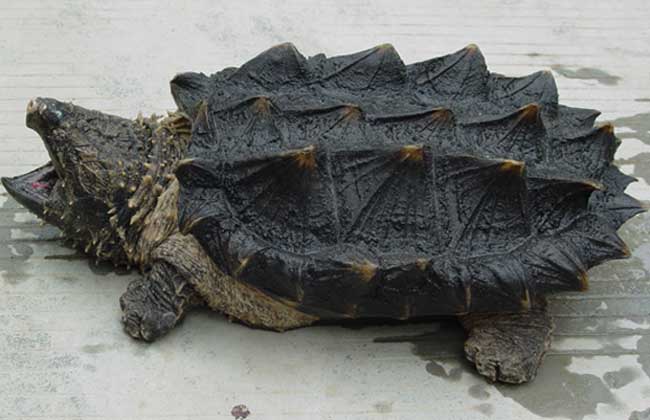
The snapping turtle is the oldest surviving reptile, one of the world's largest freshwater turtles, and known as the king of freshwater animals. It is divided into two major types, commonly called the large snapping turtle and the small snapping turtle. The large snapping turtle is also known as the true snapping turtle (alligator snapping turtle) and comes from the southeastern United States in North America. The small snapping turtle is also known as the common snapping turtle and has four subspecies: North American, Florida, South American, and Central American.
Alligator Snapping Turtle
The alligator snapping turtle, also called the large snapping turtle, alligator-shelled turtle, or crocodile-biting turtle, is found only in the Mississippi River basin of North America and is one of the world's largest freshwater turtles. The alligator snapping turtle retains primitive turtle characteristics; its mouth, carapace scutes, and red tongue are all quite peculiar. The upper and lower jaws at the front of its mouth are hook-shaped, like an eagle's beak, extremely sharp, and can easily bite off a person's finger. It is currently on the verge of extinction.
North American Common Snapping Turtle
The North American snapping turtle is the most common of the four subspecies of the common snapping turtle, and most of the common snapping turtles seen on the market are also of this type. The neck has protruding tubercles; the carapace is slightly domed and has a serrated edge at the rear, is somewhat square-round in shape, and is darker in color. The carapace shape is generally narrow at the front and wide at the back. The width of the third vertebral scute does not exceed one third of the overall carapace width and is narrower than the second costal scute. The length of the front lobe of the plastron does not exceed 40% of the carapace. The head is relatively short, the snout is slightly pointed, and there are usually black stripes on the upper and lower jaws. Juveniles generally have a black or dark brown carapace, which turns brown and grayish brown in adults. The plastron is generally black, red, or orange-red, or has red or orange-red spots. Juveniles are bold and unafraid of people, active in temperament, relatively docile, and fairly cold-tolerant.
Florida Common Snapping Turtle
The Florida common snapping turtle, also called the Florida snapping turtle, small snapping turtle, common snapping turtle, or flat-backed snapping turtle, belongs to the family Chelydridae, genus Chelydra, species common snapping turtle, subspecies Florida common snapping turtle. It is a very ferocious carnivore, with many raised sharp spines on the head and neck, the most developed among the four subspecies, making it a distinguishing marker of this subspecies. It is distributed in the U.S. state of Florida and southern Georgia.
South American Common Snapping Turtle
The South American common snapping turtle looks overall very similar to the North American subspecies, and because of different geographical distributions, the Ecuadorian population and the Nicaraguan population also differ. Its nearly round carapace has slight protrusions and gradually becomes flatter as it grows.
Central American Common Snapping Turtle
The Central American common snapping turtle is found in North America and Central America, mainly distributed in southern Mexico, from central Veracruz south to Guatemala and the Caribbean, and Honduras. It is also divided into two populations, one from Honduras and one from Mexico. In appearance it closely resembles the Florida subspecies, especially the population from Honduras. The best way to distinguish the Central American snapping turtle from other kinds of snapping turtles is the two long barbels under its chin.