Alligator Snapping Turtle Farming Techniques and Market Prices Explained
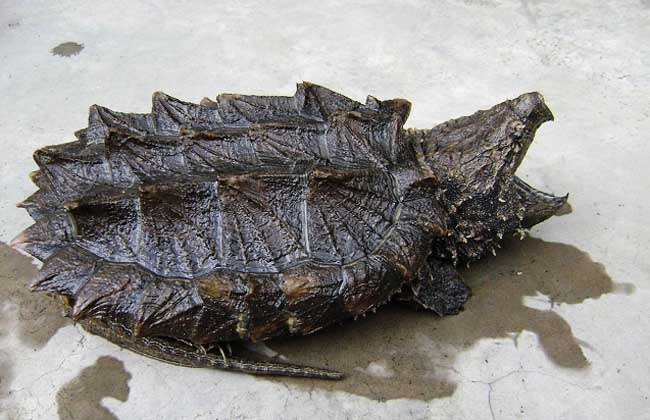
The Distribution Range of the Alligator Snapping Turtle
The alligator snapping turtle is mainly distributed in the Mississippi River basin of North America, the southern and central United States, and Central America, and is most abundant in the southeastern United States. In the United States, depending on the region of distribution, the alligator snapping turtle is known as the “Southern Turtle” and the “Northern Turtle”; its body color falls into 2 types, “yellow-backed” and “black-backed.” The yellow-backed alligator snapping turtle tolerates high temperatures, while the black-backed alligator snapping turtle tolerates low temperatures.
Alligator snapping turtles in China are mainly introduced from Florida. Apart from a very small number of alligator snapping turtles, the vast majority are snapping turtles. The provinces where they are distributed include Beijing, Shanghai, Jiangsu, Zhejiang, Jiangxi, Hainan, Guangdong, Guangxi, Hunan, Shandong, Sichuan and others.
The Growth Habits of the Alligator Snapping Turtle
The alligator snapping turtle lives normally at 2°C~38°C, can overwinter normally above 1°C, enters a state of light hibernation below 12°C, enters deep hibernation at 6°C, is slightly active at 15°C~17°C, feeds normally above 18°C, is most active and forages at 20°C~33°C, grows best at 28°C~30°C, and is less active above 34°C, lying dormant at the bottom of the water and in the mud and sand to escape the heat.
The alligator snapping turtle is a carnivore and will also eat carrion. Its diet is broad and varied; small fish, crayfish, various shellfish, and various fruits and vegetables are all targets of its hunting, and wild individuals will also prey on snakes and birds.
The alligator snapping turtle reaches sexual maturity at 12 years of age. It mates once every year; in the south this is in early spring, while in the north it is in late spring. The female turtle is responsible for building the nest, and after 2 months she will lay 10-50 eggs. The sex of the hatchlings is determined by the temperature at which the eggs incubate. The nest is generally located at least 50 yards away from the water's edge, to avoid flooding and inundation. The incubation period is 100-140 days, and the hatchlings are born in early winter. The general lifespan of the alligator snapping turtle in the wild is unknown, but it is believed to be able to live to 70-150 years. In captivity the lifespan is generally 20-70 years.
The Market Price of the Alligator Snapping Turtle
The price of the alligator snapping turtle is generally 35 yuan~45 yuan/kg. As a pet, the alligator snapping turtle is much more expensive; the purebred Florida snapping turtle is the most expensive variety among snapping turtles, priced at around 600~800 yuan each. The hybrid Florida snapping turtle is relatively cheaper, at 150~350 yuan each. The large yellow turtle stays at around 300 yuan, and the North American yellow-shelled one is also 100~130 yuan each.
The Farming Techniques for the Alligator Snapping Turtle
1. Stocking of turtle breeds: Adopting high-density green farming is a new technique for obtaining high benefits and is also an inevitable trend in the development of the turtle farming industry. The initial stocking density (about 200 g each) is 24 turtles/sq m~27 turtles/sq m, which by weight should be about 5 kg/sq m, but as the alligator snapping turtle grows rapidly, care should be taken to reduce the density in a timely manner. When the average size reaches 350 g each~400 g each, it should be reduced to 20 turtles/sq m~22 turtles/sq m. When the average size reaches 500 g each, it can be stocked at 15 turtles/sq m~17 turtles/sq m. At 600 g each, stock at 12 turtles/sq m~14 turtles/sq m. At 700 g each it should be 10 turtles/sq m~12 turtles/sq m. At 800 g each it is 8 turtles/sq m~9 turtles/sq m.
2. Feed feeding: It is recommended to use SDG alligator snapping turtle special green compound feed (protein content above 48%). When preparing, weigh the ingredients on site, add photosynthetic bacteria at 5%~10% of the total weight of the ingredients and about 45% clean water, and make long pellets with a particle size of 2 mm~3 mm. If conditions permit, making floating extruded pellet feed gives even better results. The feeding amount of compound feed is 1.5%~2.5% of the total body weight of the alligator snapping turtles, and 5%~10% for fresh live feed. Feed 3 times a day, at 6 o'clock~7 o'clock, 12 o'clock~13 o'clock, and 17 o'clock~18 o'clock respectively. When feeding, feed at multiple points and evenly, and try to make the feed produce a sound when it enters the water. Never feed it all in one place, causing the feed to pile up. The number of feed stations in each pond should be determined according to the size of the pond; generally 3~4 are set up per sq m.
3. Water quality regulation: Given that under high-density intensive turtle farming conditions, the turtle's food intake and excrement are both relatively large, and the water temperature is also relatively high, even if the feed fed is green feed, its rate of polluting the water quality is relatively fast, and more harmful substances are easily produced in the water body, with H2S being especially harmful, while splashing and bottom-applying photosynthetic bacteria can effectively improve water quality and reduce harmful substances. Each time new pond water is added, apply 10×10-6~15×10-6 photosynthetic bacteria at the same time. Changing the water is also an effective way to regulate water quality; at a water depth of about 20 cm it can be changed once a day, and at a water depth of 30 cm it can be changed once every 2 days. Never go many days without changing the water, and do not let the water body give off a foul odor. Every 7 days~10 days, quicklime can be splashed once at a concentration of 70×10-6, and care should be taken to apply it alternately with photosynthetic bacteria, never using them at the same time.
4. Water temperature control: The scientific regulation of water temperature directly affects the weight gain and survival rate of adult turtle farming. When the alligator snapping turtle is kept at 18°C~20°C for a long time, its growth rate is several times slower than at the optimal growth water temperature of 30°C~31°C. Therefore, the water temperature for raising turtles must be maintained within 30°C~31°C. On the other hand, when a turtle pond that is being refilled with water or exposed to the outside happens to encounter severe weather such as heavy rain or a sudden change in temperature, precautions should be taken in a timely manner, and every effort should be made to avoid a water temperature fluctuation greater than 2°C.
5. Rearing of hatchlings: For newly hatched hatchlings, after the umbilical cord has closed, disinfect them with 10% salt water and then place them in a container with a water temperature of 25-30, changing the water 3 times a day; after 3 days they can be fed a mixture of cooked eggs and cooked millet. After about 50 days, feed them chopped small fish, snails, mussel meat, animal innards and scraps. After 90 days they can be transferred to a cement pond for rearing.
6. Rearing of adult turtles: The feed for adult turtles is still mainly small fish, snails, mussel meat, animal innards and scraps, supplemented with some softened wheat, crushed corn, vegetables, aquatic plants, etc. Vitamins, trace elements and calcium, etc., should also be added appropriately. Feed at 10 a.m. and 5 p.m. every day; in spring and autumn change the water once every 7 days, and in summer once every 3 days. After late October they enter the hibernation period. Generally they grow 500-1000 g per year. With heated farming in winter, the annual weight gain can be as high as 700-1400 g. At 1000 g they can be sold, and the benefits are astonishing. In small-scale farming of 10-12 turtles, the annual weight gain can be about 5-10 kg, with an income of at least 5000-10000 yuan, which is considerable.
The Farming Value of the Alligator Snapping Turtle
1. Economic value: The alligator snapping turtle has already been introduced into China and successfully artificially bred. It is famous worldwide for its strong body and abundant meat, hence it is also called the meat turtle; it is a rare treasure among turtles, with characteristics such as a high meat yield, rich nutrition, fast growth speed, and high economic value. Its meat yield ranks first among turtles, and the meat is delicate, crisp and delicious with no off flavor.