How to Raise Partridges? Detailed Explanation of Breeding Techniques and Key Points
Biological Characteristics
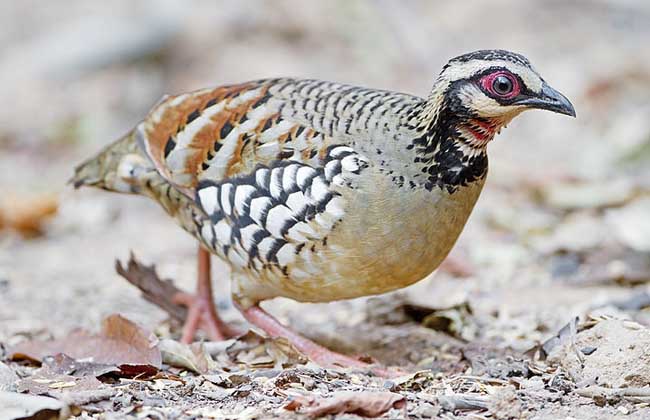
In animal taxonomy, the partridge belongs to the phylum Vertebrata, class Aves, order Galliformes, family Phasianidae, genus Francolinus. Its main wild habitats are in places such as Guizhou, Yunnan, Guangdong, Guangxi, Hainan, Fujian, and Taiwan, China, and it is also distributed in Zhejiang, Anhui, Shandong, and elsewhere. Abroad, it is mainly distributed in India, Thailand, Myanmar, Vietnam, and other places. The partridge has a band-like stripe on its forehead that crosses both eyes and runs down to the neck, shaped like a chest-protecting garment. The lower chest and back are mostly silvery gray, the wings have several black stripes, and the beak and feet are orange-red. The body length is about 34-38 cm, the male partridge weighs 550-650 g, and the female partridge 400-550 g. Partridges roost in low valleys overgrown with shrubs and sparse trees, or on stony and sandy slopes of hills. When calling, they often stand on branches at the mountain top, and their call is distinctive. During the day they flock in shrub thickets or run into nearby crop fields to forage. Their main foods are plant seeds, berries, tender branches and leaves, mosses, and lichens, and they also eat insects. They begin breeding in late April and early May, building nests in grass or among shrubs and stone piles.
Breeding Site and Facilities
In southern China, simple livestock sheds, poultry houses, or even open-air conditions can be used for breeding. In areas with large temperature differences, enclosed partridge houses should be used.
1. Partridge Farm and Partridge House Construction
For household partridge breeding, 500-1000 birds per batch is appropriate, and a house area of 15-25 sq m is sufficient. Partridge houses can also use idle rooms, other livestock sheds, or warehouse buildings, or investment can be made to build a reasonably sized intensive, factory-style partridge farm. When building a new partridge farm, several points should be noted:
① The partridge farm should be chosen in a place with guaranteed water and electricity supply, convenient transportation, far from residential areas, and an ideal pollution-free ecological environment.
② The partridge house should face south, be ventilated, and be dry. The partridge house should have a ridge height of 3 m, with front and rear windows to make full use of natural ventilation. When necessary, exhaust fans should be installed, because partridges grow and develop quickly and produce a large amount of harmful gas in the house; if it is not discharged in time, it will seriously affect their growth and development and cause relatively large economic losses.
③ The construction of the partridge house needs to incorporate heatstroke prevention and cooling, moisture removal, cold prevention, and warmth retention facilities into its design. Partridges have a certain ability to adapt to temperature changes and can tolerate high temperatures of 35-36°C. In summer, high-economic-value fruit trees can be planted in advance on the south side of the partridge house for shade, or a shed can be built for shade and heat insulation, with timely ventilation and moisture removal; in winter, the north-facing windows should be tightly sealed, cold-proof door curtains hung on the doors, and a stove or heat pipe can be used inside the partridge house for heating. When building partridge houses in the north, the north wall should be made thicker for cold prevention and warmth retention.
④ The partridge house should use a cement floor to facilitate cleaning, epidemic prevention and disinfection, and to help remove moisture and prevent dampness.
2. Partridge Breeding Facilities
1) Brooding equipment: mainly includes heating, feeding, watering, and lighting equipment.
① Brooding warmer. A brooding heat-preservation umbrella for chicks can be purchased. One brooding heat-preservation umbrella can raise 150-200 brooding partridges aged 1-25 days, or a brooding warmer can be made to raise brooding partridges. The brooding warmer can use locally available materials, that is, a wooden frame 1.2 m long, 0.6 m wide, and 0.4 m high, with fiberboard used for the two side walls, rear wall, and top of the frame. A 200 w infrared lamp is installed on top of the warmer. An iron wire mesh is installed on the front of the frame, and a small movable door is set in its center, with a door width of 0.15 m and height of 0.2 m, and an iron wire mesh installed on the door frame. The bottom mesh is made by purchasing 1 cm square spot-welded iron wire mesh, and below it a manure tray made of iron sheet, plywood, or fiberboard is installed. The warmer legs are 0.2 cm high. Each of these self-made brooding warmers can raise 80-100 young partridges aged 1-25 days.
② Stacked brooding warming cages. Partridge farms and breeders with large-scale operations can use drawer-type stacked brooding warming cages. The cage frame is 1.8 m high, 1.2 m long, and 0.6 m wide. The surrounding structure is basically similar to the brooding warmer. On both sides of the cage frame, from top to bottom, small angle iron is installed at distances of 0.38 m and 0.08 m as guide rails for 4 layers of movable cages and manure trays. Movable cage specifications: width 1.16 m, depth 0.6 m, height 0.38 m. Its structure can be improved by referring to the brooding warmer, and lamp holders are installed on the side walls, using different bulbs to adjust temperature and lighting. Each movable cage raises 80-100 young partridges aged 1-25 days.
③ Drinkers and feed troughs. The specifications and sizes of drinkers and feed troughs differ according to their growth stages. For newborn partridge drinkers, a flat-bottomed plastic dish can be used as the base, with a plastic bowl 2-3 cm smaller in diameter than the base covering it. A small hole 0.4 cm in diameter is drilled near the lower edge of the bowl. The upper edge of the small hole must not be higher than the upper edge of the base, so that water in the base does not overflow outside the base. Two drinkers are set up in one brooding warmer. After 10 days of age, a drinking trough should be used instead, with specifications: length 20 cm, width 6 cm, height 3.5 cm. A 1.5 cm square iron wire mesh cover is installed above the trough to prevent feces and other dirt from contaminating the drinking water and to prevent young partridges from entering the trough and drowning. For partridge drinkers after 25 days of age, the specifications should be larger, as needed to meet drinking water requirements. For free-range raising, broiler drinkers can be purchased; for cage raising, drinking troughs or drinking bottles can be hung outside the cage. For newborn partridge feed troughs, brooding feed troughs and feed pans can be purchased, or they can be made from wood, iron sheet, or bamboo. Their height is 3 cm. A 1.5 cm square iron wire mesh cover is installed above the self-made feed troughs and feed pans to prevent feces or dirt from contaminating the feed and to prevent partridge beaks and claws from scratching the feed out of the trough. One brooding warmer holds 2-3 feed pans or 2 feed troughs. For partridge feed troughs after 25 days of age, poultry feed pans can be purchased for free-range partridges, and feed troughs can be hung outside the cage for caged partridges (chicken feed troughs can be used as substitutes).
2) Meat partridge equipment: after young partridges are raised in the brooding warmer for 25-30 days, they can be moved into meat partridge cages and raised until market. The method of raising meat partridges is much the same as raising broilers, namely cage raising and floor raising. Generally, chicken-raising equipment can be used for raising partridges.
① Meat partridge cage, width 1.5 m, depth 0.75 m, height 0.6 m. The best material for making it is iron wire mesh, and bamboo or wood can also be used. The cages are generally 2-3 layers, and movable manure trays need to be installed between layers. Feed troughs and drinkers are hung outside the cage. Chicken feed troughs can be purchased for feed troughs, or they can be made from iron sheet or bamboo. Drinking troughs or cans and bottles are used for drinkers. Each meat partridge cage can generally raise 40-50 partridges aged 25-50 days, and from 50 days of age to before market it can raise 25 partridges.