What are the characteristics of the living habits of the partridge?
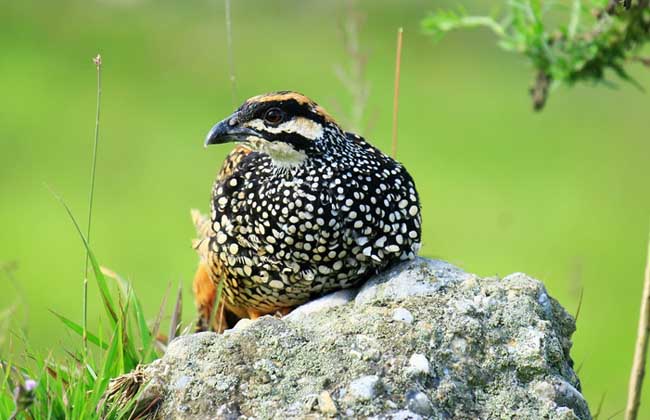
The partridge, also known as the Chinese francolin, is a species of bird. Its body shape resembles that of a chicken but is smaller, and its feathers are mostly a mix of black and white, with the eye-like white spots on the back, chest and belly being especially prominent. It is mainly distributed in Cambodia, China, India, Laos, Myanmar, Thailand and Vietnam. Let us now take a look at the living habits of the partridge!
The partridge's living environment
The partridge mainly inhabits scrub, grassland, rocky barren slopes and other treeless barren hill areas in low mountain and hilly zones, and sometimes also appears in small patches of jungle and bamboo forest near farmland. It has not been encountered in high mountains or inside forests. It inhabits undulating small hillsides covered with grass, low trees or small pine woods, and sometimes also bare rocky slopes. It likes to move about in dry areas, and at dawn and dusk it descends into the valleys to look for food. At night it perches in the grass, changing location every night. It is mostly not gregarious, but within one neighbouring area, many individuals are often present.
Breeding habits of the partridge
The breeding period of the partridge is from March to June, and courtship and mating begin between March and April. During courtship it often perches on rocks, tree stumps, shrubs or small trees to call, most frequently at dawn and in the early morning. Often when one bird calls, males in other places also call along with it, rising and falling in turn. Hunters often use a female bird as a decoy, shutting it in a birdcage with a trap door and placing it in the mountain forest to trap male birds.
The partridge nests in hillside grass or scrub. The nest is very simple and rough, mostly made of dry grass and leaves, with a little feather lining inside. Each clutch contains 3 to 6 eggs, occasionally as many as 7 to 8. The eggs are oval or pear-shaped, pale buff to yellowish brown, and measure 35 to 37mm × 28 to 30mm. During incubation the female bird is very attached to the nest, and often does not fly away even when a person comes right up to it. The chicks are precocial, and soon after hatching they can follow the parent birds about. They are also good at hiding; if they meet a person or a natural enemy, the chicks immediately hide in the nearby grass, while the female bird lures the enemy away in the opposite direction.
Diet of the partridge
The partridge is an omnivorous bird. It is fond of eating grasshoppers, ants and other insects, and also eats wild fruits, weed seeds and tender plant shoots. After the autumn harvest, it often goes into cultivated fields to peck at fallen grains, or steals yellow millet, sweet potato, pinellia and the like. It also eats fruit pulp, grass seeds and rice grains, as well as crickets and other insects.
The partridge likes to move about alone or in pairs on dry, bare brown rocky slopes. At dawn and dusk it often descends into the valleys to forage, and at night it spends the night in grass or scrub. It has no fixed habitat and changes its roosting location every night.