Analysis of the Prospects for Goose Farming and a Detailed Explanation of Farming Techniques
Summary: The goose, also known as the wild goose, belongs to the genus Anser in the family Anatidae and is a herbivorous waterfowl. In China, species such as the black brant, swan goose, greylag goose, bean goose and bar-headed goose have been found. Geese are Class II nationally protected animals in China and provide meat, eggs, down and medicinal value all in one. Below, the editor of Qinnong Net introduces the farming techniques and farming prospects for geese!
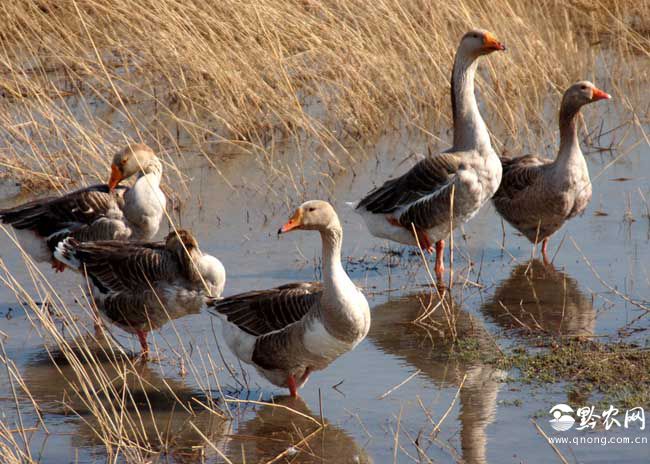
The goose, also known as the wild goose, belongs to the genus Anser in the family Anatidae and is a herbivorous waterfowl. In China, species such as the black brant, swan goose, greylag goose, bean goose and bar-headed goose have been found. Geese are Class II nationally protected animals in China and provide meat, eggs, down and medicinal value all in one. Below, the editor of Qinnong Net introduces the farming techniques and farming prospects for geese!
Farming Prospects for Geese
Goose meat is recognized worldwide as one of the three most precious and finest delicacies, and it is a banquet food served at the Great Hall of the People in China. Goose meat has been listed by the World Health Organization as the number one green food. Every part of the goose is valuable, and it has very high nutritional and medicinal value. Goose farming requires little investment and brings quick returns, with low feeding and farming costs, making it the most worthwhile farming project for investment in the 21st century.
1. The food value of goose: There is an old Chinese saying, “Better to eat four ounces of fowl than a jin of beast.” As the saying goes, “Smell the fragrance of goose meat, and even an immortal would be broken-hearted with longing.” The success of raising geese in the wild has fulfilled people's dream of craving fine food. Goose meat is a delicacy among meats, because geese raised in the wild grow up in a natural food chain environment, and during flight the fat in their bodies is burned away completely, thereby promoting the synthesis of active substances in the muscles as well as cold resistance, endurance and other nutrients, fully endowing this fowl with extremely high nutritional and medicinal value. The development of modern Chinese food culture is: “In the 1980s, eat enough; in the 1990s, eat well; in the 21st century, eat healthily.” Geese are herbivorous animals and are a safe meat. At present, the Ministry of Agriculture is stepping up efforts to carry out industrial structural adjustment, reducing the proportion of animal farming that competes with people for grain and vigorously developing the proportion of herbivorous animal farming. Because geese are raised in a wild state, their meat is fresh and delicious, and is a natural, green, pollution-free, ecological, environmentally friendly wild game. Goose meat is loved by people not only because of its high nutritional value, but also because its meat is crisp and tender, not greasy or harsh, with a delicate, pure and fragrant taste, a unique delicious flavor and a rich gamey taste. After cooking, it gives off an aromatic fragrance, with a lasting fresh aroma, a rich and fragrant smell, and a long aftertaste, making it truly the “king of meats.” Ah ah! Do you want to taste goose meat? If you want to eat it, then come to our Anhui Dingyuan Kaijin Goose Farming Base for a visit. Goose meat is not only delicious and tender, but its fat melting point is very low, generally melting at 28 degrees, making it easy for the human body to digest and absorb. The fat of other animals, however, needs to melt at above 38 degrees, so it is difficult for the human body to digest and absorb; on the contrary, it deposits cholesterol on the inner walls of human blood vessels, causing arteriosclerosis. Therefore, foreign countries regard goose meat as the first choice green health food of the 21st century. Thus the market prospects for geese are very broad.
2. The economic value of geese: Every part of the goose is valuable. Goose fatty liver contains nutrients necessary for human growth and development, such as lecithin, triglycerides and deoxyribonucleic acid, and is regarded by Europeans and Americans as a rare delicacy, with each kilogram of goose fatty liver selling for 35 US dollars, often unavailable even at a price, with a huge shortfall. Goose meat sells for about 80 to 100 yuan per kilogram. The hard feathers of geese can be made into handicrafts; the down is a high-grade filling material for down jackets, with each kilogram of down selling for about 700 yuan. The income from plucking feathers alone from one goose can reach more than 30 yuan. Therefore, the economic benefits of goose farming are very high.
3. The medicinal value of geese: After the goose gizzard is salted and air-dried, it can be made into the uniquely flavored “dried goose gizzard,” a rare high-grade delicacy. According to records in more than ten ancient Chinese pharmacopoeias and recipe books, including the Compendium of Materia Medica, Rihua Bencao, Qianjin Shizhi and Suixiju Yin Shi Pu, goose meat, besides being uniquely delicious, also has many medicinal tonic functions: it can greatly nourish the five internal organs, nourish yin and boost qi, warm the stomach and promote fluid production, and strengthen the body. Its meat is sweet and neutral in nature, and enters the lung, kidney and liver meridians. It has the effects of invigorating blood and dispelling wind, clearing heat and detoxifying, dispelling wind-cold, strengthening bones and muscles, boosting yang qi, and warming the internal organs; it can treat: rheumatism, rheumatoid arthritis, kidney deficiency, decline of yang, insufficiency of qi and blood, shortness of breath and fatigue, anemia, hair loss and other diseases. Its gallbladder has the functions of clearing heat, treating cough, and eliminating hemorrhoids; goose blood, foot skin and so on can all be used medicinally, and are medicinal raw materials eagerly sought by major pharmaceutical factories. Modern medicine has proven that regularly eating goose meat not only has health benefits such as enhancing the body's immunity, promoting human growth and development, beautifying the face and prolonging life, and preventing aging. It also has significant effects on lowering blood pressure, lowering blood lipids, degrading cholesterol, preventing coronary heart disease, cerebral thrombosis and vascular sclerosis, and preventing and controlling diabetes and so on. Goose meat has a good anti-cancer effect. Modern scientific research has proven that only 2 kinds of animals in the world do not get cancer: one is the shark in the ocean, and the other is the goose. Scientific research has found that the reason geese do not get cancer is not only that they contain a large amount of unsaturated fatty acids, iron, zinc, selenium and more than a dozen amino acids and trace elements such as vitamin A, B2, nicotinic acid, lysine and methionine, but also mainly that they contain large amounts of active substances such as immunoglobulins, linoleic acid and anti-cancer factors, while other animals have none or very few of these substances. At present, geese have been designated by the medical field as the main raw material for researching and extracting anti-cancer factor components, and are widely used in the clinical treatment of cancer and other diseases. In particular, the human body itself cannot synthesize linoleic acid and can only obtain it from food. Therefore, regularly eating goose meat can increase the human body's anti-cancer factors, and has special medical effects on enhancing the body's immunity, preventing cancer, and preventing the “three highs.”
4. The nutritional value of geese: Goose meat is not only very delicious, but also has very high nutritional and medicinal value. According to chemical analysis by nutritionists: goose meat is rich in essential mineral elements such as iron, calcium, phosphorus, zinc and selenium, and more than a dozen amino acids such as lysine and methionine, as well as various vitamin nutrients necessary for human growth and development, such as lecithin, triglycerides and deoxyribonucleic acid. In every 100 grams of goose meat, the lecithin content is as high as 4.7-8 grams, deoxyribonucleic acid and ribonucleic acid 9-13.5 grams, protein 20.98 grams, fat 11.62 grams, phosphorus 196.5 milligrams, calcium 48.05 milligrams, iron 8.71 milligrams, zinc 1.36 milligrams, selenium 17.68 micrograms, inorganic salts 1.17 grams, and more than a dozen trace elements such as vitamin A, potassium and sodium. The unsaturated fatty acid content of goose fatty liver is as high as 65-68%, of which palmitic acid is 21-22%, linoleic acid 1-2%, hexadecenoic acid 3-4%, and myristic acid 1%. Scientific analysis fully shows that goose meat is very rich in nutrition, far higher than the nutrition of any other animal, and is the ideal best green animal-source health food with high protein, low fat and low cholesterol. Therefore, goose meat has been listed by the World Health Organization as the number one green food.
5. Goose farming requires little investment: The farming sheds for raising geese are very simple, and vacant land in front of and behind houses, open spaces among trees, orchards, barren hills and so on can all be used for raising them. It is best to build a goose farm beside a reservoir, because geese are water-loving fowl. If it is household farming, a few thousand yuan is enough to start. If you want to set up a goose farm, it depends on the size. For small-scale goose farming, an investment of 10,000-20,000 yuan is enough; for medium scale, an investment of 50,000-200,000 yuan; and for a large goose farming base, it will be between 500,000 and 2,000,000 yuan. If your financial capacity allows, it is recommended to start with a small-scale goose farm at first. Once the farming techniques and sales channels are mature, then expand the scale.