How much does a wild goose chick cost? Latest market price analysis
Summary: The wild goose, also known as the wild goose, is the collective name for the swan goose, greylag goose, bean goose and brent goose, etc. of the genus Anser in the family Anatidae. It is a national second-class protected animal, docile in temperament, easy to raise, with low feed intake and strong herbivorous habits, and has high breeding value. Let us take a look below at how much a wild goose chick costs!
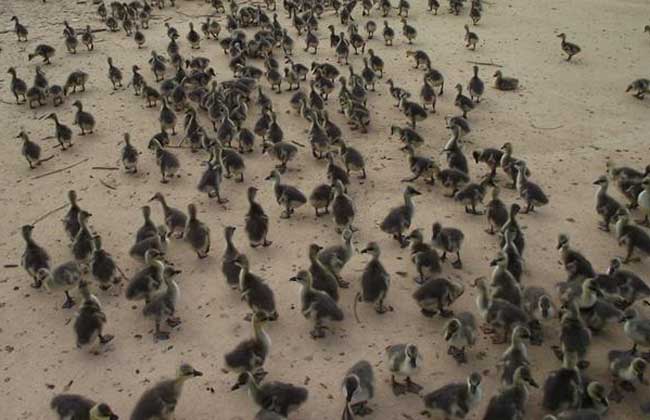
The wild goose, also known as the wild goose, is the collective name for the swan goose, greylag goose, bean goose and brent goose, etc. of the genus Anser in the family Anatidae. It is a national second-class protected animal, docile in temperament, easy to raise, with low feed intake and strong herbivorous habits, and has high breeding value. Let us take a look below at how much a wild goose chick costs!
How much does a wild goose chick cost?
Under normal circumstances, a wild goose chick costs 100-150 yuan each, while a young breeding goose costs 600-800 yuan each.
Wild goose chick hatching techniques
1. Disinfection of hatching eggs: After being laid, hatching eggs are often contaminated by bedding straw and feces, with a small amount of bacteria on the surface, and after 30 minutes the bacteria can enter the interior of the hatching egg through the shell pores. Therefore, hatching eggs should be disinfected in a timely manner. First place the hatching eggs in a disinfection cabinet, prepare 28 ml of formalin solution and 14 g of potassium permanganate per cubic meter, pour the formalin into a glass or enamel container (since a large amount of bubbles will be produced during the reaction, the volume of the container used should be 5-7 times larger than the volume of formalin used), then pour in the potassium permanganate, close the doors and windows, and after a few minutes the formaldehyde vapor will escape. After 12-24 hours, open the doors and windows to release the residual gas, and move the hatching eggs into the storage room.
2. Preheating of hatching eggs: Preheating the hatching eggs before incubation allows the embryos to adapt to the external environment and prevents the hatching eggs from sweating. First use potassium permanganate or drugs such as and to prepare the required concentration according to the instructions, soak the hatching eggs in the solution for 3-5 minutes, take them out and let them dry, then place them in the incubation room to preheat for 6-8 hours.
3. Temperature and humidity control: For hatching eggs placed in the incubator as a whole batch, variable-temperature incubation is mainly used, with the temperature variation range controlled at 30-37°C, high at first and then gradually lowered, while for hatching eggs placed in batches, constant-temperature incubation at 38-38.5°C is used. The principle for humidity control is high at both ends and low in the middle. Keep it at 65-70% for days 1-3, control it at 60-65% for days 4-28, and raise it to 70-75% for days 29-31. In addition, while ensuring normal temperature and humidity, ventilation should be as smooth as possible.
4. Turning, candling and cooling of eggs: An automatic egg-turning incubator turns the eggs once every 2 hours. When turning eggs manually or using traditional incubation methods, turn them once every 3-4 hours, with a turning angle of 45-90 degrees. Wild goose hatching eggs need to be candled three times during the entire incubation period. The first time is on the 5th day after incubation, to pick out infertile eggs and dead eggs. The second time is on the 10th day, to pick out dead embryo eggs, promptly identify the cause, and adjust the incubation conditions. The third time is on the 26th day, mainly to observe the embryonic development and decide the time to transfer to the hatching tray. For machine incubation, open the machine door twice at fixed times each day. After 16 days of incubation, about 2/3 of the hatching eggs should also be pulled out from the egg tray rack for cooling, with the cooling time controlled within 30 minutes. For traditional incubation, cooling can be done by reducing covering materials and increasing ventilation.
5. Assisted hatching and shell breaking: Wild goose hatching eggs have relatively thick shells, and the hatching teeth of the goslings are not very sharp, so some chicks cannot hatch normally. Therefore, assistance should be provided at the appropriate time during hatching. For embryo eggs whose allantoic blood vessels have already withered and whose inner shell membrane has turned yellow, gently open the blunt end of the egg with scissors, peel away about 1/3 of the eggshell, and gently pull out the gosling's head by hand, placing it into the hatcher to let it hatch on its own.
Wild goose chick breeding management
1. Temperature and humidity: For wild goose chicks on the first day after hatching, the temperature of the brooding room needs to reach 28-30°C, then decrease by 1°C each day, gradually dropping over 20 days to basically the same as the outside temperature, at which point the wild goose chicks can be released outdoors for rearing. In winter, if there is no process of gradual temperature reduction, the large temperature difference between indoors and outdoors can easily cause wild goose chicks to suffer from diseases such as colds. While ensuring reasonable temperature, suitable humidity also has a great impact on the health of wild goose chicks. The relative air humidity in the brooding room is best kept between 50%-60%.
2. Lighting: For newly hatched wild goose chicks, continuous lighting should be ensured for the first 24 hours after hatching. A 15-watt bulb can be used to provide the light source, with each bulb illuminating an area of 15-20 sq m. This is beneficial to the normal development of wild goose chicks and increases their immunity.
3. First drinking and first feeding: The first drink of water after wild goose chicks hatch is called first drinking. The main purpose of first drinking is to stimulate appetite and promote the excretion of meconium. The most appropriate time is a few hours after hatching, when the wild goose chicks can already walk freely and show pecking at their claws and bedding straw. Add 1 g of glucose and 1 g of electrolyte multivitamins per 500 ml of water, mix with warm water, and let the wild goose chicks drink freely for 3-5 minutes, which can improve their resistance. After drinking, the wild goose chicks can be given their first feed. The first feed can use complete pellet feed for ducklings, and the feeding time is about 30 minutes, with satiety as the standard.
4. Feed formulation: Goslings have a small digestive tract volume and immature functions, and their digestive and absorptive capacities are relatively weak, so they have high requirements for feed. In the first few days after hatching, feed wild goose chicks complete pellet feed for ducklings, which contains various nutrients needed for their growth. After four to five days, add 40% green feed to supplement fiber. After seven days, the feed can be changed to 40% dry and fresh feed such as corn stalks, green grass and green vegetables, plus a mixture of 40% cornmeal, 15% soybean meal and 5% wheat bran for feeding.
5. Feeding wild goose chicks: Within 7 days after hatching, feed less but more frequently. Feed 9 to 10 times every day, basically once every 2 hours, and be careful not to let the wild goose chicks eat too much. Let the wild goose chicks drink warm water and never cut off the water supply, ensuring they have enough drinking water. After seven days, the physical functions of the wild goose chicks gradually strengthen, so the number of feedings can be reduced accordingly, generally feeding three times a day, with satiety as the standard. The water temperature for drinking can also gradually transition from warm water to normal water temperature.
6. Key management points: The food and drinking water given to wild goose chicks must be fresh, clean and hygienic. Concentrate and green feed should be fresh, without moldy leaves or yellow leaves, and the soil and debris should be washed off. The brooding room should be cleaned thoroughly, disinfected regularly, and ventilated at all times to keep the air in the house fresh and prevent wild goose chicks from being poisoned by excessive ammonia concentration indoors. Feed troughs and water troughs should not be contaminated by feces, and all utensils should be cleaned and disinfected frequently.
7. Epidemic prevention measures: During the wild goose chick stage, two vaccinations are needed for necessary epidemic prevention to improve the disease resistance of greylag geese and increase the survival rate. Within seven days after hatching, vaccinate with live gosling plague vaccine by subcutaneous injection in the neck at a dose of 0.5 ml per bird. At 25 days, inject a combined avian influenza vaccine by subcutaneous injection in the neck at a dose of 2 ml per bird.