A complete collection of wild goose species pictures, helping you get to know all kinds of wild geese
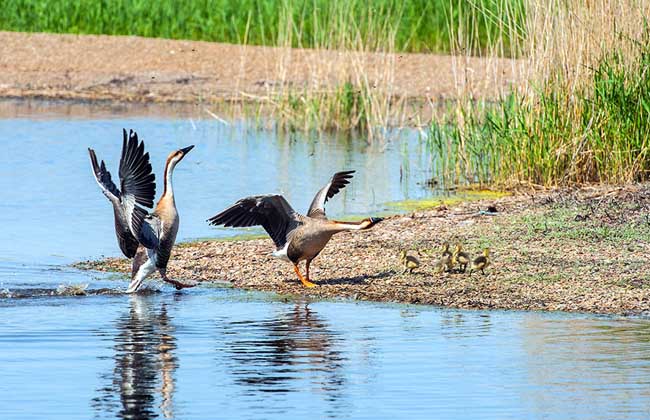
Wild geese are the general name for birds of the genus Anser. There are 9 species in the world, and 7 species in China. Besides the greater white-fronted goose, common ones also include the swan goose, bean goose, bar-headed goose and greylag goose, etc. They are commonly known among the public as “wild geese” and are one of the well-known groups of birds. Now let us take a look at the species of wild geese and a complete collection of pictures!
Brant goose
Male and female brant geese are similar. The head, neck and chest are blackish brown, the back and both wings are grayish brown, and there is a white transverse patch on each side of the neck, broken at the front and back of the neck and not forming a complete neck ring. The lesser coverts on the wings are gray, the wingtips are black, the uppertail coverts are white, the tail is blackish brown, the upper belly is grayish brown, the flanks are paler, and the lower belly and undertail coverts are white. Male and female are similar. The bill, tarsus, feet and claws are blackish brown.
The brant goose breeds in the tundra permafrost zones of North America and the polar regions of Siberia, and winters on grasslands and estuaries along the southern coast.
Greylag goose
Male and female greylag geese are similar, with the male slightly larger than the female. The crown and hindneck are brown, and there is a narrow white stripe at the base of the bill, which becomes rusty yellow during the breeding season, sometimes with the white stripe not obvious. The back and both shoulders are grayish brown with pale brownish-white feather edges, the rump is gray, the sides of the rump are white, the primary coverts on the wings are gray, the remaining upperwing coverts are grayish brown to dark brown, the flight feathers are blackish brown, the uppertail coverts are white, and the tail feathers are brown with white tips and feather edges, with the outermost two pairs of tail feathers entirely white. The sides of the head, chin and foreneck are gray, the chest and belly are dirty white mixed with irregular dark brown spots that gradually increase from the chest to the belly. The flanks are pale grayish brown with grayish-white feather tips, and the undertail coverts are white. The iris is brown, the bill is flesh-colored, and the tarsus is also flesh-colored. Young birds have a dark grayish-brown upper body, the chest and front part of the belly are grayish brown without black patches, and the flanks also lack white transverse patches.
The greylag goose mainly inhabits freshwater waters in different habitats, and is commonly seen in and around lakes, reservoirs, estuaries, flooded plains, wet grasslands, marshes and grasslands rich in reeds and aquatic plants.
Swan goose
The swan goose is a large waterfowl, with a body length of about 90 cm and a weight of 2.8-5 kg. The bill is black, the body color is pale grayish brown, the crown to hindneck is dark brownish brown, and the foreneck is nearly white. From a distance, the crown and hindneck look black and the foreneck looks nearly white, with the black and white clearly distinct and strongly contrasting. It mainly inhabits lakes, ponds, rivers, marshes and nearby areas on open plains and plains grasslands. It feeds on the leaves and shoots of various herbaceous plants, including terrestrial plants and aquatic plants, reeds, algae and other plant foods, and also eats a small amount of animal foods such as crustaceans and mollusks.
The swan goose is distributed across Eurasia and northern Africa, including all of Europe, the African region north of the Tropic of Cancer, the Arabian Peninsula, and the Asian region north of the line formed by the Himalayas - Hengduan Mountains - Minshan - Qinling - Huai River. It breeds in Mongolia, Northeast China and Siberia, and winters in central and eastern China, Taiwan, China, and Korea.
Greater white-fronted goose
The greater white-fronted goose is a large and heavy bird in the genus Anser, with a body length of 64-80 cm and a weight of 2-3.5 kg, about the same size as the bean goose. The upper body is mostly grayish brown, and there is a broad white patch from the base of the upper bill to the forehead. The underparts are white mixed with black patches. In flight, it flaps its wings forcefully and has a high wingbeat frequency. The neck is relatively long. The legs are located at the central pivot point of the body, allowing it to walk freely. It has a flat bill with serrated edges, which helps filter food. It mainly feeds on plant foods.
The greater white-fronted goose is distributed in North America, including the United States, Canada, Greenland, Bermuda, Saint Pierre and Miquelon, and the transitional zone between North and Central America within Mexico. It is also found in Eurasia and northern Africa, including all of Europe, the African region north of the Tropic of Cancer, the Arabian Peninsula, and the Asian region north of the line formed by the Himalayas - Hengduan Mountains - Minshan - Qinling - Huai River. In China it is found in Heilongjiang, including Hulunbuir League and Harbin, Liaoning (Yingkou, Liao River, Chaoyang), **(Kashgar), Tibet (southwestern Qamdo), the eastern coastal provinces to Taiwan, China, and westward to Hubei and Hunan, where it is locally common in wintering areas.