Wild goose farming technology video, teaching you how to raise wild geese well
Summary: Wild geese combine meat, eggs, down and medicinal uses in one, with well-developed breast and leg muscles. Although the muscle fibers are coarser than those of wild duck, the meat is delicious, and after cooking it is fragrant and tender. Protein reaches 20.98%, fat is 10.62%, and they are rich in vitamins and trace elements needed by the human body. Wild goose feathers can be made into badminton shuttlecocks, feather fans and quill pens, and the down can protect against cold and keep warm. At present, wild goose farming has just started
Wild goose, also called wild goose, is the general name for the swan goose, greylag goose, bean goose and brant goose in the genus Anser of the family Anatidae. It is a large migratory bird and a national second-class protected animal. It is docile by nature, easy to raise, has a small feed intake, is strongly herbivorous and grows fast. The feed-to-meat ratio is 2.5:1. Generally, after about 60 days of rearing, the body weight can reach 4-5 kg, and the heavier ones can reach 8-10 kg. Wild geese combine meat, eggs, down and medicinal uses in one, with well-developed breast and leg muscles. Although the muscle fibers are coarser than those of wild duck, the meat is delicious, and after cooking it is fragrant and tender. Protein reaches 20.98%, fat is 10.62%, and they are rich in vitamins and trace elements needed by the human body. Wild goose feathers can be made into badminton shuttlecocks, feather fans and quill pens, and the down can protect against cold and keep warm. At present, wild goose farming has just started, and coastal cities and some game markets across the country are all facing shortages. The prospects for wild goose farming are good. The wild goose farming technology is introduced below.
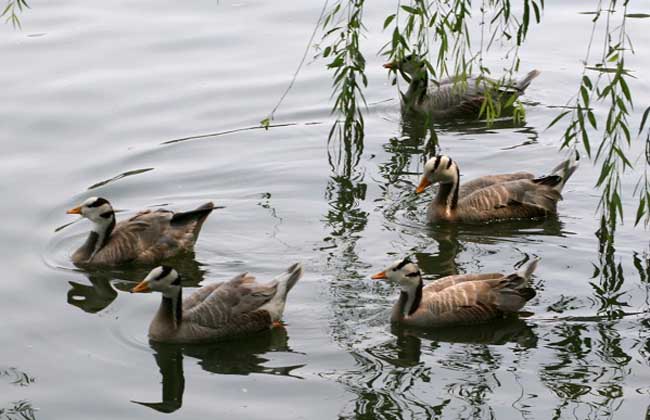
Living habits of wild geese
Wild geese have strong adaptability and are omnivorous waterfowl. They often inhabit watersides or swamps overgrown with aquatic plants, and eat some non-toxic wild grasses, pasture grasses, cereals and snails, shrimp, etc. that have no special odor. Sometimes they also wander in lakes and like to mate in water. They are highly gregarious and good at fighting. In spring, 10-20 of them move in small groups, and in winter, hundreds of them forage and rest together. When roosting, some geese stand guard. If something unusual is found, they cry loudly and the flock flees. When living in groups, they establish a hierarchy through fighting, and the dominant geese have priority in feeding and mating.
Reproductive characteristics of wild geese
1. Egg laying: Wild geese need 3 years to reach sexual maturity. They are monogamous, with one male paired to one female, and they pair for life. Both parents participate in raising the young geese. Under artificial rearing, they reach sexual maturity at 8-9 months, and the male-to-female ratio is 1:2-3. Wild geese come into heat in spring and mate in water. During courtship, the male goose swims around the female goose in the water and continuously shakes his head up and down, while stretching his neck to sip water as if drinking and swimming toward the female goose. Once the female goose responds with the same movements, the male goose moves behind the female goose. The female goose sinks her body slightly, and the male goose mounts her back, pecks and holds the feathers on her neck with his beak, and vibrates his wings to mate. After mating, they swim and play together in the water or go ashore to preen their feathers. The female goose begins laying eggs 10 days after mating, laying 1 egg at intervals of 2-3 days. The annual egg production is about 15 eggs in the first year, and can reach 25 eggs from the second to the sixth year. Each egg weighs 150 grams.
2. Incubation: Small-scale goose farms can let the geese hatch naturally, or use mother geese as surrogate incubators. Large-scale goose farms need artificial incubation, and the incubation period is 31 days. Select fresh breeding eggs of suitable size, normal egg shape, color meeting breed requirements and clean surface. After disinfection by formaldehyde fumigation (add 15 grams of potassium permanganate and 30 milliliters of formaldehyde per cubic meter, at room temperature 24°C-27°C), place them in the incubation room (22°C-24°C) to preheat for 6-8 hours before setting them for incubation. The temperature during the early incubation period is 38.3°C-39.0°C, the middle period is 37.5°C-38.0°C, and the late period is 37.0°C-37.5°C. The relative humidity is 75%-80%. Turn the eggs once every 2-3 hours, with a turning angle of 90 degrees. When turning eggs, the movements should be light, steady and slow, so as to avoid rupture of the blood vessels of the yolk membrane and separation of the chorioallantoic membrane from the eggshell membrane, which can cause embryo death. In the late incubation period, cool the eggs 2-3 times a day at a cooling temperature of 25°C-27°C. If the room temperature is too low, development will be affected by “egg chilling”. During incubation, candling must be carried out 2 times, on the 8th day and the 28th day after incubation respectively, to remove infertile eggs and dead-in-shell eggs. After the second candling, transfer the embryos to the hatcher. Hatching begins on the 30th day and ends on the 31st day.
Housing conditions for wild geese
The goose house should be warm in winter and cool in summer, with sufficient sunlight and good ventilation. It can be divided into a brooding house, a fattening house and a breeding goose house. The brooding house should be kept warm and moisture-proof. The fattening house should be equipped with perches, with feeders and waterers beside them. The breeding goose house should be relatively large, with land and water exercise yards outside, and a fence 1.8-2 m high around the exercise yard. The land exercise yard should be dry without standing water, covered with 5 cm thick sandy soil, and planted with trees or crops for shade. The fence of the water exercise yard should extend straight to the bottom of the water, and the mesh size should be such that a wild goose's head cannot get through. There should also be grassland with abundant plants for grazing.