Wild goose farming techniques and answers to common questions about why they fly south and whether they can swim
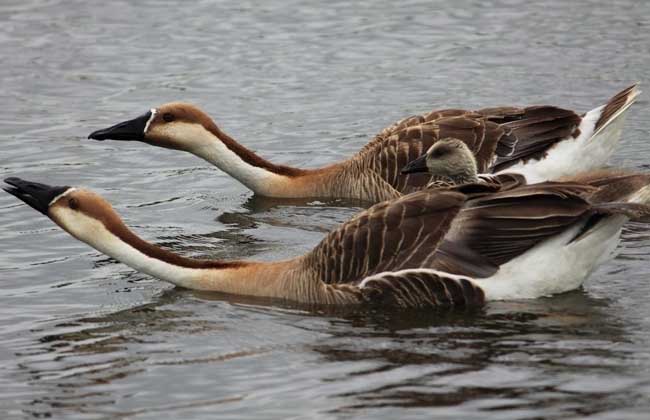
Variety distribution of wild geese
1. Brant goose: breeds in the tundra permafrost zones of North America and the polar regions of Siberia, and overwinters on grasslands and estuaries along the southern coast.
2. Greylag goose: northern Eurasia, overwinters in North Africa, India, China and Southeast Asia.
3. Swan goose: distributed across Eurasia and northern Africa, including all of Europe, the African region north of the Tropic of Cancer, the Arabian Peninsula, and the Asian region north of the Himalayas - Hengduan Mountains - Minshan - Qinling - Huaihe River line. Breeds in Mongolia, Northeast China and Siberia, and overwinters in central and eastern China, Taiwan, China, and Korea.
4. Greater white-fronted goose: breeds in the tundra permafrost zones of the Northern Hemisphere, and overwinters in temperate farmland. Distributed in North America, including the United States, Canada, Greenland, Bermuda, Saint Pierre and Miquelon, and the transitional zone between North and Central America within Mexico. In Eurasia and northern Africa, including all of Europe, the African region north of the Tropic of Cancer, the Arabian Peninsula, and the Asian region north of the Himalayas - Hengduan Mountains - Minshan - Qinling - Huaihe River line.
Can wild geese swim?
Wild geese can swim. Wild geese live in groups by the water, often in flocks of hundreds or thousands. When resting at night, some geese stand guard around the flock, and if there is an attack, they call out a warning. They mainly feed on tender leaves, fine roots and seeds, and occasionally peck at grain in farmland. Each year after the spring equinox they fly back north to breed, and after the autumn equinox they fly south to overwinter.
Why do wild geese fly south
Wild geese fly south to spend the winter. The south has a tropical climate, which is warmer than the north, and food is more plentiful than in the north. Wild geese are migratory birds, and flying south is for overwintering. Migratory birds generally have migratory habits, moving regularly with the seasons between wintering grounds and breeding grounds; they form large groups, and the timing and locations of their coming and going are very regular, with fixed wintering sites, breeding grounds and migration locations.
Farming value of wild geese
Wild geese have thick feathers, are good at flying, and have well-developed breast muscles. Each 100 grams of meat contains 20.98 grams of protein, 11.62 grams of fat, 196.5 milligrams of phosphorus, 48.04 milligrams of calcium, 8.71 milligrams of iron, and 1.17 grams of inorganic salts, making it a relatively good nutritional health product. Wild geese also have medicinal functions, which are recorded in detail in more than ten ancient Chinese medical texts, including "Qianjin Shizhi" and "Compendium of Materia Medica".
1. Goose meat: sweet and neutral in nature and flavor, entering the lung, kidney and liver meridians. Dispels wind-cold, strengthens the skeleton, benefits yang qi, and warms the water organ.
2. Goose fat: the fat of wild geese has effects such as invigorating blood and dispelling wind, and clearing heat and detoxifying.
3. Down: the down of wild geese has good warmth retention and is very light and soft, and can be used as filling material for pillows, cushions, clothing, quilts and so on. The relatively stiff feathers can be processed into fans and handicrafts.
Farming techniques" />
Wild goose farming techniques
1. Hatching egg disinfection: after being laid, hatching eggs are often contaminated by bedding straw and droppings, with a small amount of bacteria on the surface, and after 30 minutes the bacteria can enter the interior of the hatching egg through the shell pores. Therefore, hatching eggs should be disinfected in good time. First place the hatching eggs in a disinfection cabinet, prepare the medicines at 28 milliliters of formalin solution and 14 grams of potassium permanganate per cubic meter, pour the formalin into a glass or enamel container (since a large amount of bubbles will be produced during the reaction, the volume of the container used should be 5 to 7 times larger than the volume of formalin used), then pour in the potassium permanganate, close the doors and windows, and after a few minutes formaldehyde vapor will escape; after 12 to 24 hours open the doors and windows, release the residual gas, and move the hatching eggs into the storage room.
2. Preheating of hatching eggs: preheating the hatching eggs before incubation allows the embryo to adapt to the external environment and prevents the hatching eggs from sweating. First use potassium permanganate or drugs such as "Jundusha" or "Baidusha" to prepare the required concentration according to the instructions, soak the hatching eggs in the liquid for 3 to 5 minutes, remove and air-dry them, and place them in the incubation room to preheat for 6 to 8 hours.
3. Temperature and humidity control: for hatching eggs set all at once, variable-temperature incubation is mainly used, with the temperature variation range controlled at 30 to 37°C, high at first and then gradually lowered; for hatching eggs set in batches, constant-temperature incubation at 38 to 38.5°C is used. The principle of humidity control is high at both ends and low in the middle. Keep it at 65 to 70% for days 1 to 3, control it at 60 to 65% for days 4 to 28, and raise it to 70 to 75% for days 29 to 31. In addition, while ensuring normal temperature and humidity, keep ventilation as smooth as possible. ② Egg turning, candling and cooling. Automatic egg-turning incubators turn the eggs once every 2 hours; when turning eggs manually or using traditional incubation methods, turn them once every 3 to 4 hours, with a turning angle of 45 to 90 degrees. Wild goose hatching eggs need to be candled three times during the entire incubation period. The first is carried out on the 5th day after incubation, to pick out infertile eggs and dead eggs. The second is carried out on the 10th day, to pick out eggs with dead embryos, promptly identify the cause, and adjust the incubation conditions. The third is carried out on the 26th day, mainly to observe embryo development and decide the time to transfer to the hatching tray. With machine incubation, open the machine door twice at fixed times each day; after 16 days of incubation, about 2/3 of the hatching eggs should also be pulled out from the egg tray rack for cooling, with the cooling time controlled within 30 minutes. With traditional incubation, cooling can be done by reducing the covering material and increasing ventilation.
4. Assisting hatching: wild goose hatching eggs have relatively thick shells, and the hatching tooth of the gosling is not very sharp, so some chicks cannot hatch normally; therefore, assistance should be given at the appropriate time during hatching. For embryo eggs whose allantoic blood vessels have already withered and whose inner shell membrane has turned yellow, gently open the blunt end of the egg with scissors or the like, peel away about 1/3 of the shell, and gently pull out the gosling's head by hand, placing it in the hatching machine to let it hatch on its own.
5. Gosling rearing: goslings refer to young geese during the period from hatching to full 1 month of age. This period is the key stage of artificial domestication, and because goslings have incomplete digestive function and poor body temperature regulation ability, they require careful rearing and management.
6. Growing goose rearing: generally refers to young geese from 4 weeks of age to before fattening. During this period, grazing should be the main method, with an appropriate supplement of a suitable amount of concentrated feed. Grazing should mainly be done in the morning and evening, with a rest at noon. After grazing until 80% full, let them drink water and rest for half an hour before grazing again, with grazing 2 to 3 times per day. Grazing flocks should preferably be 250 to 300 birds. During grazing, prevent rain exposure and pesticide poisoning. Concentrated supplement formula: corn meal 60%, crushed barley 12.5%, crushed wheat 13.5%, 12.5%, stone powder 1.5%.
7. Fattening goose rearing: once growing geese have grown their main feathers, they can be fattened for market. Using grazing as the main method, individuals with large body frames have a notable fattening effect. Fattening methods can use grazing with supplementary feeding of rice or wheat grains, or confinement feeding with grain or root and tuber feed, feeding 3 to 4 times per day; after half a month they can be fattened for market. Forced feeding can also be used, feeding with soaked and expanded corn kernels for about 10 days before market.