A Detailed Guide to the Breeding of the Golden Coin Turtle and the Farming Techniques and Feeding Habits of the Chinese Golden Coin Turtle
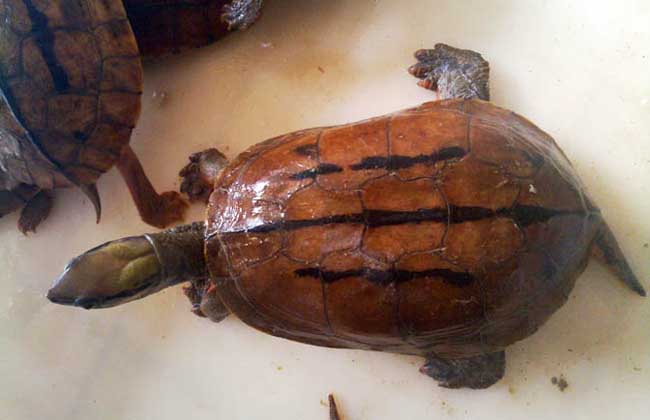
Living Habits of the Golden Coin Turtle
1. Omnivorous: The golden coin turtle is omnivorous. It likes to inhabit mountain rock crevices or mud burrows near water areas, and after being startled it dives to the bottom of the water, often going to mountain streams or damp places to forage for various aquatic animals. In nature, it mainly preys on snails, fish, shrimp, tadpoles and other aquatic animals in the water, and also eats young rats, small fish, shrimp, snails, young frogs, scarab beetles, earthworms, snails and fly maggots, and sometimes also eats pumpkin, bananas and tender plant stems and leaves, and seeds. Under artificial rearing conditions, it likes to eat animal offal, earthworms, lean meat, small fish and mixed feed.
2. Ectothermic animal: The golden coin turtle is an ectothermic animal, with a growth temperature between 24-32°C. When the water temperature is 28°C, it must surface to breathe about once every 20 minutes in the water; when the water temperature is 25°C, it surfaces to breathe about once every 26 minutes; when the water temperature is below 12°C, it enters a hibernation state. Each year in April the temperature gradually rises and it begins to be active; from May to October the temperature rises, its range of activity expands and its food intake increases, with the fastest weight gain especially from July to September; after November, when the temperature drops below 15°C, its activity decreases and it gradually enters a hibernation state, staying inside its burrow without eating or moving, continuing until March of the following year.
3. Breeding habits: The golden coin turtle grows slowly, and generally its gonads only mature after 6 years of age, when it begins to mate. Mature golden coin turtles frequently move about and feed from May to October; in autumn, at dawn or dusk, when the temperature is around 20-25°C, they begin to mate. The following year in June, when the water temperature rises to around 25°C, the female turtle begins to lay eggs, and egg-laying continues until the end of July or the beginning of August before ending; over the whole period it lays eggs 3-4 times in total, with 3-4 eggs each time.
Breeding Techniques for the Golden Coin Turtle
1. Identifying male and female: It is difficult to distinguish male from female golden coin turtles at the hatchling and juvenile stages; they can only be distinguished after growing into adults. The method of identification is that the male golden coin turtle's plastron is slightly concave, while the female golden coin turtle's plastron is flat and straight; the male's body is thin, the female's body is thick; the male's carapace is arched and oval-shaped, with a round and broad rear end, and the cloacal opening is farther from the plastron, while the female's cloacal opening is closer to the plastron and has no copulatory organ; the male's tail is mostly long and thick, while the female's tail is short and thin; the male has a slight fishy smell, while the female has no fishy smell. When you press the turtle's four legs and head and push backward with your hand, the male turtle's copulatory organ is exposed and is purplish-black, while the female turtle does not have one.
2. Determining turtle age: The age of the golden coin turtle is mainly determined by the patterns on the shell; the more layers in the patterns, the older the age. Some golden coin turtles do not have very clear patterns on their backs, so sometimes it is not very precise.
3. Mating management: The golden coin turtle grows slowly, and generally its gonads only mature after 6 years of age, when it begins to mate. For artificial breeding, one should select those over 6 years of age and strong in body as parent turtles, and raise them together in a pond at a male-to-female ratio of 3:1, allowing the turtles to mate freely. Golden coin turtles mostly begin to mate from 5 to 6 p.m. in September to October, when the temperature is 20 to 25°C. By the following June, when the water temperature rises to around 25°C, the female turtle begins to lay eggs, and egg-laying continues until the end of July or the beginning of August before ending. Over the whole period it lays eggs 3 to 4 times in total, with 3 to 4 eggs each time.
4. Artificial incubation: During the egg-laying period of the golden coin turtle, collect the golden coin turtle eggs at any time, and select fresh, non-deformed eggs to be put into indoor incubation. In the incubation room, generally build an egg incubation pond 30 to 40 cm high, fill the incubation pond with soft sandy soil, and additionally add a layer of 20 cm transparent plastic board at the edge of the incubation pond to prevent the young turtles from escaping.
5. Incubation management: First dig a 10 cm pit in the sand bed, then gently and evenly place the collected eggs in the sand pit, insert a marker tag beside the eggs, and clearly mark the date and quantity of the buried eggs on the marker tag. Then gently cover the eggs with sandy soil. The temperature of the incubation room should be kept between 25 and 32°C, and the humidity of the sandy soil should be kept at 80%; water the sandy soil once every 2 to 3 days to maintain the humidity of the sandy soil. After about 85 days, the young turtles will automatically crawl out of the sand surface; if they do not crawl out, then dig open the sandy soil to check whether they have hatched.
Farming Techniques for the Golden Coin Turtle
1. Turtle pond construction: Young turtles, adult turtles and parent turtles should be raised in separate ponds, which can avoid large turtles swallowing small turtles, and at the same time facilitates determining the feed feeding amount and carrying out rearing management work, and makes it easy to observe and grasp the growth and activity conditions of each type of turtle.
2. Selection of breeding turtles: It is best to choose wild turtles; turtles purchased before egg-laying can lay eggs in the same year. If choosing artificially raised turtles, when selecting turtles, one cannot rely only on the individual weight of the turtle, but should mainly base it on the age of the turtle, with the individual weight of the turtle used only as an auxiliary condition. A healthy turtle has a well-proportioned appearance, a plump and strong body, bright eyes, and when its four limbs are pulled, it feels very strong, with no broken tail. In addition, the stocking ratio of female to male turtles is best at 2:1.
3. Water quality management: Tap water is sufficient, because it has few pathogens and does not need to be exposed to sunlight to release chlorine, but the chlorine content must not exceed 300 mg/L. River water, rainwater, well water, etc. can also be used. At the beginning, the water depth only needs to submerge the turtle's back, and later it is gradually deepened to about 15 cm. As long as the turtle's head and neck can extend above the water surface, it is favorable for the turtle's breathing. It is best to put a small amount of aquatic plants such as water peanut on the water surface, which can both purify the water quality and serve as a hidden and resting place for the turtle, creating a natural ecological environment for the turtle.
4. Water temperature regulation: The golden coin turtle is a warmth-loving animal; its feeding temperature is above 20°C, and its growth water temperature is 25-35°C. Because hatchling turtles are delicate and weak and have poor adaptability to external environmental changes, they have higher requirements for water temperature. To enable hatchling turtles to safely overwinter and grow quickly, they must be raised with heating. The optimal water temperature should be controlled between 28-30°C, and the water temperature for young turtles can be relaxed to between 26-32°C.
5. Feed feeding: The feed for raising golden coin turtles is divided into two major categories: animal feed and plant feed. For animal feed, choose lean pork, animal offal, fish, shrimp, shellfish meat, etc., and for plant feed choose bananas (peeled) and apples, etc. Feeding is mainly based on animal feed, with the two types of feed used alternately; the number of feedings of plant feed is about 1/7 of the number of feedings of animal feed. From observing the eating conditions of the golden coin turtle, it can be seen that the golden coin turtle most likes to eat lean pork among animal feed and bananas among plant feed. When feeding, the feed should be chopped up. When the indoor temperature is below 25°C and above 30°C, feed once every day at 9 a.m.; when the indoor temperature is 26°C-29°C, feed once each at 9 a.m. and 6 p.m. every day.
6. Disease prevention and control: Although the golden coin turtle has strong resistance to disease, its ability to adapt to environmental changes is relatively poor at the hatchling stage, and it is prone to illness. In addition to frequently changing the water to keep the water quality fresh, a water medicated bath should also be given about once every half a month, and a 1/10,000 potassium permanganate aqueous solution and 2 mg/L furazolidone can be used alternately. Frequently disinfect the rearing vessels with disinfectants such as bleaching powder or benzalkonium bromide. At ordinary times, pay attention to preventing enemies such as cats, dogs, rats, snakes and ants from harming the hatchling turtles.