Arctic Fox Pictures: A Complete Collection, High-Definition Real Photos to Enjoy
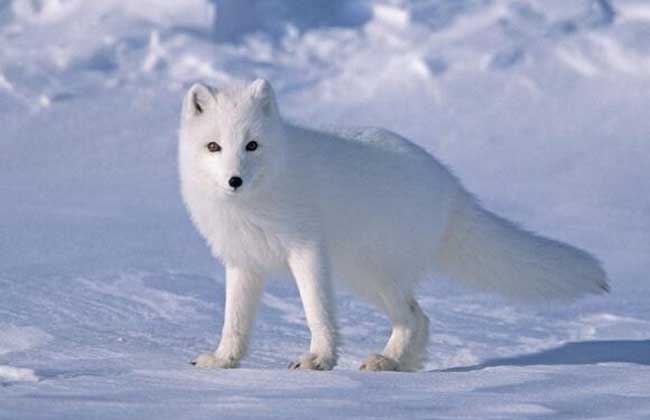
The Arctic fox, also called the blue fox, white fox, and so on, is distributed across the Arctic region and ranges throughout the entire Arctic, including: Russia, Canada, Alaska, Greenland and the outer edges of the Svalbard archipelago, as well as subarctic and alpine areas such as Iceland and the Scandinavian mainland. Its food consists mainly of lemmings, but it also eats fish, birds, bird eggs, shellfish, Arctic hares and berries, and so on. It is a valuable fur-bearing animal and has been bred in captivity.
The Arctic fox has a body length of 50-60 cm, a tail length of 20-25 cm, and a weight of 2.5-4 kg. Its face is narrow, its muzzle pointed, its ears round, and its tail fur fluffy with a white tip. In winter its entire body fur is white, with only the tip of the nose black; in summer its body fur is grayish black, with the underside lighter in color. It has very dense underfur and relatively few guard hairs, can live on ice fields at minus 50°C, and has especially thick fur on the soles of its feet. It lives alone or in groups.
The Arctic fox likes to build its den in hilly terrain. The den has several entrances and exits. When a blizzard hits, it can stay in the den for several days without coming out, and year after year it carries out some repairs and expansions to its den so that it can live there long term. In summer, when food is abundant, the Arctic fox stores part of its food in its den. In winter, when the food stored in the den is completely used up, the white fox will track polar bears and pick at the leftovers the polar bears leave behind, but when a polar bear is very hungry, it will also attack the Arctic fox.
The Arctic fox is capable of long-distance migration and has a very strong navigational ability. In 5 and a half months it migrates a distance of 4,600 km, averaging 90 km per day, and can keep going for several days in a row. It can migrate from the Pacific coast to the Atlantic coast within several months, a journey close to the east-west distance of Canada. It can navigate and travel hundreds of km, will leave its den in winter and migrate to a place 600 km away, and then return home the following summer.
There is a strict hierarchy among Arctic foxes. One of them can dominate and control the other vixens. In addition, members of the same group share the same territory, and if these territories must border those of a neighboring group, they rarely overlap. Generally, March is the mating season for the Arctic fox. Each litter usually produces 8-10, and the highest record is 16.