Fox farming techniques and feed formulation methods, with a full picture gallery
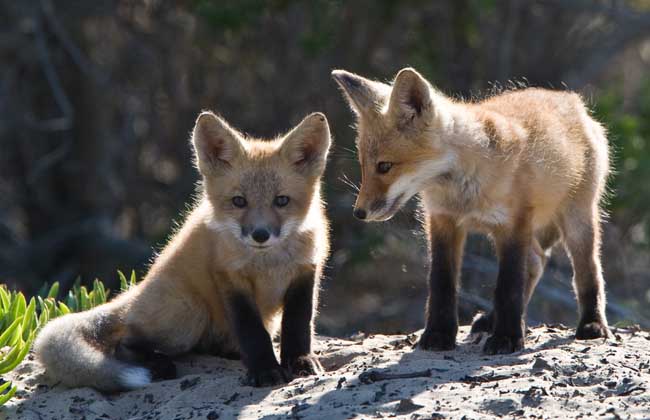
The living habits of foxes
Foxes live in a wide variety of environments, inhabiting mountains, hills, forests, grasslands, high mountains, deserts, plains and other places, often using rock crevices, tree hollows, burrows, and shrub thickets as dens. They lie in their dens during the day and come out at night to be active; they move swiftly and are good at running, and their tracks closely resemble those of rabbits. They have keen eyesight, well-developed senses of smell and hearing, and strong memory.
Foxes can climb along cliffs, can swim and climb trees, are alert by nature, cunning and suspicious, and are active by night and rest by day. Wild foxes occasionally live in groups, and competition for survival between species is fierce, with the strong preying on the weak. They have strong cold resistance, cannot tolerate heat, and like to live in dry, fresh-air, clean environments.
The lifespan of foxes varies with breed: the red fox lives 8-12 years, with a breeding lifespan of 4-6 years; the silver-black fox lives 10-12 years, with a breeding lifespan of 5-6 years; the Arctic fox lives 8-10 years, with a breeding lifespan of 4-5 years. The generally optimal production and breeding age is 3-4 years old. Natural enemies in the wild include wolves, lynxes, hunting dogs, and birds of prey such as eagles and vultures.
Fox breed classification
1. Arctic fox: also called the blue fox, white fox, snow fox, etc. It is distributed in the Arctic region, with a body length of 50-60 cm, a tail length of 20-25 cm, and a body weight of 2.5-4 kg. Its face is narrow, its muzzle is pointed, its ears are round, and its tail fur is fluffy with a white tip. In winter its entire body fur is white, with only the tip of the nose black; in summer its body fur is gray-black, with a lighter color on the underside. It has very dense underfur and relatively few guard hairs, and can live on ice fields at minus 50 degrees C. The fur on the soles of its feet is especially thick. It lives alone or in groups.
2. Silver fox: also called the silver-black fox, black fox, etc. It is named for the fact that some of its guard hairs are white, while the roots and tips of other guard hairs are black and the middle of the guard hairs is silver-white. It originated in northern North America and eastern Siberia, and is a color mutation of the red fox under wild natural conditions. Its body shape and appearance are the same as the red fox, with only a great difference in coat color. It has a pointed muzzle, round eyes, long ears, slender limbs, and a fluffy, long tail. It is a commonly farmed fox species.
3. Fire fox: also called the red fox, etc. It has a slender body, a pointed muzzle, large ears, short limbs, and a long, large tail trailing behind it. It is widely distributed across the Eurasian continent and the North American continent, and has also been introduced to Australia and other places.
4. Sand fox (corsac fox): It is a typical animal of the genus Vulpes and the smallest of China's Vulpes species. Its limbs and ears are slightly smaller than those of the red fox, and its coat color is light sandy brown or light brownish-gray, with an obvious off-white tone. Its back is light silver-gray or reddish-gray, its abdomen is white mixed with yellow, and its lower jaw is white. Its whole-body fur is thick and soft, and its ears are large and pointed with broad bases. Its body length is 500-600 mm (excluding the tail), and its tail length is 250-350 mm.
Fox feed formulation
1. Plant-based feed: Plant-based feed includes cereal grains such as corn and wheat and their processed by-products, legume seeds such as soybeans and peanuts and their processed by-products, and various fruits and vegetables such as radishes, apples, lettuce, Chinese cabbage, and sweet potato vines.
2. Animal-based feed: Apart from poisonous fish, animal-based feed includes various sea trash fish, freshwater fish, and their processed by-products (such as internal organs); the meat of various healthy livestock, poultry, and wild animals and their processed by-products (such as paws, heads, wings, liver, lungs, skeletons, blood, ears, spleen, and intestines); silkworm pupa powder, meat-and-bone meal, fish meal, dried fish, dried powder, feather meal, eggs (including dead-embryo eggs), and dairy products, etc.
3. Additive feed: Additive feed includes amino acids such as lysine and methionine; malt, cod liver oil, yeast, vitamins, etc.; minerals such as shell powder, bone meal, salt, and various trace elements; antibiotics such as oxytetracycline, tetracycline, and olaquindox; and antioxidants such as BHA, BHT, and dihydropyridine.
Fox farming techniques
1. Before mating: Fox farming mainly focuses on silver foxes and blue foxes. The mating preparation period for silver foxes is from December to January of the following year, and the mating preparation period for blue foxes can be extended to February. The main task during this period is to adjust the nutritional level of the diet and increase the proportion of protein in the diet, so that the breeding foxes reach a moderately above-average body condition before mating. Different nutritional standards should be applied to breeding foxes that are too fat or too thin, so that their body weight reaches 5-6 kg before mating. At the same time, light should be gradually increased to stimulate gonadal development, and breeding foxes should be kept in sunny places.
2. Mating period: The mating period for silver foxes is from February to March, and the mating period for blue foxes is from March to April. During this period, breeding foxes should be supplied with feed that is rich in nutrients, good in palatability, and easy to digest, and the proportion of trace elements and multivitamins in the feed should be appropriately increased. Per kg of feed, 20-30 mg of vitamin E, 4-5 g of scallions or garlic, and 1-1.5 g of trace elements can be added.
3. Pregnancy period: Female foxes have especially strong nutritional needs during pregnancy. Attention should be paid to supplying feed with comprehensive nutrition and good quality, and never feed moldy or spoiled feed, so as to prevent miscarriage. At the same time, the hygiene and disinfection of the fox house should be done well, the fox house should be kept quiet, and stress factors should be minimized as much as possible.
4. Lactation period: Female foxes have relatively poor appetite in the initial stage after giving birth, so it is best to feed small amounts frequently. After 3 days, feed 3 times a day at fixed times and in fixed amounts. When the cubs reach 25 days of age, supplementary feeding should be carried out, generally 2 times a day. During supplementary feeding, fresh liver, fish, milk, eggs, etc. can be mixed into a paste for the cubs to eat, and after supplementary feeding they should be returned to their original nest.
5. Growing period: Fox cubs can generally be weaned and separated from the nest at 45-90 days of age. In production, this can be handled flexibly according to the growth and development of the cubs: those that are strong and capable of living independently should be separated early, while those that are weaker should have their separation time delayed. After separation, the cubs enter the growing period. Because the cubs grow and develop relatively quickly at this stage and their fur grows rapidly in the later stage, they need a large amount of nutrients. Therefore, in production, the cubs should be allowed to eat well and be full as much as possible, so as to ensure their normal growth and development.
6. Disease prevention
(1) Regular vaccination for prevention: Regular vaccination to enhance the specific immunity of foxes is an effective measure to prevent epidemics. Vaccination should be carried out 2 times each year (in December when keeping breeding stock, and in July 2 weeks after the cubs are separated and weaned), such as canine distemper vaccine and viral enteritis vaccine.
(2) Drug prevention methods: Adding some drugs to the feed can effectively prevent the occurrence of certain epidemics. For example, adding 1 oxytetracycline tablet per fox per week to the feed can not only prevent feed from turning rancid, but also prevent the occurrence of intestinal diseases.
(3) Cutting off transmission routes: When introducing breeding foxes, a veterinary department should be asked to carry out quarantine. To prevent bringing in sources of infectious diseases, newly introduced breeding foxes must be kept separately in isolation for about half a month after arriving at the site for observation, and only after being confirmed disease-free can they be moved into the site for rearing. Other animals must not be mixed with foxes on the same site, to prevent mutual transmission.
(4) Regular washing and disinfection: Disinfection is one of the important measures to prevent or eliminate infectious diseases. Therefore, the farm should spray the entire site with Baidusha or peracetic acid every month for preventive disinfection, so as to control the occurrence of epidemics. The manure under the cages should be removed in a timely manner every day, and the ground should be washed. The farming environment should always be kept dry, clean, pollution-free, and free of mold and rot.