Detailed Explanation of Key Points for Efficient Mink Farming Techniques
The mink is an important fur-bearing animal, and its growth and development are closely related to light. In production, if attention is paid to controlling light and making full use of the beneficial effects of light on its growth, development and reproductive performance, production costs can be effectively reduced and economic benefits improved.
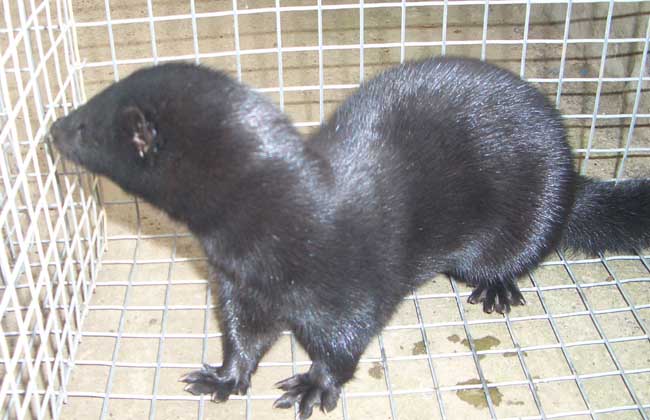
So-called light control means using artificial or modern electronic technology to simulate the changes of the natural photoperiod, providing suitable light duration and intensity for mink reproduction and molting, so that mink production can develop more rapidly in the direction suited to human needs.
In the long process of evolution, the growth, development and breeding reproduction of mink have formed an inseparable connection with the changes of the natural photoperiod. Under natural conditions, as the seasons change, that is, with the changes of the natural photoperiod, mink reproduce once a year and molt twice. Under artificial light control conditions, however, mink can reproduce at any time of the year, and the reproductive cycle can be effectively shortened to achieve three litters in two years. At the same time, mink winter pelts can be brought to maturity earlier and slaughtered earlier, saving feed expenses and management costs and greatly reducing production costs.
The artificial light control scheme is unrelated to the date on which the shortening of daylight begins. Even in hot summer, giving mink short-day light can promote the growth of winter fur in summer. However, in production it should be noted that the growth of winter fur in mink has a refractory period. After the winter fur matures, extending the light duration can accelerate the development of sexual organs, but it does not cause the growth of summer fur; summer fur begins to grow only after entering the gestation period. If light is extended before the winter fur matures, it will prevent the development of winter fur and inhibit the growth of sexual organs. Therefore, farms and households should pay attention to grasping the optimal period for artificial light control.
In production, light-controlled feeding generally begins on December 21, initially giving 1 hour of light per day, extending to 8 hours per day by January 1, then increasing by 15 minutes—30 minutes every 5 days, until May 1 of the following year, when the daylight hours reach 15 hours 25 minutes. Using this method can significantly improve the mating conception rate of mink. If the aim is to promote the maturation of winter fur, light-controlled feeding generally begins on June 21 in production, mostly using 40-watt fluorescent lamps for illumination, and the artificial photoperiod changes at twice the speed of the local natural photoperiod, adjusted once a week, so that the light duration is rapidly shortened and the winter fur is promoted to develop rapidly; generally by October 6 the winter pelt can mature.
Seven days—8 days after the end of mating, electric lights are used to extend the light, with daily light duration reaching 14 and a half hours. During the lighting period, the small chamber covers of the light-control shed are opened so that the mink can fully receive light, until the start of littering, when light supplementation is stopped. Using this method, newborn mink kits are lively and robust, and the survival rate of the kits is relatively high.