Detailed Explanation of Key Points and Methods of Toad Breeding Technology
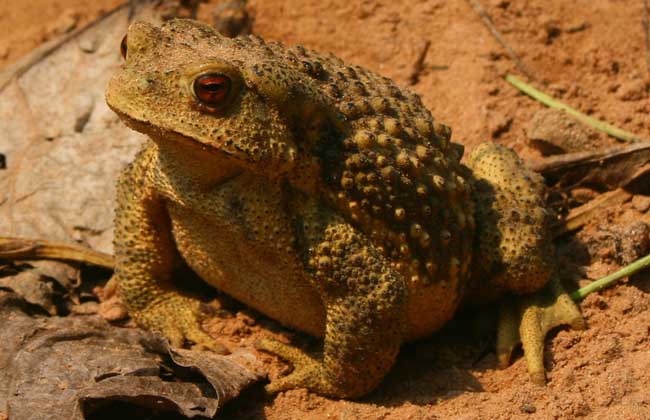
The toad, commonly known as the "lai ha ma" (warts-and-all toad), refers to animals of the class Amphibia, family Bufonidae. Toads eat insects, snails and other small animals, and are beneficial to crops. A toad will inhale air to puff up its body and prop itself up on its four legs to intimidate attackers.
Living Habits of Toads
They like to hide in mud burrows, under damp stones, in grass and beside ditches. Their skin loses water easily, so they mostly hide during the day and come out to move about at night and dusk. Adult toads mostly overwinter in clusters in the mud and sand at the bottom of water or under damp soil on land. They stop eating and rely on glycogen stored in the body to maintain minimal metabolism, and only when the temperature rises to 10-20 degrees C the following year do they end hibernation. They hunt and move about at night, feeding on beetles, moths, snails, fly maggots and so on. Artificial breeding and reproduction is easier than for other frog species.
Artificial Breeding of Toads
1. Site construction: Build a wall 1 to 1.5 m high around the breeding site, and inside it breeding ponds, spawning ponds and hatching ponds can be set up. Around the breeding ponds there should be lawn or vegetable plots for the toads to hunt and rest; lighting lamps should be installed in the site to attract insects at night for them to prey on.
2. Reproduction: Toads are oviparous and have a fairly strong reproductive capacity. Each year when the water temperature is about 10 degrees C and the relative air humidity is 90 percent, they spawn; each female lays about 5,000 eggs at a time, and the eggs are generally arranged in double rows within tubular gelatinous egg strings, which twine around aquatic plants. The egg strings can be placed in hatching ponds for artificial hatching. During hatching, keep the water temperature above 10 degrees C, and adjust the water depth at any time to control the water temperature. In severe weather such as cold waves and storms, plastic film can be used as a cover to keep them warm.
3. Management: When breeding toads, they should be fed in separate ponds and groups according to their different developmental stages, and sufficient bait should be maintained. The bait for young toads is plankton; pig and cattle manure, vegetable trimmings, waste from slaughterhouses and food factories, and bran and so on can be put into the ponds to cultivate plankton; adult toads mainly feed on insects, so various plants can be grown in the breeding site and lights used at night to attract insects, and manure can also be piled up in the breeding site to breed worms as food for them.
Technique for Collecting Shed Toad Skin
Toads shed their skin one to two times every year, and each shedding makes them grow larger; when shedding, they eat the skin as they shed it, and finish eating it when the shedding is done. This is why people only know of toad skin but find it very hard to collect. Generally after Qingming, toads come ashore one after another to feed and reproduce; after Mangzhong is the best period for collecting toad skin, because from coming ashore to Mangzhong they have basically completed the reproduction, rest and feeding period, the temperature has reached above 25 degrees C, earthworms and insects have already multiplied in large numbers, food sources are widespread, and the toads are robust, so preparations for the specific work of collecting toad skin should be started immediately.
1. Indoors, use glass to enclose 3-5 shedding ponds 2.5 m long, 1.5 m wide and 5 m high; the pond bottom is smoothed with cement and has a certain slope, each pond is provided with a drain for easy washing, and above each pond lighting equipment is installed for illumination during nighttime operations.
2. Put toads from the breeding pond that weigh more than 100 grams, have all four limbs intact and have no wounds on the belly or back into the shedding pond, wash the mud and dust off their bodies with clean water, and after the moisture dries spray the pure Chinese herbal preparation "Tuoyisu" (shedding agent). Generally, about 100 hours, that is four days, after spraying Tuoyisu, they begin to shed their skin.
3. Before shedding, observe their various symptoms at all times; generally when about to shed they show such signs as leaving the group, staying alone, slow reactions, and the surface becoming wet and shiny. If these symptoms are seen, shedding begins in about ten minutes.
4. When a toad sheds, it generally starts from the back, then the head, hind legs, belly and front legs. When it has shed three legs, that is, all the other parts have already been shed, and only one front leg remains, immediately pick it up with your hands, gently pull off the remaining part, and pry open its mouth and gently take out together the part it has already eaten but has not yet had time to swallow; that is a complete toad skin.
5. The freshly shed skin has mucus; it should immediately be gently rinsed clean with clean water, then use stainless steel tweezers to place the toad skin on a piece of glass prepared in advance, 25 cm long and 12 cm wide, and gently stretch it into a specimen shape. When stretching the specimen, use light force; do not tear it or fail to stretch it open, otherwise the commercial quality will be affected. After the specimen is made, put it indoors to dry in the shade, or place it in an infrared sterilizing cabinet to dry; generally when it is 90 percent dry it is a finished product, which can be sealed and preserved after packaging or sold.
6. Put toads that have shed their skin in another pond for two hours, and after their bodies are dry scrape off the toad venom or put them back into the breeding pond; if food is sufficient and rearing is done properly, by autumn or before hibernation their skin can be collected again, but those that have already shed cannot have their skin collected again within a short period, because skin shed again in less than four months is very thin, has high medicinal value, is very hard to shape neatly, and has no commercial value.
Collection and Processing Technique for Toad Venom
1. Making a venom clamp: The venom clamp can be purchased from a medicinal materials company as a copper or aluminum clamp, or a bamboo clamp can be made by oneself. Choose a section of high-quality bamboo tube 20 cm long and 5 to 7 cm in diameter, split it into two halves, and on the same side of the two halves connect them with a hinge (the iron hinge should be installed on the outer side of the bamboo tube), then install a tension spring on the outer side; when you grip it with your hand it closes into a tube shape, and when you release your hand, due to the pulling force of the tension spring, the bamboo tube separates into two halves again. In this way the venom collection clamp is made.
2. Collection: The time for collecting venom is from wheat harvest to late autumn each year; catch them with nets or by hand, then collect the venom together. When collecting venom, first wash the mud off the toads' bodies, dry the moisture, then use the venom clamp to clamp the postorbital glands and squeeze with appropriate force, and a white liquid will spray onto the inner wall of the venom clamp. Do not use too much force, otherwise it will cause bleeding and contaminate the toad venom, lowering its appearance and quality; if the edges of the venom clamp are too sharp, it will also often cause bleeding, so the corners of the venom clamp edges can be appropriately smoothed. After the venom is collected from the left and right postorbital glands of the toad, release the toad and it can still grow normally; generally it should be placed in fields or lawns more than 50 m away from ponds, and on no account should it be put into water immediately, so as to avoid wound infection and suppuration leading to death. In orchards and vegetable fields with pits and ponds, toads can also be artificially stocked, combining raising and collecting, so that toads can be used to eliminate pests and toad venom can also be collected to increase income.