Detailed Video Tutorial on Toad Farming Techniques
Toads, commonly known as laihama, are amphibians of the family Bufonidae, specifically the Chinese toad (Bufo gargarizans) and the black-spectacled toad (Duttaphrynus melanostictus). They are distributed across East China, Central China, and North China. The toad is an extremely valuable medicinal animal; the milky white secretion from its parotoid glands and skin glands can be processed into the precious traditional Chinese medicine known as toad venom (Chansu). Currently, toad venom is in short supply on the domestic market, and demand on the international market is even greater. Artificial toad farming is easy, low-cost, and quick to yield returns, making it a very promising household sideline. Toads can be raised in abandoned ditches and ponds, riverside flats and marshes, courtyard vegetable gardens, and other locations, and can also be released in open fields.
Economic Value of Farming
Toad venom is warm in nature, pungent and sweet in taste, and toxic. It has the effects of detoxification, reducing swelling, strengthening the heart, and relieving pain. It mainly treats carbuncles, malignant sores, boils, toothache, sore throat, bleeding gums, heart failure, and other conditions. In addition, toad venom is used as a mucosal anesthetic in oral and ENT surgery. Using it as the main ingredient, Chinese patent medicines such as Liushen Wan, Chansu Wan, Xiaozhong Jiedu Wan, Meihua Dianshe Dan, and Shaqi Wan can be formulated.
In addition to toad venom, the toad's head, skin, tongue, liver, and gallbladder can all be used medicinally. The dried whole body of the toad after removal of internal organs is used as medicine, called dried toad (Ganchan). It is cool in nature, sweet and pungent in taste, and slightly toxic. It has the effects of reducing swelling, detoxification, relieving pain, and promoting urination. It can treat chronic bronchitis, painful boils and sores, sore throat, edema, difficult urination, and other conditions.
Biological Characteristics
1. Morphological Features
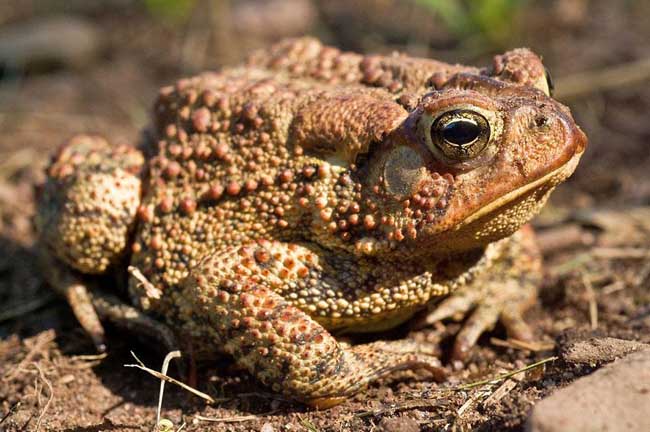
The Chinese toad (Bufo gargarizans) resembles a frog in appearance, with a body length generally over 10 cm. It is divided into three parts: head, trunk, and limbs. The neck is not obvious, there is no tail, and the trunk is thick and short. The skin is extremely rough, the head is relatively smooth with no black bony ridges, and there are large, long parotoid glands on both sides. The body is covered with skin gland wart-like protrusions of varying sizes, with the abdominal wart-like protrusions being smaller. Body color varies considerably; the back has no spots. During the breeding season, the male's back is dark green, with light-colored markings on the sides of the body, while the female is deep creamy yellow, with markings on the belly formed by creamy yellow and brown or black. The male is smaller, with black nuptial pads on the inner three fingers, and no vocal sac.
The black-spectacled toad (Duttaphrynus melanostictus) has a body length of 7-10 cm, with black bony ridges or black lines on the head. The back is generally yellow-brown with slight reddish-brown markings, and the belly is creamy yellow with gray markings. The male has black nuptial pads on the inner base of the first and second fingers, and has a single subgular internal vocal sac.
2. Living Habits
Toads prefer moisture, darkness, and warmth. In summer and autumn, they often rest during the day in shady, damp places such as ditch banks, grass clumps, and brick and stone crevices behind houses, emerging at dusk and early morning to forage, and are most active in the middle of the night. They eat various pests such as beetles, moths, snails, slugs, cutworms, fly maggots, and termites, but sometimes also eat earthworms. In winter, when the temperature drops below 10C, toads successively burrow into brick and stone crevices, soil holes, or dive to the bottom of water to hibernate, stopping feeding and relying on consuming liver glycogen in their bodies to maintain minimal metabolism. They do not end hibernation until the temperature rises to 10—12℃ the following year. After emerging from dormancy, they mate and lay eggs in still ponds or slow-flowing ditches.
The egg-laying season of toads varies by region. For example, in the Chengdu Plain it is in January-February, along the East China coast it is mostly in early March, and in North China it is in March-April. The eggs are black, and each female lays about 5,000 eggs at a time, generally arranged in rows within tubular gelatinous egg strings. The egg strings can reach several meters in length and wrap around aquatic plants. The eggs hatch and develop into tadpoles, which live in ditches or puddles and often swim in groups in one direction. After 2-3 months, they begin metamorphosis and move to land.
Toad Farming Techniques
1. Stocking Methods
Adult toads can be captured and raised in captivity using abandoned ditches and ponds, riverside flats and marshes, and courtyard vegetable gardens. According to the enclosure area, use 30 cm long reeds or bamboo strips and bamboo branches, spaced 3 cm apart, to enclose the perimeter, and tie them firmly with straw rope. A 15 cm high wall can also be built to prevent toads from escaping. Pond enclosures should also connect to some dry land to facilitate hanging lights to attract insects and to catch toads for milking. Raising toads in courtyard vegetable gardens mainly involves keeping toads that have been milked during summer and autumn so that milking can continue. Milk once every two weeks. When raising toads in enclosures by ponds and river beaches, it is best to use black lights to attract insects to feed the toads; one black light can attract and trap more than 100,000 small insects in one night.
Open-field stocking is mainly in cotton fields. One mu can stock 100—500 toads that have had their first milking. Stocking toads in cotton fields can both help control pests and allow a second milking after two weeks.
2. Breeding Management
① Capture breeder toads: select large, well-developed, healthy toads free of disease and injury for breeding, stocking 1—2 pairs of breeder toads per square meter.
② Collect egg masses for breeding, place them in paddy fields or breeding ponds for artificial hatching. During hatching, keep the water temperature at 10—30C, with 18—24E being optimal, and adjust the water depth at any time. After 3—4 days, small tadpoles will hatch. In case of cold waves, heavy rain, or other severe weather, plastic film can be used as cover to keep warm.