Toad Species Picture Guide: Quickly Identify Common Toad Varieties
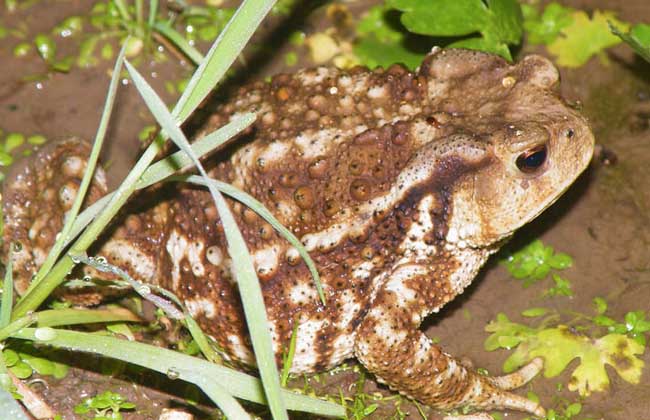
Toads are also known as scabies toads, warty toads, toad scab wart treasures and so on. They are amphibians of the order Anura, family Bufonidae. In China they are divided into two species, the Asiatic toad and the black-spectacled toad, and they are distributed throughout the country. The toad venom and toad skin extracted from their bodies are medicinal materials in short supply in China and have extremely high medicinal value. Below, let us take a look at the complete picture guide to toad species!
Asiatic Toad
The Asiatic toad is also known as the large toad, scabby belly, warty toad and so on. It lives in burrows in the soil, or rests under stones and among grass, crawling out at dusk to hunt. The spawning season varies by region, and the eggs are arranged in four staggered rows within tubular gelatinous egg strings. The egg strings wrap around aquatic plants, and each toad lays 2000 to 8000 eggs. Adult toads hibernate in the mud or rotting grass at the bottom of the water. Its tadpoles like to swim in groups in the same direction, and in winter they mostly stay in the mud at the bottom of the water. It feeds on captured animals such as snails, slugs, ants, beetles and moths.
Siberian Toad
The Siberian toad has an average body length of about 60 mm, and the largest female can reach 80 mm. The head is wider than it is long, the snout tip is rounded, the canthus rostralis is distinct, and the cheeks slant outward. The distance between the nostrils is slightly less than the distance between the eyes, the upper eyelid is wide and slightly greater than the interocular distance, and the tympanum is distinct and oval. During the day it mostly hides under grass and stones or in earth holes, and at dusk it goes out to search for food. In winter it lives in groups in burrows in sandy soil. In China it is mainly distributed in Heilongjiang, Jilin, Liaoning, Inner Mongolia, Qinghai, Gansu, Ningxia, Shaanxi, Shanxi, Hebei and Shandong.
Black-spectacled Toad
The black-spectacled toad is a very cute warty toad. It has a ring of black protrusions around its eyes, as if it is wearing black-framed glasses, so it is called the black-spectacled toad. Its body is plump, about 6 to 7 cm in size, and its body color varies greatly, including yellow-brown, black-brown and gray-black, and some have irregular brownish-red patches. It is widely distributed in flatlands and low-altitude areas, and is the amphibian most willing to live alongside humans, often appearing near homes, in rice fields, open spaces and other places. Adults adapt very well to the environment. In a well-shaded pool, such as a lotus pond, a pool of less than 100 sq m may gather hundreds of black-spectacled toads.
Red-eyed Toad
The red-eyed toad is a new toad species, discovered in September 2010 in the steep cloud forest region of Colombia, and it once left scientists baffled. Exactly which toad species it belongs to remains a mystery, and the reason lies in the ruby-like color of its eyes. Stock can be obtained by catching them in the wild, or by collecting egg masses or tadpoles for rearing.
American Toad
The American toad has a body length of 51 to 110 mm. It can usually be found in forests and even in front yards, and especially prefers humid environments. From March to July it lays string-like egg masses in the mud of ponds or rivers, with 6000 eggs. It feeds on crickets, yellow mealworms, earthworms, ants, spiders, slugs, centipedes and other small vertebrates, and is distributed in Canada and the United States.