Detailed Explanation of Bullfrog Farming Technology, Master Scientific Breeding Methods Comprehensively
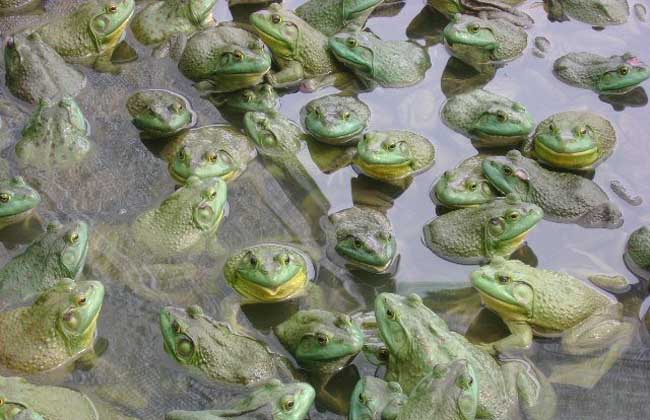
The bullfrog belongs to the class Amphibia, order Anura, family Ranidae, genus Rana. Bullfrog farming is a newly emerging special economic breeding industry both domestically and abroad today. The bullfrog is an amphibian with the highest comprehensive economic utilization value. It originated in North America and was introduced to China in '59. It got its name because its call sounds like a cow mooing. It is a large edible frog. Bullfrogs grow fast, their meat is delicious, nutritious, and high in protein, making them a delicacy at festive banquets.
The Economic Value of Bullfrogs
1. Food. The bullfrog has been regarded in China as a rare delicacy for state banquets. In 1984, when US President Reagan visited China, President Li Xiannian hosted a banquet with nine dishes, and Reagan praised the “stone scale legs” made from bullfrog without end. Today, bullfrogs have been included in the menus of many hotels and restaurants in China. Eating bullfrogs is nothing rare in the world. The world's consumption of bullfrogs originated in France. Later it spread to the countries of North America. Now the annual consumption of bullfrogs on the international market reaches more than 300,000 tons, with a price of about 50 US dollars per kilogram. China began farming them in '86, and produced 300 tons last year. Jiangsu, Zhejiang, Hainan, Shanghai, Guangdong, and Shandong are potential markets. Bullfrogs are sold to coastal hotels at 30---60 yuan/kg.
2. Medicinal use. Frog meat is neutral in nature and sweet in taste, while the gall is cold in nature. It treats many human diseases, such as edema and erosion of the throat, and has the effects of invigorating blood and resolving masses, clearing heat and detoxifying, tonifying deficiency, and relieving cough.
3. Leather. Bullfrog skin is firm and thick, soft, smooth, and elastic, and has colorful patterns, making it a superior raw material for leather products such as wallets and gloves. Shoes made from frog skin cost 400 yuan per pair. Frog skin is refined and processed into leather glue, used as an adhesive for ornaments such as jewelry and diamonds.
4. Feed. Drying the by-products of bullfrogs (heads, internal organs) into mixed feed to feed chickens can increase the egg production rate.
5. Expert insect catcher. Bullfrogs, like other frogs, mainly feed on agricultural pests. One bullfrog can prey on more than 10,000 pests per year on average. One tadpole can eat more than 100 mosquito larvae in a day at most. Using bullfrogs to control insects can not only effectively control harmful insects and reduce damage to crops, but also greatly reduce the amount of pesticides used.
6. Aerospace use. Frog oil is used in the aerospace industry.
Living Habits
① Amphibious nature: it likes to inhabit rivers, ponds, swamps, and grasses along banks. ② Gregarious nature. ③ Metamorphic nature. ④ Cannibalistic nature. ⑤ Poikilothermic nature. ⑥ Hibernation. ⑦ Variable body color: skin color can change with temperature, light, and the color tone of the living environment. There are generally two basic colors: one is dark brown; the other is green. In winter and early spring it is dark brown, in late spring bright green, and in autumn light brown. Young frogs are green. ⑧ Calling: the sound of a bullfrog's call closely resembles that of a yellow cow. When the breeding season arrives, they begin to call. ⑨ Regeneration: after part of a bullfrog's body is injured, shed, or removed, it can grow back. ⑩ Lifespan: bullfrogs have a relatively long lifespan and can normally live to 16 years.
Bullfrog Breeding Technology
Bullfrogs are dioecious. During breeding, mature individuals enter the water to “compete for mates.” The female releases eggs and the male releases sperm, which combine in the water for external fertilization. This is a typical representative of frog reproduction.
1. Age of sexual maturity. From the hatching of tadpoles to sexual maturity, bullfrog gonadal development generally takes about 8—9 months. In terms of body weight selection, females are about 350 g or more, and males 300 g or more. But in reality, sexual maturity of bullfrogs also varies greatly depending on temperature, bait, and farming methods.
2. Male-to-female ratio: 2:3, 1:1
3. Stocking density: 5 pairs/10 sq m
4. Spawning site: s=10—20 sq m, H=1.2 m, escape-proof wall, escape-proof net, about 1 m, with half water surface and half land, and some herbaceous plants should be planted on the land and in the water.
5. Spawning habits
① Estrus behavior: Under the influence of external environmental factors (such as temperature and light), sexually mature male and female bullfrogs both show obvious estrus behavior. The initial behavior of male estrus is continuous calling to summon females, with an average of more than 100 calls per hour, and chasing behavior. When a female is caught and the fingers lightly touch the chest under her jaw, the left and right forelimbs will quickly close and embrace. The nuptial pad on the inner side of the base of the first forelimb digit can be seen to be especially obvious and flesh-red. A female in estrus does not eat food and jumps toward the male's call, sometimes making a “ka ka” response, indicating that the female has courtship demands, and only at this moment does the female allow the male to jump onto her back for amplexus.
② Amplexus: When estrus reaches its climax, the male and female embrace in amplexus, generally in the latter half of the night, and the amplexus period generally lasts as long as 1—2 days.
③ Spawning and fertilization: The bullfrog breeding season is from April to September, earlier or later depending on the region. The external conditions for spawning are not demanding; the key is temperature. As long as the water temperature reaches 20—30°C, whether in ponds or ditches, they can spawn normally. The ideal environment requires quietness, being sheltered from the wind, few passersby, and aquatic plants along the bank. When amplexus behavior is nearing its end, the female, stimulated by the foreign body, transmits the stimulus through sensory organs to the central nervous system and then to the pituitary gland, prompting the pituitary to secrete hormones. Under the action of sex hormones, the female pushes backward with force, and the abdomen contracts due to respiration and the male's embrace, expelling the eggs outside the body. At the same time, the male releases semen for external fertilization. The spawning time is 10—20 minutes at a time. Generally, an individual lays 20,000-30,000 eggs, with a maximum of 50,000 eggs.
Bullfrog eggs are round and divided into two poles, upper and lower. The animal pole is black, and the vegetal pole is grayish-white. Some newly laid eggs have the animal pole on top, while others have the vegetal pole on top, so freshly laid eggs are black-and-white mixed, speckled with dots. About 30—60 minutes after spawning, the animal poles all turn upward, which is called the automatic rotation of the eggs. If after 2 hours there are still eggs with the white vegetal pole on top, they are unfertilized eggs. Based on this, the fertilization rate after bullfrog spawning can be calculated, and the fertilization rate is generally above 90%.
There are many reasons for spawning without fertilization, mainly: ① Imbalance in the male-to-female ratio. The normal male-to-female ratio is 1:1, with a fertilization rate above 90%; at 2:1 the fertilization rate is 75—80%; at 3:1 it is only 40—50%. Too many or too few males both have an effect. ② The male frogs are too old, weak, aged, or disabled. Practice shows that two-year-old breeding frogs have the highest fertilization rate, while breeding frogs that have produced 3—4 clutches have a lower fertilization rate. ③ The water temperature is too low and the water quality is not clean. D The water surface is too wide and the spawning site is unsuitable. There are also many ways to increase the fertilization rate. Artificial fertilization is an effective shortcut, and the fertilization rate can reach 90—95%.