Detailed Explanation of Key Technical Points for Bullfrog Cage Culture
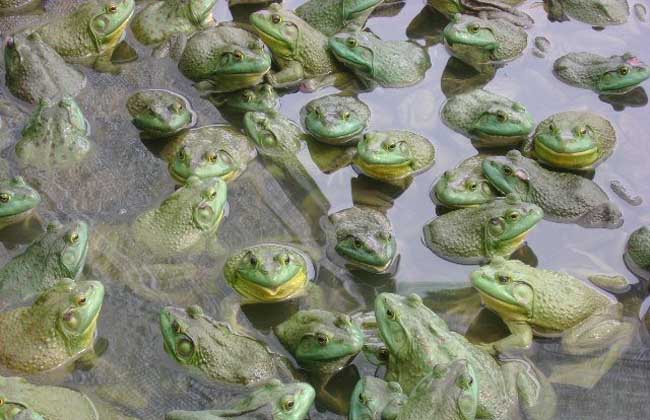
The specific content of the high-density three-dimensional high-yield frog culture technology in cages is to use farmyard manure, wheat bran, etc. to cultivate earthworms, yellow mealworms, and fly maggots, and then use earthworms, etc. to feed the bullfrogs in the cages. The cages are set in fish ponds, and the frog feces and worm and maggot feces can fertilize the water to raise fish. This method has the advantages of less land occupation, low cost, prevention of natural enemies, large stocking density, fast bullfrog growth, easy management, and high comprehensive benefits. Its specific technical measures are as follows.
Cage Setup
The cage material used for bullfrog culture is required to have good ventilation and water permeability. Generally, it can be made by sewing together plastic mesh sheets or window screen. The specifications and shapes of the cages should be adapted to local conditions. Generally, a rectangular shape is preferable, and the volume should not exceed 10 cubic meters. After the mesh sheets are sewn, they can be tied into a cage frame with bamboo strips or wooden slats, and the mesh sheets are fixed to it and fully opened. When setting the cage in a pond, foam boards or floating materials can be tied at 30 cm below the water surface of the cage body to ensure the stability of the water level in the cage, and a rope can be used on the shore to pull it to prevent it from being moved by strong winds.
Stocking Density
When raising bullfrogs in cages, the water body in the cage should be fully utilized, and high-density rearing can be carried out. The general stocking density is: 300-500 tadpoles per square meter, 50-200 young frogs per square meter, and 80—100 adult frogs. After bullfrogs are put into the cage, large and small frogs should be separated into different cages and graded in a timely manner according to their growth speed, so as to avoid unnecessary losses caused by cannibalism.
Reasonable Feeding
After the frog seedlings are put into the cage, one or more feeding trays should be set in the cage according to the size of the cage body and the number of frogs. The daily feeding amount should be determined according to the size of the frogs, weather changes, and water temperature, and it is advisable that the feed is eaten within one hour after feeding. Usually, feeding is done twice a day, once from 9-10 a.m. and once from 5—6 p.m.
Disease Prevention and Disinfection
Because the stocking density is high and the frogs are concentrated when raising bullfrogs in cages, disease prevention and disinfection work should be done well. Generally, every 10 days, a bleaching powder solution with a concentration of 1 ppm is splashed on the cage body for disinfection.