Bullfrog Growth Process Explained in Detail: Understanding How Bullfrogs Grow in One Article
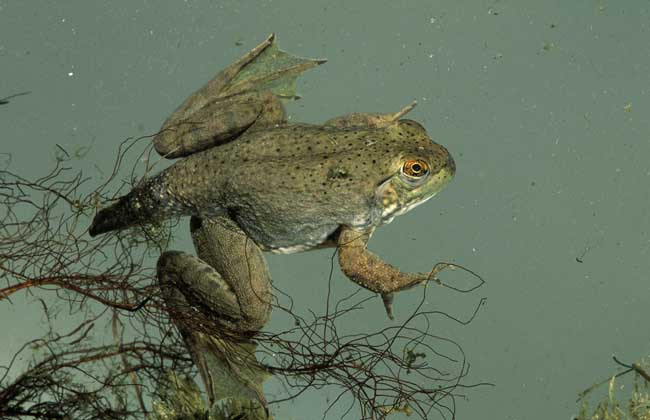
The bullfrog is named for its loud, resounding call that resembles the bellowing of a cow. It is a metamorphic animal, and its growth process consists of four stages: fertilized egg, tadpole, young frog and adult frog. Now let us take a detailed look at exactly what the bullfrog's growth process is like!
Bullfrog Fertilized Eggs
When the water temperature rises above 18°C, the male frog begins to become sexually active. For frogs weighing 300 to 500 g, the number of eggs laid ranges from 10,000 to 50,000, and the number of eggs per gram of body weight ranges from 15 to 109.
Bullfrogs live in aquatic environments such as lakes, ditches, harbors and ponds as well as the nearby land, and usually prefer to perch at the edges of ditches and ponds. If floating plants grow on the water surface, they lie among the aquatic plants with only their heads exposed above the water, and dive into the water at the slightest disturbance. Bullfrogs have a gregarious nature, often with several or several dozen individuals sharing one spot, and once they have adapted to the environment, they do not move casually.
Bullfrog Tadpoles
The water temperature suitable for growing tadpoles is 20°C to 30°C. Within this temperature range, the tadpole growth and metamorphosis period is about 85 days. In different regions, due to differences in air and water temperature, the growth rate and metamorphosis time of tadpoles also differ. In the same location, the speed of tadpole metamorphosis is also closely related to the water temperature; low temperature is the main factor affecting tadpole growth and metamorphosis.
Bullfrog Young Frogs
Young frogs feed on earthworms, crustaceans such as shrimp, snails, mussels, fish, the larvae of amphibians and reptiles, and the internal organs of mammals.
Bullfrog Adult Frogs
Growth of Adult Frogs The growth of bullfrogs at the adult stage is much faster than at the tadpole stage. After a bullfrog metamorphoses from a tadpole into a frog, its growth mainly consists of an increase in body weight, while the increase in body length is relatively much slower. Under suitable climate and sufficient food, bullfrogs grow very quickly, gaining an average of about 50 g per month. After 5 months of rearing, a young frog can grow to about 250 g, at which point it can be sold as a commercial frog.
After the gonads of adult frogs mature, growth slows noticeably, because part of the nutrients digested and absorbed must be supplied to the growth of reproductive cells. At this time, bullfrogs are mostly 2 years old, and most weigh more than 350 g.
The growth of adult frogs is constrained by temperature and food. When the water temperature is below 10°C or above 34°C, bullfrogs basically do not eat. A water temperature of 23°C to 28°C is the most suitable growth stage. If food is insufficient, bullfrog growth slows down. When the winter temperature drops below 10°C, most bullfrogs stop growing and enter a dormant state. However, if they are moved into artificial greenhouses or plastic tunnels where the air and water temperature is 20°C to 30°C, the bullfrogs resume eating and grow quickly, with an average monthly weight gain of more than 30 g, and no hibernation occurs.