Bullfrog farming technology video tutorial, teaching you scientific bullfrog farming
Bullfrogs originated in North America and were introduced to China's inland areas from Cuba and Japan in 1959. At present, China mainly relies on farming for production, and they are produced all over the country, mainly concentrated in Hunan, Jiangxi, **, Sichuan, Hubei and other places. Commercial frogs are mainly marketed in autumn and winter, and the supply sources are mainly from Guangdong and Fujian. Now let us take a look at the bullfrog farming technology video together!
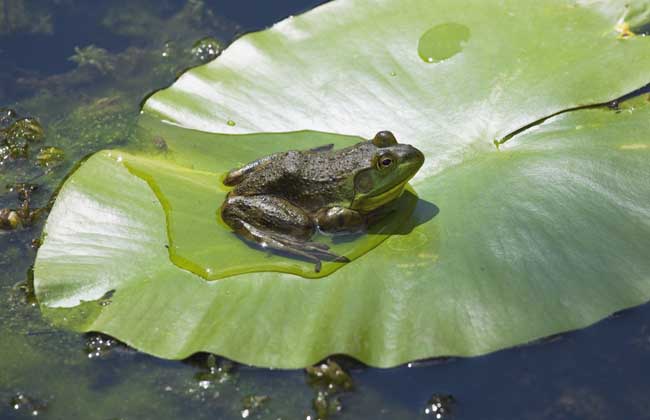
Bullfrog breeding technology
1. Selection of parent frogs
① Sexually mature male and female bullfrogs differ noticeably in appearance. The tympanum diameter of male bullfrogs is clearly larger than the diameter of the eye. The inner side of the thumb on the forelimb has a well-developed nuptial pad, which becomes even more obvious during the breeding season. The skin on the throat is golden yellow and becomes darker in color during the breeding season, and there is a pair of band-shaped vocal sacs inside that can produce loud sounds. The tympanum diameter of female bullfrogs is slightly smaller than the diameter of the eye. The thumb on the forelimb has no nuptial pad. The skin color on the throat is grayish white with black markings, and there is no vocal sac.
② The quality of parent frogs is directly related to the breeding effect and the economic traits of the offspring. Therefore, parent frogs must be strictly selected. Parent frogs should be disease-free, uninjured, strong in build and proper in form. For male frogs, choose those aged over 2 years, with golden yellow skin at the vocal sac, obvious nuptial pads, and a body weight of about 300-400 grams. For female frogs, choose those aged 3 years, with a enlarged, soft and elastic abdomen, and a body weight of about 400-500 grams. The best time to select parent frogs is in November before overwintering, and it should be completed by March at the latest. Parent frogs selected before winter are best raised separately by sex, and then the male and female parent frogs can be raised together in early April of the following year.
2. Male-to-female ratio
In principle, the ratio of male to female parent frogs should be 1:1, and it is even better if the proportion of male frogs can be appropriately increased. Too few male frogs will affect the breeding effect. However, there should not be too many male frogs either, because too many male frogs will cause competition among them for female frogs, affecting normal amplexus between male and female parent frogs, and even causing injury or death of parent frogs. Parent frogs are generally stocked at the standard of 1 pair per 5 sq m of water surface.
3. Spawning and spawning quantity
① Water temperature: When the water temperature rises above 18°C, male frogs begin to show estrus, mainly manifested as frequent croaking and chasing female frogs. Generally, female frogs come into estrus about 15 days later than male frogs. Females in estrus appear restless and agitated, linger around male frogs, and submit to amplexus by male frogs. During amplexus in bullfrogs, the male frog lies on the back of the female frog and tightly clasps the female frog's armpits with its hands.
② Amplexus: The duration of amplexus can be as short as a few hours or as long as 2 days. When the female frog spawns, due to the contraction of her own abdomen and the assistance of the male frog's tight pressure, mature eggs in the uterus are continuously discharged from the body through the cloacal opening. Usually, 2 eggs are discharged side by side from the cloacal opening. At this time, the male frog's rear abdomen is pressed tightly against the female frog's back, and it releases sperm at the same time. Sperm and eggs complete fertilization in the water outside the body.
③ Quantity: Generally, spawning lasts 10-20 minutes. Bullfrogs require a quiet environment when spawning, and during the spawning season, idle people should be prohibited from entering and leaving so as not to disturb spawning and cause spawning to stop. The spawning quantity of bullfrogs is greatly related to age, individual size, nutritional conditions and ecological conditions. For frogs weighing 300-500 grams, the spawning quantity ranges from 10,000 to 50,000, and the number of eggs per gram of body weight ranges from 15 to 109.
Bullfrog egg incubation technology
1. Egg collection
After bullfrogs spawn, the fertilized eggs cannot remain in the spawning pond for long. Generally, eggs should be collected 20-30 minutes after spawning. At this time, the egg membrane outside the fertilized egg has fully absorbed water and expanded, and the fertilized egg can rotate within the egg membrane, so that the animal pole of the fertilized egg faces upward and the vegetal pole faces downward. A gray-black egg mass can be seen on the water surface. This is the suitable time for egg collection.
In order to ensure timely egg collection, during the spawning season, inspection of the spawning pond should be strengthened so that egg masses can be discovered in time. In the evening when male frogs croak frequently, special attention should be paid to observing the amplexus of parent frogs. Generally, the place where parent frogs were in amplexus the previous night is the place where they will spawn the next day. In this way, egg masses can be found purposefully and omissions can be avoided.
When collecting eggs, use scissors to cut the aquatic plants attached to the egg mass. Never pull or tear forcefully, so as not to break the egg membrane and affect incubation. The collected egg mass should be quickly moved into the incubation pond. It is best to put 1 egg mass in 1 incubation pond. If the incubation pond is relatively large and multiple egg masses must be placed, eggs laid on the same day should be placed to ensure synchronous incubation and avoid differences in tadpole size in the incubation pond due to differences in incubation time, which would affect the release and stocking of tadpoles.
2. Incubation density
Incubation density is directly related to the incubation rate. When using an incubation pond for still-water incubation, only 6,000 eggs can be placed per square meter. If micro-flowing water or cage incubation is used, the incubation density can be increased to 8,000-10,000 eggs per square meter.
3. Environmental conditions required for incubation
The incubation of bullfrog eggs is closely related to water temperature. The water temperature required for incubation is 20-31°C, and the optimum water temperature is 25-28°C. The suitable pH of incubation water is 6.8-8.5. Acidic water has less oxygen content, which will affect incubation and also soften the egg membrane, causing the eggs to collapse and die from membrane rupture. Incubation water must have sufficient oxygen. Generally, the dissolved oxygen content of the water must not be lower than 3 mg/L. When it is lower than 3 mg/L, it will cause egg death.
4. Management during incubation
At noon, because the incubation pond is exposed to direct sunlight, the water temperature is relatively high, while at night or on rainy days the temperature is low, resulting in a large temperature difference between day and night, which affects the incubation rate. A shade shed should be built above the incubation pond, and at night the incubation pond should also be covered to keep the temperature stable.
During incubation, the embryonic development should be observed frequently, and dead eggs should be removed in time so as not to spread and affect water quality. After tadpoles hatch, the dissolution of the egg membrane will consume a large amount of oxygen in the water, causing oxygen deficiency in the water and deteriorating water quality. At this time, appropriate flowing water or water replacement should be adopted.
Newly hatched tadpoles have poor swimming ability and often cling to the walls of the incubation container or to aquatic plants. They should be disturbed as little as possible so as not to affect the tadpoles' rest and survival rate.