How long must a masked palm civet be raised to reach sexual maturity?
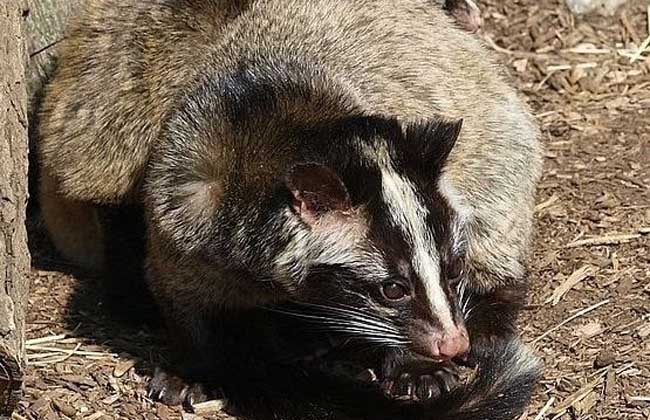
The masked palm civet is a forest-edge animal and a nocturnal animal that likes to be active at dusk, at night and before sunrise. It is good at climbing and is an omnivorous animal. It comes into estrus from February to May each year, the gestation period is 70 days to 90 days, and it gives birth in summer, with 1 to 5 cubs per litter. Now let us take a look at how long a masked palm civet must be raised to reach sexual maturity!
Breeding season of the masked palm civet
The breeding season is from March to July each year. From late February to early August, the scrotum of the male civet hangs down, the skin color is flesh-red, the hair is sparse, and the testes are enlarged, smooth and elastic; the glans is congested and exposed. Over a period of as long as 5 months, it has good mating ability. After August begins, the testes gradually shrink, reaching their smallest period in September, when the testicular volume shrinks by 40%. In January the testes begin to gradually enlarge, and in March the testicular volume reaches its maximum period.
Sexual maturity and age at first mating
Female civets generally reach sexual maturity at 10 to 12 months of age, and male civets generally at 18 to 22 months of age. The masked palm civet has a lifespan of 15 years. For breeding age, female civets are 1 to 10 years old, and male civets are 2 to 7 years old. How early or late sexual maturity occurs is related to birth time, feeding conditions and nutritional level. Cub civets born before June can reach sexual maturity at 10 to 12 months of age as long as nutrition is good, but cubs born after June generally do not reach sexual maturity until 19 to 22 months of age even under the same nutritional conditions. The estrus period of female civets runs from late February to mid-June, among which late March to mid-May is the peak estrus period; during this period, female civets in estrus can account for 87% of the whole group.
Mating process of the masked palm civet
1. Courtship: The male and female are affectionate with each other, chase each other, frolic and lick each other, stimulating both sides' sexual desire.
2. Standing response: Because of the male civet's courtship, the female civet's sexual desire increases, she stands restlessly, naturally spreads her hind legs, raises her tail, and looks back at the male civet.
3. Mounting and ejaculation: After the male civet receives the strong stimulation of the female civet's standing response, he suddenly leaps up, mounts the female civet, clasps her waist with his forelimbs, and thrusts his hips forcefully forward. His eyes become glazed, indicating that ejaculation is complete, and then he leaves on his own. The mating process lasts about 7 to 12 minutes.
Estrus manifestations of the masked palm civet
1. Early estrus: The female civet is restless and agitated, walks back and forth, urinates frequently, the vulva is red and swollen, and appetite decreases. She follows the male civet but does not accept mating. This period lasts 3 to 5 days.
2. Peak estrus: The female civet's labia are congested, everted, and the skin color is flushed; the vulva is slightly open, and mucus flows out. At this time she accepts mating from the male civet. This period lasts 3 to 8 days.
3. Late estrus: The female civet's vulva shrinks, the swelling disappears, and appetite returns, generally for 3 to 5 days.