Okra cultivation technique video tutorial, with a detailed explanation of the whole planting process
Okra is also known as Vietnamese sesame, goat's horn bean, hu ma, okra, kidney-tonifying vegetable, etc. It is an annual herbaceous plant of the genus Abelmoschus in the Malvaceae family, native to India, and widely cultivated in tropical and subtropical regions. In China, the cultivated area is also very extensive in provinces such as Hunan, Hubei and Guangdong. It has long been known as the king of vegetables and has extremely high economic and edible value. Now let us take a look at the okra cultivation technique video together!
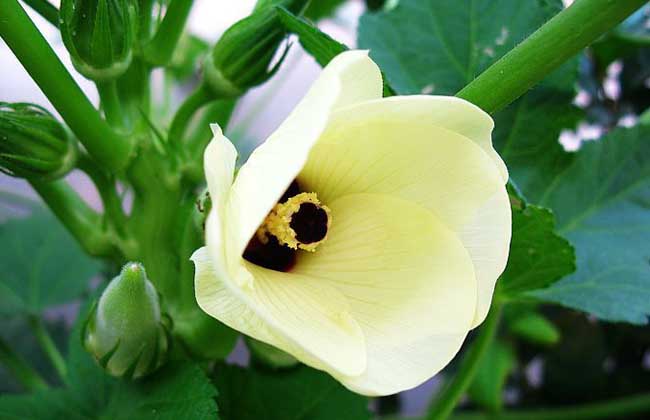
Okra growing conditions
1. Temperature: Okra likes warmth and fears severe cold, and has strong heat tolerance. When the air temperature is 13°C and the soil temperature is around 15°C, the seeds can germinate. However, the optimum temperature for both seed germination and the growth period is 25-30°C. When the monthly average temperature is below 17°C, flowering and fruiting are affected; when the night temperature is below 14°C, growth is slow, plants are short, leaves are narrow, there are few flowers and many flowers drop. At the optimum temperature of 26-28°C, there are many flowers, the fruit-setting rate is high, fruits develop quickly, yield is high and quality is good.
2. Water: Okra is drought-tolerant and moisture-tolerant, but not waterlogging-tolerant. If the soil is too wet during the germination period, it easily induces seedling damping-off. If there is drought during the fruiting period, plant growth is poor and quality is inferior, so the soil should always be kept moist.
3. Light: Okra is especially sensitive to light conditions and requires a long photoperiod and sufficient light. A sunny plot should be chosen, ventilation and air movement should be enhanced, and reasonable close planting should be observed to avoid shading one another and affecting ventilation and light penetration.
4. Soil: Okra has broad adaptability to soil and is not choosy about soil fertility, but loam or sandy loam with deep soil layers, looseness and fertility, and good drainage is more suitable. In the early stage of growth, fertilizer should be mainly nitrogen, while in the middle and late stages more phosphorus and potassium fertilizer is needed. However, too much nitrogen fertilizer makes plants prone to excessive vegetative growth, delays flowering and fruiting, and raises the node position of fruit setting; insufficient nitrogen fertilizer causes poor plant growth and affects flowering and fruit setting.
Okra growth cycle
1. Sowing and germination period: From sowing to the flattening of 2 cotyledons is the germination period, which takes about 10-15 days. When sown at the optimum temperature of 25-30°C, it can germinate and emerge in 4-5 days. Usually, direct seeding in the open field takes about 7 days for seedlings to emerge, and plastic film mulching can advance emergence by 2-4 days.
2. Seedling growth period: From the flattening of 2 cotyledons to the opening of the first flower, it takes about 40-45 days. Generally, after the cotyledons have fully expanded, the first true leaf expands after 15-25 days. After that, one true leaf develops every 2-4 days, among which the first and second true leaves are round. During the seedling stage, growth is slow, and even more so when the soil temperature is too low.
3. Flowering and fruiting period: From the first flower to the end of harvest, it takes about 85-120 days. About 50-55 days after emergence, the first flower opens. The first and second flowers take slightly longer from flowering to harvest. After that, as the temperature rises, the harvest time shortens. Usually, the first harvest can be made about 70 days after sowing. At the optimum temperature of 28-32°C during the day and 18-20°C at night, it can be harvested 4 days after flowering. After flowering and fruiting, okra grows faster and its vigor increases, especially at high temperatures. In July, one true leaf expands every 3 days, while in September it takes 4-5 days for one true leaf to expand.
Okra cultivation methods
1. Land preparation and fertilization: For the plot prepared for planting okra, after the previous crop is harvested, deep autumn and winter plowing should be carried out in time, with deep plowing of 30 cm, to deepen the mature soil layer, further loosen the soil, and enhance the soil's water storage and fertilizer retention capacity. Before planting, make the land fine, level, loose and soft, with a loose top and firm bottom. Okra requires more fertilizer. Per mu, spread 5000 kg of decomposed barnyard manure and 20 kg of compound fertilizer on the ground before land preparation, then plow them deeply into the soil, harrow and mix thoroughly so that soil and fertilizer are blended, and then open furrows and make beds.
2. Sowing at the right time: Direct seeding is mostly used, and seedling transplanting can also be used. Generally, sowing is in mid-May, planting out is in mid-June, and large-scale harvesting is in August.
3. Thinning and intertillage: After okra emerges, thinning should be done in time. When there are 2-3 true leaves, remove diseased, weak and small seedlings, leaving 2 plants per hole. After seedlings emerge, intertillage and weeding should be carried out in time, about once every 10 days. Before the first flower opens, intertillage should be strengthened and seedlings should be properly restrained to promote root development. Before the rows close, carry out intertillage and earth up to prevent plants from lodging.
4. Fertilizer and water management: Okra is relatively drought-tolerant and moisture-tolerant, and during the growth period it requires relatively high air and soil humidity, especially during the flowering and fruiting period when sufficient water is needed. Okra has a long growth and harvest period, and the whole growth period is about 100 days. On the basis of applying sufficient base fertilizer, topdressing should be done appropriately. The first topdressing is carried out after emergence, applying 6-7 kg of urea per mu.
5. Setting up supports and removing leaves: In summer, supports should be set up to prevent lodging. Bamboo poles or branches 1 m long can be inserted beside the plant roots to support the plants. In the early stage of growth, prevent excessive vegetative growth from causing spindly growth. In the middle and late stages, promptly remove the old leaves on each node below the tender fruits already harvested. For fruits kept for seed, promptly pinch off the growing tip, which can promote the seed fruits to mature fully, help the seeds become plump and improve seed quality.
6. Timely harvest: From sowing to when the plant height is about 30 cm and there are 7-9 true leaves, okra flowers and sets pods, and the first tender fruit forms in about 60 days. After that, the whole harvest period lasts 60-100 days, and the whole growth period can reach about 120 days, or even longer.
① Harvest standards: The general requirement is that tender fruits should be firm and resilient, green in color, fresh and bright, with seeds beginning to swell but without signs of aging. For tender pods for fresh eating, when the temperature is high the pod length is 7-10 cm and the transverse diameter is 1.7 cm; when the temperature is lower, the pod length is 7-9 cm and the transverse diameter is 1.7 cm. For tender pods for processing, those 6-7 cm long with a transverse diameter of 1.5 cm are Grade A, those 8-9 cm long with a transverse diameter of about 1.7 cm are Grade B, and pods more than 10 cm long are substandard. Whether for fresh eating or processing, the pod length should not exceed 10 cm.
② Harvest time: Generally, after the first fruit is harvested, harvest once every 2-4 days in the initial stage, and as the temperature rises, the harvest interval shortens. In the peak fruiting period in August, harvest once a day or every other day. After September, as the temperature drops, harvest once every 3-4 days.
③ Harvest method: Harvesters should wear long trousers and long-sleeved shirts, and wear gloves to prevent prickling of hands and legs. Use scissors to cut from the fruit stalk, and never tear or pick by hand, so as to prevent damage to the plant. Be careful to cut all of them and not miss any. If missed or harvested late, not only will the individual fruit be old, of poor quality, and unsuitable for eating and processing, but it will also affect the growth and development of other tender pods.