Spring goes and spring returns: Tips and advice for growing succulents through summer in Guangdong
Foreword
Follow the Encyclopedia · Meet beauty (WeChat ID: duoroubaike)
The main text begins:
Thanks to the author [Master of Jie's Garden] for theoriginal submissionsharing
Submission date: June 9, 2018
Edited and compiled by: Encyclopedia Jun
Location: Guangzhou, Guangdong Province
It has been four or five years since I first became aware of succulents, and I truly fell down the rabbit hole in 2016. Not long after that, I started following Succulent Plant Encyclopedia, and before I knew it I had been silently reading Encyclopedia Jun's posts for more than 2 years. I am very grateful in my heart to this platform, which has let someone who knew nothing slowly become friends with succulents, clearly understand their growth characteristics, and then make my terrace rich and full. Now even basic flower growing is no problem for me.
I will not ramble on too much. The reason I am submitting this time is to tell everyone about my experience growing succulents in greater Guangzhou, because Guangzhou's climate does not have clearly defined four seasons, and the hot, humid summer is especially long. At the very beginning, because of my ignorance, I paid no small amount of tuition. Now I will share my experience with everyone (especially beginner succulent growers in Guangzhou; masters, please do not roast me. I believe people who are already at master level can handle any environment, and all kinds of methods can bring succulents back from the dead, haha).
First, I need to tell everyone about the environment of my terrace. Whether growing succulents or flowers, the first thing to do is understand their living environment. People who often read articles about growing succulents should have noticed one thing: How to mix soil? According to the environment! How to get through summer? According to the environment! How to prevent pests and diseases? Still according to the environment! So the environment determines everything. What kind of environment grows what kind of flowers and plants. This is my personal view. As for everyone else's opinions, I cannot uniformly persuade everyone; every argument has its own reasoning, haha.
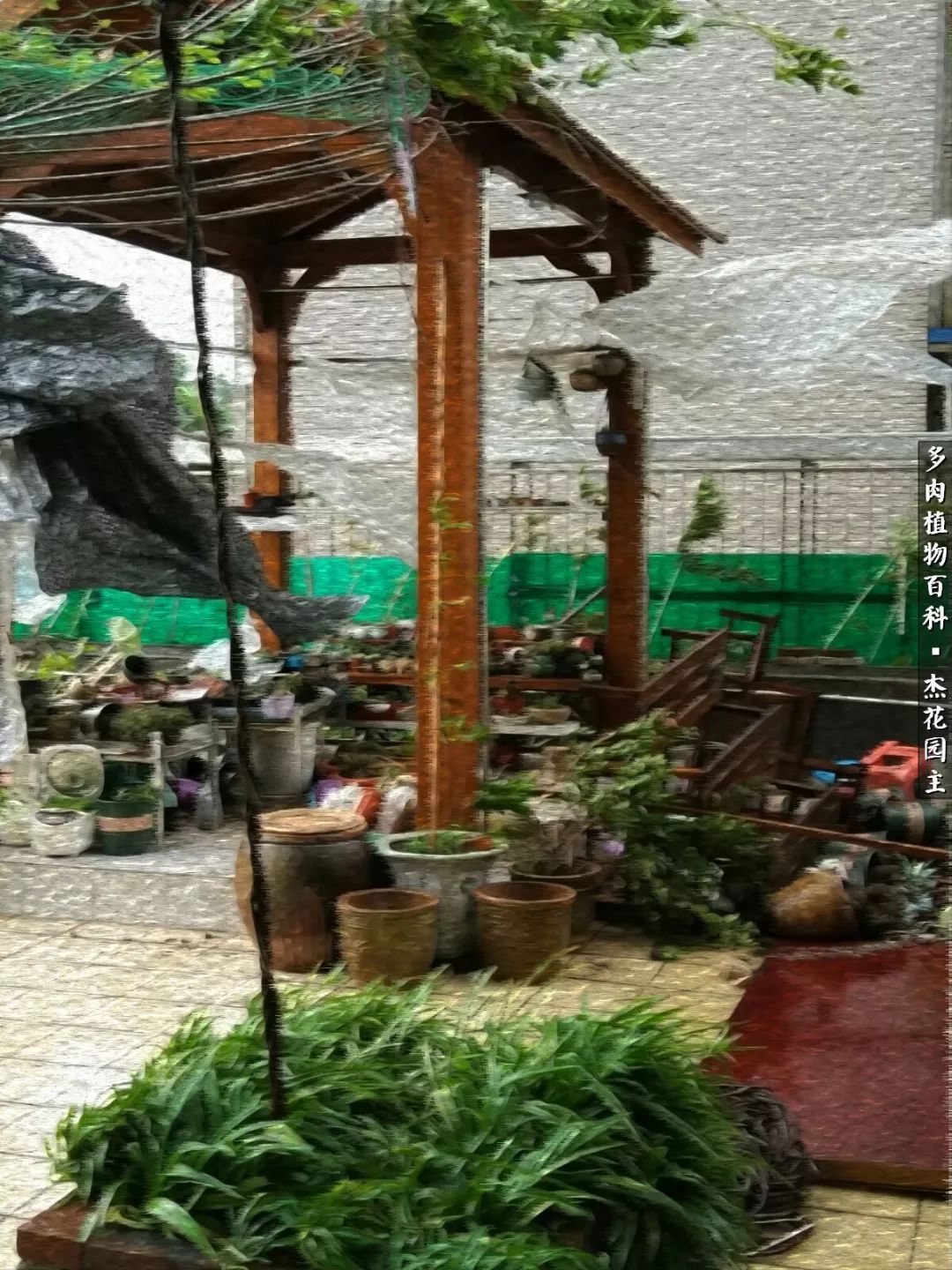
All right, let me get back to the environment where I grow succulents. Guangdong has long periods of high temperature and high humidity, and the biggest feature of my terrace is strong wind! I live on the second-floor platform of a residential complex beside an elevated road. Guangzhou has elevated roads everywhere, and anywhere close to the road should have strong wind. Why is it windy? My home is beside an elevated road at an intersection. In front, behind, left and right of the intersection there are no buildings blocking the wind, plus the wind brought by the traffic day and night, which creates wind flowing across the terrace every day. On typhoon days, it can only be described as terrifying. The Guangzhou area is a coastal area. Spring is the rainy season, summer is the typhoon season, and it still rains; it can rain continuously for several months. Summer rain is more severe. Besides the rain, you also have to face rain falling under a sun of over 30-plus degrees. For succulents, this is fatal. But what can save my succulents' lives is only the wind.
Speaking of typhoons, I have to mention Typhoon "Hato" in August 2017. It almost took my life. Everyone, look at the pictures:
The news that day said: the central wind speed was 45 meters per second passing through Panyu, Guangzhou, and then I felt that this speed was actually passing through my home. The moment I saw it, my whole body was trembling. Now let us look at what it is like when calm:
Does it not feel like peaceful years
Now let us look at the disaster area after the storm
You could say it was all broken bodies and ruined forms, or even corpses
At the time I thought, if I could not save them all, I would leave the hobby and never dare touch them again.
I could only do my best to save them. Under a temperature of over 30 degrees (the day after the typhoon, the temperature returned to above 30 degrees), holding a pile of moist soil, I planted the succulents back one by one, then cut off water, placed them under the wooden pavilion to get wind, and continued shading. I used a shade film to cover one side of the pavilion, thinking it was already the end of August, and if I could endure 2 months, October would be fine. Everything could only be left to fate.
By October, the weather gradually became cooler, and more than half of my succulents had died. Almost all were damaged, and not a single one was in good condition. Then I moved them all outside for open-air growing, exposed to wind and sun, leaving it to fate. However, succulents are tough little babies. A single autumn transformation can make me fall deeply into them again. Without saying much, look at the pictures:
The pictures are labeled with the time they were taken that day. The bottle in the first picture sacrificed itself in the typhoon. After changing the pot, I never paid it any attention again.
Without comparison there is no harm. For the sake of this submission, I spent some time putting together a set of succulent comparison pictures to tell everyone one thing: Spring goes and spring returns! Do not lose heart. No matter how ugly they are in summer, do not dislike them and do not be afraid.
This red egg had its head chopped off by the typhoon, and then it burst with heads!
A cluster of Beniba, though it has not recovered to its best condition, has still grown quite a lot, and it truly shocked me.
This Debbie is a bit pitiful. The typhoon stripped all its leaves, but it still came back very strongly, making one marvel at the power of life.
This Echeveria runyonii lost its best shape in the typhoon, but it burst out a bunch of pups. Give it a round of applause.
Nana's Little Hook
The red gem that had its head chopped off by the typhoon
Silver Star had its bones shaved and body slimmed by the typhoon, and then it slowly grew back on its own
There were too many shocking things, so I will not detail them one by one. That typhoon gave me the drive to remodel my terrace. On the day I wrote this article, Guangzhou experienced Typhoon "Ewiniar." A slight tornado appeared on my terrace. I took many videos and will share them with everyone if I get the chance. It was really quite terrifying. Without any suspense, all my succulents got wet, but this time no pot of succulents was knocked over by the typhoon, because the rain film had been improved based on past experience. Let me save myself an excuse and write about my succulents getting through typhoons next time I post an article (it is no longer simply getting through summer).
After talking about typhoons, let us talk about summer. When summer survival is mentioned, everyone is afraid. The question most people ask is: How to get through summer? It rains every day in Guangzhou! It is hot every day! Many people complain about the weather, but to be honest, human effort matters. If people can survive this weather, succulents can survive it too.
First, you need to cram on soil knowledge. Most articles say soil should be mixed according to your own environment and according to the climate. What climate does greater Guangzhou have? High temperature and high humidity, lots of rain, so drainage must be strong. How do you mix soil with strong drainage? Use stone. The rest, such as peat soil, nutrient soil, coconut coir... these are growth nutrients and are also necessary, but cannot be too much, because they retain too much water. Once there is too much, it leads to increased moisture. Many people also ask whether they can use all granules (all stone). All granules are fine, it is just that growth is slow. The best ratio is granules making up 65%-80%. With this ratio, I do not change the soil all year round, saving trouble, haha! But if you want to cultivate small seedlings and leaf cuttings, lower the granule ratio to about 30%-50% (do not do leaf cuttings in summer; you are just asking for trouble).
After talking about soil, let us talk about rain. When it rains, everyone knows succulents need shelter from rain, but they do not know they need ventilation while being sheltered from rain. Most people going out in the rain use umbrellas, but do not like wearing raincoats. Why? Because it is stuffy and not breathable, uncomfortable. In fact, if succulents could talk, they would definitely answer you the same way: they also need airflow! A master once said: Succulents are not afraid of wetness, nor afraid of heat; what they fear most is being both wet and hot! That is very true. Everyone, ponder it well. As for how to remove moisture and heat? Actually, you can use your own feelings to explain. When you get soaked and are under a big sun, how do you deal with clothes that are both wet and hot on your body? Either get wind, or turn on the air conditioner! Succulents are the same, so when they are soaked and stuffy, they also need ventilation and airflow. If you want to be extravagant, give them air conditioning.
After talking about rain, let us talk about temperature. Most succulents are plants that tolerate high temperatures. When they encounter high temperatures, they go into self-dormancy, which is equivalent to sleeping. So once the temperature is high, absolutely do not water, but do not completely cut off water either. This sounds a bit contradictory. If we analyze it, we will know the reason: completely cutting off water will cause the root system to die from drying out, but if it is sleeping and you water it, it cannot absorb it either. So give a small amount of water. With a narrow-spout spray bottle, just water a circle along the edge of the pot, and choose the evening for watering. If you truly want to understand summer watering, I suggest everyone look back at the article shared by Encyclopedia Jun on 2017-04-21, "A few techniques to let succulents get through summer easily! "Planning ahead" is better than "mending the fold after the sheep is lost"!". This article is very detailed and very suitable for operations in high-temperature, high-humidity areas.
As for daytime, succulents definitely must see the sun. Whether grown outdoors or on a balcony, succulents cannot be cut off from sunlight. Except for the sun from 12 noon to 2 p.m., they should be given all the sun during the rest of the time (though I believe that with so many high-rise buildings in Guangzhou blocking one another, you may not necessarily get sun during this time period). Everyone should check the sunlight at their own home. At this point, I need to nag the extreme beginners with one sentence: the time period I said to avoid the sun is when ultraviolet rays at noon are strongest, and when there are no shade measures and it is under direct blazing sun. Do not get nervous just because they get a little sun.
Besides watering and sun exposure, the most critical thing is cooling. How do you cool down? When you are hot, how do you cool down? Either get wind, or turn on the air conditioner! Haha, after all this back and forth, it still comes down to wind. That is why at the beginning I said: what saves my succulents' lives is only wind! Ventilation is very important. If there is no natural wind, create artificial wind.
Many balcony growers build tiered shelves for succulents and then attach small fans, and still fail to get through summer. Why? The issue is the shelf height. Ventilation needs space. The height of each shelf level should be over 1 meter and cannot be too dense. Also, ventilation for succulents is not leaf ventilation, but root ventilation. Then the problem comes again: how do roots get ventilation? First, use pots with holes to grow succulents. These holes, besides drainage, are for air permeability and ventilation. Flowing wind must be able to blow into the holes; that is successful ventilation. As long as the bottom of the pot has holes (the pot bottom had better not be a single hole; the more ventilation holes the better), and then the place where it is placed should not be flush against the ground, so wind can flow to the bottom. That is enough. It is like when we were little and there was no air conditioning; when using a fan, we would pull our clothes up to let the fan blow inside our clothes, haha, very cool! (Many masters use pots without holes to grow succulents and still grow them very well. Everyone remember, those are masters. If you are not a master, please still follow what I said and find pots with many holes.)
Speaking of this, everyone look at my container. Haha, when the rice cooker broke, I just used it directly for planting and never paid it much attention. The golden creeping sedum grew more and more wildly. However, I rarely watered it. Later I learned that this rice cooker leaks water, so I just left it outside in wind and sun.
All right, now let us talk about pests and diseases. For summer watering, what I water is not purified water or tap water; what I water is medicine water. What medicine? Mancozeb or carbendazim. In any case, every time I water, I must add a little medicine. Sometimes when I see small black fungus gnats, I directly sprinkle the powder into the pot soil. Why is this medicine good? Then I suggest you read what Encyclopedia Jun published on 2017-5-4, "A miraculous medicine for preventing succulent leaf surface infection: Mancozeb"
So everyone should self-reflect on their succulent growing situation. If you are comfortable, the succulents are comfortable. If you are so hot you cannot stand it, they also cannot stand the heat. If you get soaked and are uncomfortable, the succulents are uncomfortable too. It is the same, because succulents are living things.
As for succulents getting ugly in summer, then let them. If I am hot, I also will not care about my appearance. However is comfortable, that is how it goes; however I can survive, that is how it goes. Still the same sentence: Spring goes and spring returns.
Look, this Gemini has now turned into a big flatbread again
The green Beniba with no image to speak of
Little Blue Clothes sprawls out like a corpse as soon as it gets hot
Next let us look at a series of comparison pictures. Everyone pay attention to the time, and you can see when succulents have their crazy growth period.
Orange Monroe
Swan Lake (Liberia)
Moonlight Goddess
Pink
Desert Star
Xiuyan
Aloe Queen
Large Purple Cashmere
Small Purple Cashmere
Large White Phoenix
Swan Lake (Liberia)
This one looks like Swan Lake, and also does not. I am not too sure either. It has an invincible name: let us call it Unknown.
A Pink Blue Bird not in condition
Pink Beauty shaped stem
After looking at so many pictures, I believe everyone can see a pattern: the growing season for succulents in greater Guangzhou is concentrated from November to around March of the following year. Although the time is short, the explosion of growth is astonishing. Being thoroughly transformed depends on this time. So at this time, give as much water as you can and as much sunlight as you can. In short, let it fully absorb the nutrients it needs, and it will explode with growth.
At the end, I will give beginners in greater Guangdong some succulent growing advice:
First, timing for getting succulents. The best time to start growing succulents is from the end of the year in November to January of the following year. Other times are not suitable for beginners to start, especially those sent bare-root by express delivery, because succulents need time from planting to potting to settling in and growing roots. In greater Guangzhou, the growing season is concentrated from November to around March of the following year. After March comes the high-temperature, high-humidity season. Even if bare-root succulents are planted, rooting will be very slow. Beginners who cannot control their hands will tinker in all kinds of ways, and in the end the succulent dies from all the fussing before it has even settled in.
Second, do not tinker randomly. All plant growth needs to go through a settling-in process. Settling in is the adaptation period. When people go to an unfamiliar environment, they can suffer from not adapting to the climate and water and soil, let alone plants. They are all living things. Do not tinker with it; just let it recover on its own. What I mean by tinkering is do not randomly move its position, do not pull it out at every turn to see whether it has grown roots, do not fertilize and water in all kinds of ways just because you think it has not changed, and do not spray medicine in all kinds of ways just because you think its leaves have become ugly. During the settling-in process, first give it a designated environment, put it there and do not move it casually; do not be afraid if the leaves become ugly; if pests appear, deal with them on the spot; water according to whether the soil is dry or wet; for fertilizer, at most put in a few granules of slow-release fertilizer.
Third, variety selection. For beginners, try as much as possible to choose varieties that are easy to grow and tough. The varieties I recommend are: Huangli, Boye Blue Bird, Purple Joy, Qiuli, Jilongyue, White Phoenix, Pink Beauty. These varieties are tough. Since they are tough, beginners do not need all kinds of protection. Grown rough and raised rough, they can be grown very well; just give them enough sunlight.
These are only my personal experience and suggestions, for everyone's reference in growing succulents. Perhaps there are still many incorrect and insufficient points. If I get the chance to learn of them, I will definitely correct them. This time, please be forgiving, haha.
Succulent culture needs you and me to promote it! Remember to share good articles more, so more people fall in love with succulents!
Tip this article
At present, the official account's tipping function has been adjusted. The author's WeChat tip code is used instead of the system tip. If you want to tip the author, please directly scan the WeChat tip code and tip the author of this article!
Advertisement ADVERTISEMENT
It is the weekend again. Encyclopedia Jun recommends a recently released and very popular movie, officially released on July 5"Dying to Survive"In less than a day, the box office had already broken 300 million yuan, with a Douban score of 9.0. It is said to be a film where thousands shed tears and applause never stops! The most important thing is the special social significance it reflects, which can make more people pay attention to leukemia patients and the difficulties they face, thereby accelerating the reform process and avoiding the tragic situations in the film!
This article has beenexclusively authorizedby the author to the WeChat official account: Succulent Plant Encyclopedia (ID: duoroubaike). The content of the article does not represent the views or stance of the official account! The Encyclopedia has signed with a third-party internet copyright rights protection company and has opened whole-network rights protection. Unauthorized private reprinting by other platforms is strictly prohibited! If stolen reprints are found, infringement liability will be pursued! Readers are welcome to report!