Purple sweet potato planting technique video tutorial, teaching you step by step how to grow purple sweet potatoes well
The purple sweet potato, also known as black sweet potato, shao sweet potato, etc., originated in Japan. Its flesh is purple to deep purple, and it is rich in selenium and anthocyanins. Its nutritional value is very high, and it has very high planting prospects. Its yield in our country is extremely high, and it is grown in Guangdong, Guangxi, Hunan, Guizhou, Shandong, Jiangxi, Shaanxi and other places. Now let us take a look at the purple sweet potato planting technique video together!
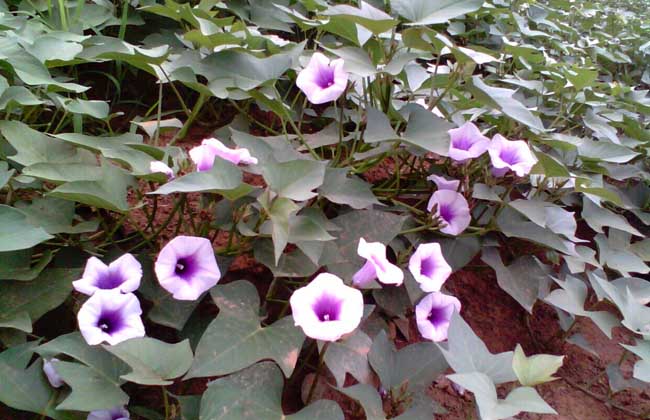
Planting time for purple sweet potatoes
The planting time for purple sweet potatoes is generally mid-February. When the temperature reaches about 15 degrees in mid-February, they can be taken out of the cellar for seedling raising. First prepare the seedbed, place the seed potatoes horizontally in a connected row on the seedbed, with a row spacing of about 5 cm, cover with fine soil, moisten the soil with a sprayer, cover well with plastic film, and cover with an overhead film to retain moisture and heat. When the sprouts grow to more than 20 cm, they can be cut and inserted into the field. Purple sweet potatoes grown for seed are required to be harvested in mid-to-late October, while those for fresh eating are delayed until early November, and must be completely harvested before frost. Before storage, clean the potato cellar, remove the surface soil and disinfect it. Before entering the cellar, dry the purple sweet potatoes for 1-2 days so the wounds heal. During storage, pay attention to ventilation and dehumidification in the early stage, and to heat preservation and moisture retention in the later stage.
Growing environment for purple sweet potatoes
Purple sweet potatoes like a warm climate environment. The suitable growth temperature for stems and leaves is 18-25°C. Growth stops when the temperature is below 15°C. The optimum soil temperature for root tuber growth is 22-24°C, and expansion stops when the soil temperature is below 20°C. It is a short-day crop and needs sufficient light and high light intensity. During the growth period, the suitable soil moisture is 60%-80% of the maximum field water-holding capacity.
Purple sweet potato planting techniques
1. Seedling raising and seed selection: When the temperature reaches about 15 degrees in mid-February, they can be taken out of the cellar for seedling raising. First prepare the seedbed, place the seed potatoes horizontally in a connected row on the seedbed, with a row spacing of about 5 cm, cover with fine soil, moisten the soil with a sprayer, cover well with plastic film, and cover with an overhead film to retain moisture and heat. When the sprouts grow to more than 20 cm, they can be cut and inserted into the field.
2. Apply sufficient base fertilizer: Generally, apply 40-50 loads of high-quality organic fertilizer per mu, and 35-50 kg of nitrogen, phosphorus, potassium, and compound fertilizer. All the organic fertilizer is broadcast before plowing, and the compound fertilizer is used as core fertilizer when ridging.
3. Field management: After ridging, while the soil is moist, apply herbicide once to prevent weed growth. Cultivate 2-3 times, and combine cultivation with soil banking to support the ridges. Purple sweet potatoes are afraid of waterlogging, so it must be drained in time. When drought is severe, those with the conditions should take timely measures against drought. Turning the vines of purple sweet potatoes disrupts nutrient transport and generally reduces yield by 30%. You can only lift the vines, loosen them, and break off the root hairs. When lifting the vines, do not disrupt their direction, and still put them back in their original place. Because purple sweet potato vines grow vigorously and have many adventitious roots at the nodes, lifting the vines is key to increasing purple sweet potato yield.
4. Harvesting and storage: Purple sweet potatoes grown for seed are required to be harvested in mid-to-late October, while those for fresh eating are delayed until early November, and must be completely harvested before frost. Before storage, clean the potato cellar, remove the surface soil and disinfect it. Before entering the cellar, dry the purple sweet potatoes for 1-2 days so the wounds heal. During storage, pay attention to ventilation and dehumidification in the early stage, and to heat preservation and moisture retention in the later stage.
Pest and disease control for purple sweet potatoes
1. Purple sweet potato black spot disease
[Symptoms] Purple sweet potato black spot disease can occur during the seedling raising period, growth period, and storage period. It mainly infects sweet potato seedlings and tubers. Infected seedlings turn black and rot, and black patches grow on infected tubers. Diseased tubers have a bitter taste. During storage, it can continue to spread and cause cellar rot.
[Control] ① After harvest, promptly remove diseased and residual tubers, and burn them in a centralized manner or bury them deeply. ② Avoid continuous cropping in heavily diseased land. ③ Choose plots with higher terrain for planting, clear ditches and drain water after rain, and reduce humidity. ④ Before planting, soak the base of the seedlings in a 1000-fold dilution of 50% carbendazim for 10 minutes. One week after planting, spray 100-150 ml of 50% acetochlor emulsifiable concentrate per mu mixed with 50 kg of water on the soil surface to prevent weeds from growing densely.
2. Purple sweet potato nematode disease
[Symptoms] Purple sweet potato nematode disease is also relatively common in purple sweet potato cultivation. After stem nematodes invade the tuber flesh, they multiply in large numbers and secrete saliva, causing infection by miscellaneous bacteria. The skin of affected tubers fades in color and has cracks, and the tubers become hollow, so sweet potato nematode disease is also called bran heart disease.
[Control] The control method for purple sweet potato nematode disease is that in areas with severe stem nematode occurrence, before seedling raising, soak the seed potatoes in a 300-fold dilution of 50% phoxim for half an hour. This can kill most of the nematodes in the tubers, and the control effect can be above 90%. In addition, use fully fermented manure as base fertilizer. After harvest, promptly remove diseased and residual tubers to reduce the harm of nematode sources to the next year's cultivation.
3. Purple sweet potato leaf spot disease
[Symptoms] Purple sweet potato leaf spot disease is caused by infection with Phyllosticta fungi. When it occurs severely, the leaves locally or entirely wither and die. The lesions on the leaves are round to irregular, initially reddish-brown, later turning yellowish-brown or gray, with slightly raised edges, and small black dots scattered in the center of the spots, which are the pathogen's pycnidia. In northern regions, the pathogen overwinters on diseased residues as mycelium and pycnidia, and the following year releases conidia to spread and infect. In southern regions, sweet potatoes are planted year-round, and conidia on diseased leaves spread through water and cause repeated infection. When there is a lot of rain and high field humidity, the disease is severe.
[Control] ① Remove diseased residues. ② In the early stage of disease, spray with a 400-600-fold dilution of 65% zineb wettable powder, or a 1000-fold dilution of 70% thiophanate-methyl wettable powder for control, spraying once every 5-7 days, for a total of 2-3 sprays.