One pot of flowers bloomed for a whole year without stopping, the neighbors' flowers are truly enviable
Many flowers only bloom for one season, and after they fade you can only look at the leaves. But there are also many flowers that can keep blooming for half a year or a whole year. There is no such thing as too many flowers. Flower lovers who love flowers must get one!
“
Flowers with long blooming periods
”
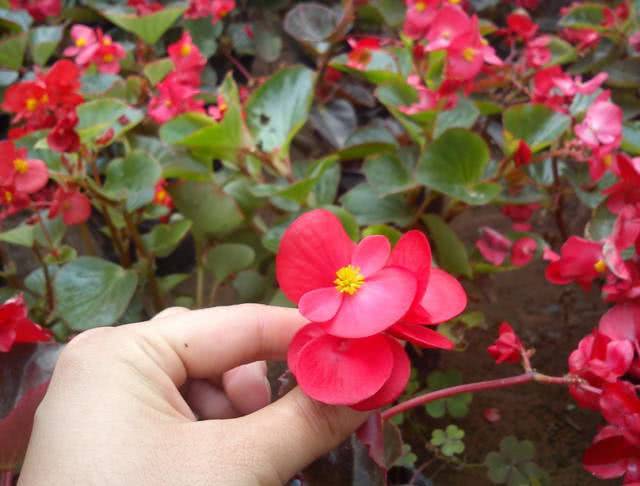
Wax begonia
Blooming period: year-round
Wax begonia is a perennial herbaceous plant of the genus Begonia in the family Begoniaceae. Wax begonia has a rounded, neat plant shape, with many densely packed flowers, and is easy to pair with other plants. It is being used more and more in current landscaping. Wax begonia has a long blooming period, many flower colors, and rich variation. It is a flower that is beautiful in both bloom and foliage.
Wax begonia likes sunlight, tolerates slight shade, fears cold, and likes warm, slightly shady and humid environments and moist soil, but fears heat and waterlogging. In summer, pay attention to shading, ventilation and drainage. Wax begonia is very sensitive to sunlight. In summer, adjust the light duration, create an environment suitable for its growth, and provide it with shade. Potted plants grown indoors should be placed in a spot with scattered light and air circulation, and windows need to be opened at night for ventilation.
Chinese rose
Blooming period: natural blooming period from August to April of the following year
The Chinese rose is famous for its long blooming period, and it has many varieties, beautiful flower shapes, and a rich fragrance. It is suitable for beautifying courtyards, decorating gardens, arranging flower beds, and planting as flower hedges and on flower trellises. The Chinese rose has strong adaptability and is cold-tolerant and cold-tolerant; it can be planted both in the ground and in pots. The downside is that it has relatively many pests and diseases. Eden Rose, Angela and others all have very long blooming periods, and they are very beautiful too!
It is recommended to plant climbing Chinese roses. Climbing Chinese roses have strong adaptability, are cold-tolerant and drought-tolerant, and like an environment with sufficient sunlight, air circulation, good drainage and shelter from wind. They require fertile, loose, slightly acidic soil rich in organic matter, but their range of soil adaptability is relatively wide. The relative air humidity should preferably be 75%-80%, but slightly drier or slightly moister is also fine. They have the characteristic of continuous blooming.
For most varieties, the optimum temperature is 15-26°C during the day and 10-15°C at night. When the winter temperature is below 5°C, they enter dormancy. Most varieties can withstand a low temperature of -15°C. If the summer high temperature continues above 30°C, most varieties bloom less, quality decreases, and they enter a semi-dormant state.
Crown of thorns
Blooming period: March to December
Crown of thorns is a common plant for decorating the home and is very easy to care for. Its blooming period is also relatively long, and its flowering and fruiting period is basically year-round. The flowers are small and delicate, with bright colors, and are very cute.
Crown of thorns likes warmth, likes light, is drought-tolerant, avoids moisture, and fears cold. It grows well in loose, well-drained sandy soil. Summer and autumn are its growth period. In winter, it can safely overwinter when the room temperature is above 3°C. If it is above 15°C, plus sufficient sunlight, it can still continue to bloom. If the winter room temperature can be kept above 15°C, it can bloom continuously throughout the winter. If the humidity is too low, the leaves will all fall off and it will enter dormancy. During the blooming period, it requires sufficient sunlight, and a topdressing should be applied once every half month; either organic liquid fertilizer or compound chemical fertilizer is fine.
Rieger begonia
Blooming period: October to May of the following year
Rieger begonia has diverse flower shapes, mostly double-petaled, and rich flower colors including red, orange, yellow, white and so on. The flowers are large and the colors are gorgeous, with a unique posture, color and fragrance; moreover, the blooming period is long, lasting from October to 5 of the following spring. Beautiful, right!
Rieger begonia likes a warm, humid, and well-ventilated growing environment, and has relatively strict requirements for light, temperature, water and fertilizer. It generally does not form seeds and can be propagated by cuttings and tissue culture. The stems are fleshy and juicy and break easily if you are not careful. When watering, take care not to pour water from the leaves or flowers. When the surface of the medium soil is slightly dry, water thoroughly. It likes cool conditions and has difficulty getting through the summer, because it easily gets diseased under high temperature and high humidity. Its light should be half-day sunlight, and direct sunlight is not suitable.
Hibiscus
Blooming period: year-round
The hibiscus branches and leaves resemble those of the mulberry tree. According to legend, the name comes from the place in the ancient eastern sea where the sun god's chariot rises, where there were two large mulberry trees growing while supporting each other, so people called these mulberry trees "Fusang." Hibiscus has a good shape and gorgeous flowers, and many countries and peoples love it. Malaysia even honors the hibiscus as its national flower. The blooming period is year-round.
Hibiscus is a strongly sun-loving plant. It likes warmth and humidity, requires sufficient sunlight, does not tolerate shade, and does not tolerate cold or drought. In the Yangtze River basin and areas north of it in China, it can only be grown in pots, and overwintered in a greenhouse or other protected area while maintaining a temperature of 12°C-15°C. When the room temperature is below 5°C, the leaves turn yellow and fall off, and below 0°C, it suffers cold damage. It tolerates pruning and has strong branching ability. It has a relatively wide range of soil adaptability, but grows best in slightly acidic loam rich in organic matter with pH6.5-pH7.
Madagascar periwinkle
Blooming period: almost year-round
Many flower lovers grow Madagascar periwinkle. Madagascar periwinkle has strong ornamental value and is suitable for potted display, flower beds and rock garden viewing. It is especially suitable for large flower trough cultivation, with an excellent decorative effect. When Madagascar periwinkle blooms, the scene is gorgeous and has a unique style. Tall-stemmed varieties of Madagascar periwinkle can also be used as cut flowers for viewing. Because of its strong heat resistance, long blooming period, bright colors and fast growth, Madagascar periwinkle is deeply loved by flower lovers among herbaceous flowers.
Madagascar periwinkle likes high temperature and high humidity, tolerates partial shade, and does not tolerate severe cold. The most suitable temperature is 20°C-33°C. It likes sunlight, avoids moisture and fears waterlogging. It can be cultivated in general soil, but saline-alkali soil is not suitable. Sandy soil or soil rich in humus with good drainage and ventilation is best. Its blooming period is almost year-round.
Fiddleleaf coral
Blooming period: almost year-round
Its scientific name is Jatropha pandurifolia, and because its leaf shape resembles a fiddle, it is also called fiddleleaf cherry; and because it looks like cherry blossoms, it is called daily cherry. Although the flowers are not large, the blooming period is long. No matter when, you can see it blooming. It is a common ornamental flower in courtyards and is widely used in landscapes.
(Mafengwo jiaq)
Fiddleleaf coral likes high temperature and high humidity environments, fears cold and dryness, and must be kept above 12°C when overwintering. It likes sufficient light and tolerates slight partial shade; it likes to grow in loose, fertile, acidic sandy soil rich in organic matter.
Petunia
Blooming period: April to November
Petunia has large and numerous flowers, blooms profusely, has a long blooming period, and has rich colors. It is an excellent ornamental flowering plant. It can be planted in natural clumps and can also be used as a cut flower. Petunia is easy to care for and easily reaches a good state. Its blooming period can last from April to November, and with suitable climate or greenhouse cultivation it can bloom in all four seasons. It is very beautiful for home decoration.
Petunia likes a warm environment with sufficient sunlight, does not tolerate frost, fears rain and waterlogging, and is best grown in loose, fertile, well-drained sandy soil. The suitable growth temperature is 13-18°C, and the overwintering temperature is 4°C; below this temperature, cold damage will occur.
In summer it can withstand high temperatures above 35°C. In summer it needs sufficient water. Especially in the hot summer season, water in the morning and evening to keep the potting soil moist. During the plum rain season, be careful not to let it become too wet, otherwise the roots easily rot, and the flowers fade or rot. During the blooming period, it should be exposed to more sunlight, and in summer pay attention to shading.
If you also like it
Then grow a pot of it
Show it to flower lovers who need it!