A complete picture guide to Xiang pig breeds, introducing you to all kinds of Xiang pigs
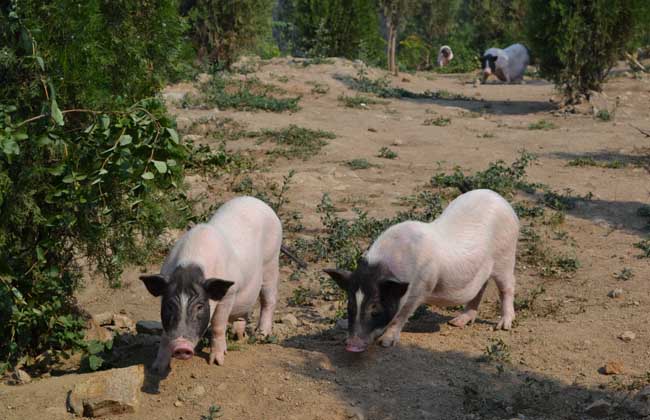
Xiang pigs, also known as mini pigs, are consistent with the modern lifestyle as a meat food, and they are comprehensively nutritious, rich in essential amino acids and trace elements for the human body. They are very suitable for making food for the elderly and fully meet the physiological needs and health requirements of the human body. Common breeds include Congjiang Xiang pig, Jianbai Xiang pig, Tibetan Xiang pig, Bama Xiang pig, and others. Let us take a look at the complete picture guide to Xiang pig breeds below!
Congjiang Xiang pig
The Congjiang Xiang pig is especially small in body size, with a relatively straight head, shallow and few wrinkles on the forehead arranged in an inverted "eight" shape, no hair whorls, and a ring of hairless eye circles around the eyes. The coat is black, sparse and glossy, and there are also a small number with white tail tips, four hooves, and forehead center. The skin is thin and the bones are fine, the mouth is round and pointed, the snout tip is pink or black, the ears are small and thin, extending slightly flat to both sides or slightly drooping, the body is short, the back and loin are broad and concave, the abdomen is large and round and touches the ground, the hindquarters are relatively plump, the limbs are thin and short, the forelimbs are straight, the hindlimbs are mostly lying, and there are 5 to 6 pairs of teats.
Jianbai Xiang pig
The Jianbai Xiang pig is a world-famous miniature pig and also a national second-class rare protected animal. It is mainly produced in the jungle mountain villages of Jianhe County, Qiandongnan Prefecture, Guizhou Province. Its main food is wild plants. It has attracted great attention from scientists because of its pork's unique fragrance, tenderness, pure naturalness, and lack of pollution. According to expert appraisal, the Jianbai Xiang pig is rich in essential amino acids and trace elements for the human body.
Tibetan Xiang pig
The Tibetan Xiang pig is also known as the ginseng pig. In the Gannan and Minxian areas of Gansu, it is also called the "juema pig" because it often roots for and eats juema. It is an ancient livestock resource unique to the western Sichuan plateau, Yunnan, Tibet, Gannan and Minxian in Gansu, and belongs to the external grazing type. Its main places of origin are Aba Prefecture and Garze Prefecture in Sichuan, Shangri-La in Yunnan, Nyingchi Prefecture in Tibet, and the Gannan and Minxian areas of Gansu.
Bama Xiang pig
The Bama Xiang pig originates from Bama Yao Autonomous County, Guangxi. It is a precious and rare local small pig breed with a long breeding history, stable genetic genes, and excellent quality. In March 1995, after Bama was named "Hometown of Chinese Xiang Pigs" by the National Special Products Economic Professional Committee, it was recorded in history as a local specialty. The Bama Xiang pig is wild in nature and precocious, with a delicate appearance, and a body that is short, small, short, and round. It is raised extensively and has strong adaptability and disease resistance. Breeding sows generally have a service life of eight years, with the longest reaching fourteen years.