How to Raise Budgerigars? A Detailed Guide to Care Methods
Parrots are admired and cherished by people for their beautiful feathers and their knack for learning human speech.
Lovebirds (peach-faced lovebirds), a bit larger than budgerigars, are extremely agile, extremely lively and curious, and possibly the most intelligent among parrots of cockatiel size and below, but they are fast and fierce, and once in breeding condition they become aggressive, attacking other parrots, especially after coming into season. Their calls are shrill, making them the noisiest of the small parrots. But! They are so incredibly cute! If you like blue and white, then Sky Blue, Platinum Grey Head, and Violet are better suited to you; look them up yourself, they are so cute, just fierce. Mine are a Yellow Peach and a Black Silver Top; the Yellow Peach was hand-raised and is extremely smart, while the Black Silver was paired later, fierce and extremely aggressive.
Pacific Parrotlets, similar in size to budgerigars, with short tails; common colors are green, blue and yellow, with prices increasing in that order. The featured image is a blue Pacific Parrotlet. The sex of Pacific Parrotlets is mainly determined by whether there are cobalt blue feathers on the back, a very beautiful color. They may be the quietest species among parrots, extremely well-behaved, gentle and docile, and in my personal opinion very suitable as pets. Blue Pacific Parrotlets seem to have a slightly worse temperament than green ones; this is personal experience and not certain.
Cockatiels, a size larger than the above species, are docile, well-behaved, quiet, adorably dorky, and their blush patches are explosively cute. They have good pet qualities, commonly available in two colors, Lutino and Normal Grey, with Albino being rarer and more expensive. The downside is that they have feather dust.
A few more points
1. The fun of parrots lies in their relatively high intelligence and good interactivity; a hand-tame parrot brings you no less fun than a cat or dog, so when buying a parrot it is best to buy one that was hand-raised and is tame. Among the above species, if you buy a cage-raised adult bird, only the Pacific Parrotlet and the Cockatiel, being docile, are relatively easy to gradually become tame and clingy; budgerigars are also possible but the odds are small, and for adult lovebirds I have not yet seen anyone raise one to be tame.
2. So how do you get a tame, hand-friendly bird? You can buy one that someone else has hand-raised until weaning, or you can buy a young bird and feed it yourself. For first-time parrot keepers the latter is not recommended; if you choose the challenge, please be sure to do your homework thoroughly and do not waste a life.
3. No matter which species you keep, please be sure to research diet, common diseases and basic care knowledge thoroughly before getting one. Keeping a pet means being responsible for it; getting one on a whim harms both people and bird. Small parrots cannot last more than a day or two when sick, so only with experience in handling common diseases and a loving heart can you raise a parrot well.
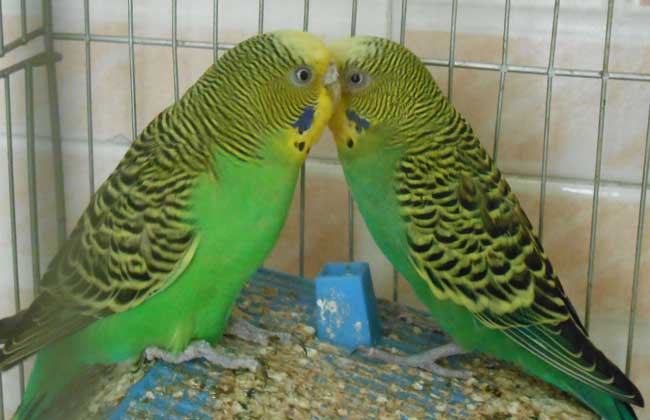
The budgerigar is a bird of the order Psittaciformes, family Psittaculidae, also known as the shell parakeet, zebra parakeet, parakeet, budgie and so on. It is lively in temperament and easy to tame, and is one of the most common and popular pet birds in China. It is often the first parrot bought by many people who have just become interested in parrots, and is also the species most often seen at bird shows. Let us take a look below at how to raise budgerigars!
Budgerigar Breeding Methods
1. Budgerigars usually reach sexual maturity at 4 months of age and begin coming into season in May and June; once fully in season they can breed. The male will feed the female, and the female may actively invite mounting, or the male may actively place his foot on the female's back to request mounting. They can breed throughout the year.
2. Budgerigars generally lay 4 to 10 eggs per clutch; the eggs are white, with 1 egg laid every day or every other day. When the third egg is laid the female begins sitting on the nest to incubate; incubation is mainly done by the female and lasts 18 days. Both parents feed the chicks together, and the brooding period is about 30 days. During incubation the female is fairly sensitive to outside disturbance, so keep the environment as quiet as possible to avoid the parents being startled and abandoning the nest, which would affect incubation and chick rearing.
3. For breeding in winter, the room temperature should be kept above 20°C with relative humidity of 45 to 50%, and indoor air circulation should be maintained. The peak breeding period can last 3 to 4 years, after which the breeding rate gradually declines. In order to purify and rejuvenate the breeding flock, breeding birds should be continually replaced. The average lifespan is 7 to 10 years.
How to Raise Budgerigars?
1. Prepare a sturdy, sufficiently large bird cage. The budgerigar's hooked beak is strong and powerful, and it prefers to gnaw on wooden things, so the cage prepared for a budgerigar cannot be made of wood but needs to be made of sturdy metal wire. Adult budgerigars are relatively large in size, so the cage should be prepared in a slightly larger size.
2. Budgerigars like to eat seeds with shells. When preparing food for them you need to consider their preferences and the nutritional content, and also make reasonable combinations. For example, you can usually give the parrot millet, glutinous millet, barnyard millet, Chinese cabbage, shredded carrot, apple and so on.
3. Budgerigars do not much like bathing; every time it is bath time they are extremely uncooperative, so unless absolutely necessary you can choose to use a spray to clean the parrot. Budgerigars have a coat of gorgeous feathers; to ensure the parrot's beauty and feather color, they must not be placed in direct sunlight.
4. Although budgerigars do not like bathing, the hygiene in their cage still needs to be cleaned promptly; generally clean the bottom of the cage once every 5 to 7 days. The food bowl and water vessels in the cage need to be cleaned every day to keep the parrot's feeding utensils clean and keep it away from harm by bacteria.
Points to Note When Feeding Budgerigars
1. Cuttlebone cannot just be taken from the market and fed directly; the best method is to soak it in water for two days to remove some of the fishy smell, then dry it in the sun. I have found that some large budgerigars (big-heads) with too strong a fishy smell also refuse to eat it.
2. Really do not give green vegetables every day; even the best big-head cannot stand it and will get diarrhea. My experience truly tells me this is so. Two or three times a week is enough, and it is best to feed on sunny days. Do not wash green vegetables, put them in the fridge and then take them out to give to the bird. Although green vegetables in the fridge do not rot easily, they will still breed a lot of bacteria after many days.
3. Eating too much hemp seed does indeed cause excess internal heat; one sign of excess heat is that the bird looks like it is vomiting and appears dull. The oats recommended to me by an expert are indeed good; feeding a little less of them together with millet is fine. Hulled millet is good for the bird to eat and good for the keeper to clean the cage, but in fact hulled millet mostly has its germ removed during machine hulling, so its nutrition is not as good as that with the hull. Also, when buying millet, do not assume that golden yellow is good; beware that it may have been dyed. This is not alarmist; it is what the old hands told me. Ordinary yellow, even yellow close to rice color, is the most natural, and even feeling a little fine powder to the touch is best.
4. Egg millet can absolutely be used regularly; do not always think of it as just something to bring on breeding condition. Add some vitamin-type nutrients (such as Centrum) mixed with egg yolk, and either shade-dry or simply oven-dry it. With more nutrition in the regular diet, you will find your bird really does become sturdier. My early big-heads all had good body size after birth, and besides baby fat, this was the effect of egg millet.
Feed for Budgerigars at Different Stages
1. Budgerigar chicks: after budgerigar chicks hatch, the mother bird loves most to give the chicks green vegetables. Therefore, it is suggested to feed green vegetables at 10 a.m. and 3 p.m. every day to ensure the chicks' intake of staple food. There is a certain trick to preparing feed for young parrots: you cannot just feed whatever they like to eat, but should combine multiple feeds reasonably.
① Egg millet: 1 kg of millet mixed with 4 egg yolks; the amount generally accounts for 40% of the total feed.
② Rice: rice with the husk still on is best; small parrots all like to eat the seed coat of rice, which can supplement starch, protein, trace elements and various vitamins, and can increase the beak's chewing ability. The amount generally accounts for 30% of the total feed.
③ Millet: generally accounts for 10 to 15% of the total feed.
④ Others: the remaining portion can be fed as hemp seed, barnyard grass seed, melon seeds and so on. According to practical experience, feeding 10 to 20 raw melon seeds per day is best.
2. Adult parrots: the mixed feed ratio for adult parrots is 7 parts millet or glutinous millet, 2 parts barnyard millet, 1 part perilla seed; this mixed grain feed is suitable for feeding many kinds of small parrots. In addition, feed mineral supplements such as cuttlebone and shells.
3. Homemade feed: pet stores now have many feeds produced by manufacturers, and their nutritional combinations are generally quite reasonable, so there is no need to mix them yourself. But if you usually like to make feed yourself, you must pay attention to reasonably configuring the nutritional components in the feed.
① Protein: protein is the main component making up a parrot's muscles, nerves, blood, skin, internal organs and feathers. The content is generally required to be around 15 to 30%, depending on actual needs. For example, young birds have a relatively large demand.
② Carbohydrates: carbohydrates are divided into nitrogen-free extract and crude fiber. If fiber is too high the nutritional value will be lower, slowing the parrot's growth; if too low it will slow intestinal activity. The general requirement is 3 to 5%.
Summary: If it is your first time keeping a parrot, you may not do everything perfectly, but the experience of caring for budgerigars is still gained from the actual process. As long as you care for budgerigars patiently and observe them carefully, believe that before long you too will become an expert keeper.