A Detailed Guide to Lovebird Breeding Methods and Precautions
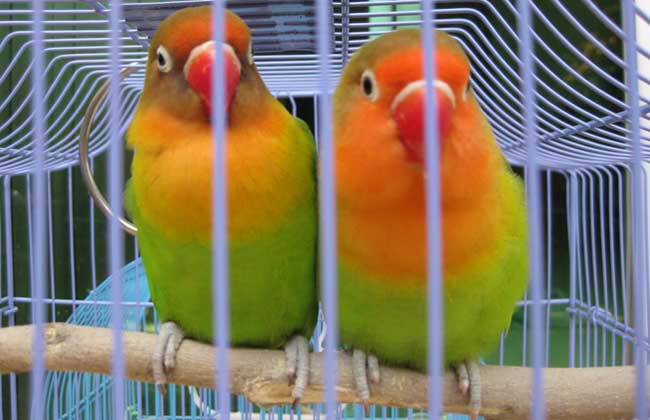
Lovebirds are also known as parrotlets, love birds, and so on. There are currently 9 varieties in China, and they are relatively precious captive-bred birds. Common varieties include the Fischer's lovebird, the yellow-collared black lovebird, the peach-faced lovebird, the small roseicollis lovebird, and the blue lovebird. Let's take a look at lovebird breeding methods together below!
Preparation for Lovebird Breeding
Lovebirds can breed 3 to 5 clutches per year, with autumn and winter being the best. In July and August, the nest box should be removed to stop breeding. Entering autumn, preparations for breeding should begin. Make a nest box from five-ply board, with dimensions of 20 cm * 20 cm * 30 cm, divided into upper and lower levels or left and right compartments, with a partition board in the middle having an entry-exit hole with a diameter of 7 cm. One side of the upper level has a round hole with a diameter of 6 cm connecting to the cage. Disinfect the prepared nest box in advance with 0.06% disinfectant solution or alkaline water, then dry it. Lay fine twigs, bark shavings, sawdust, or fine wood shavings at the bottom of the nest, and place it in a darker spot above the rear of the cage.
Feed Preparation for Lovebirds
During the lovebird breeding period, sufficient nutrition should be provided, increasing the proportion of eggs in egg millet so that it reaches 30%. Increase the proportion of oil seeds. If conditions permit, fresh millet and fresh corn can be added, and the proportion of additives should also be appropriately increased. In terms of management, reduce the frequency of cleaning the cage to once every two weeks, do not move the bird cage at will, keep the environment as quiet as possible, and do not easily peep at the parent birds and chicks. After 1 week, begin checking the eggs. If eggshells are found outside the nest, it proves that the chicks have hatched. To ensure breeding again next year and stronger offspring, the nest box should be removed after the breeding period, washed, and stored, and the proportion of oil seeds in the feed and eggs in egg millet should be reduced.
Lovebird Pairing Methods
Lovebirds reach sexual maturity at about 8 to 10 months of age and can then be paired. If both the male and female birds are in a strong estrus period, they can pair up in 3 days; generally it takes about 10 days. Soon the parent birds begin nest building, often with the female laying grass inside the nest and the male carrying grass outside. Sometimes the male also feeds some food to the female. The parent birds usually mate at 9 o'clock, 12 o'clock, or 15 o'clock. After mating, the female begins laying eggs about one week later. The first clutch is 3 to 4 eggs per clutch, and females over 1 year old lay 4 to 7 eggs per clutch. The incubation period of lovebirds is generally 20 to 23 days, mainly undertaken by the female, while the male is responsible for feeding. At night, the male also spends the night inside the nest box.
Raising Lovebird Chicks
Newly hatched lovebird chicks have no down on their bodies and rely on the female's body for warmth. The male forages outside the nest box and then enters the nest to feed the female, and the female then feeds the food to the chicks. The brooding period is about 30 days, but it takes another 10 days before the chicks can peck food on their own. Chicks within 10 to 12 days after hatching are very difficult to raise by hand, and only chicks older than 12 days have a chance of surviving hand-feeding. For artificial feeding, the feed can be chosen from millet powder, cooked egg yolk, green vegetable leaves, and so on. Cook the feed to about 70 to 80 percent done, add additives, grind it into a paste, shape it into small balls, and smear it into the bird's mouth. The feeding amount should be based on the crop becoming bulging, about 6 times per day.
Summary: During the lovebird breeding period, pay more attention to observation, such as whether the relationship between the male and female parent birds involves mating, entering the nest, nest-building behavior, incubation conditions, chick-feeding conditions, and whether the chicks can eat by themselves, and so on. Record promptly and grasp first-hand information. Only by continuously summing up experience can healthy young birds be bred.