How much does a lovebird cost? Market price analysis
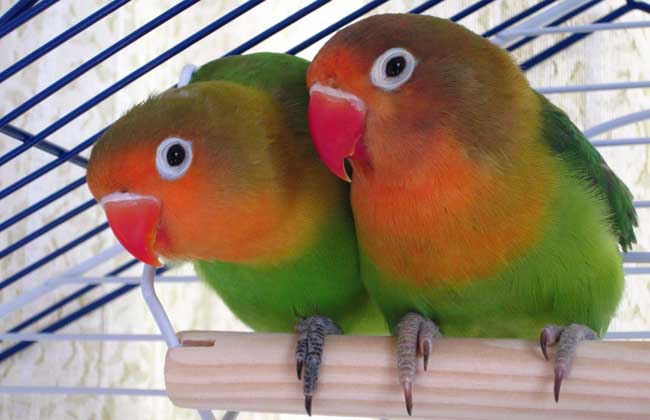
Lovebirds, also known as parakeet lovebirds, are a very cute small pet, usually kept in pairs, and are among the more precious parrot species. Because of their brilliant plumage, lively and cute nature, and intelligence, they are deeply loved by bird keepers. In China, three types are kept: the black-headed lovebird, the red lovebird, and the yellow-headed lovebird. Let's take a look below at how much a lovebird costs!
How much does a lovebird cost?
Lovebird prices are very affordable. The common brown-headed lovebird costs about 60 yuan per pair, the yellow peach-faced lovebird costs 80 yuan per pair for young birds and 120 yuan per pair for adults, the green black-headed and blue black-headed ones cost about 150 yuan per pair, the green peach-faced ones about 200 yuan per pair, while the violet (ink blue) lovebird, rainbow lovebird, golden silk-headed lovebird, white red-eyed lovebird, and purple-red lovebird are more expensive, generally rarely seen, and have no fixed price.
How do you choose a good lovebird?
When buying a lovebird, you must make sure the one you get is captive-bred rather than wild-caught. This is not only because of moral and conservation issues; wild-caught birds are usually prone to illness and death. Lovebirds are excellent pets, especially lovebirds hand-fed and raised from chicks. If they trust people, they can become very close to humans and will perch on a person's finger or shoulder. Very few lovebirds can talk, but if trained from a young age, they may be able to mimic human speech.
How to tell male from female lovebirds
1. Head shape: The male's head is occipital, pointed, and slightly smaller. The female's head is flat, smooth, and perfectly round, slightly larger than the male's.
2. Body shape: The male is lean, with tight feathers, active, and aggressive in temperament; the distance from the eye ring to the top of the head is greater, and the eyes appear smaller. The female is plumper, with slightly looser feathers, less active; the distance from the eye ring to the top of the head is shorter, and the eyes appear larger.
3. Tail feather tips: The male's tail feather tips are more pointed, forming a V shape. The female's tail feather tips are forked, forming a W shape.
4. Cloaca: The male's cloaca shows a small gap between the pubic bones and has a pointed protrusion (that is, a pointed object). The female's cloaca has a large gap between the two pubic bones; especially in adults, a middle finger can fit in, and it is flat with no protrusion. This method of identification is particularly accurate; an experienced person can correctly distinguish male from female even in young birds.
How do you best keep lovebirds?
1. Lovebirds mostly eat hulled millet and like hulled grains, but feeding only millet will leave the parrot undernourished, so a mix of many grains must be fed, such as rice, hemp seed, barnyard grass seed, sunflower seeds, red millet, black millet, yellow millet, safflower seed, sorghum, etc. Note that sunflower seeds should not be fed too much; feeding 10 to 20 raw sunflower seeds per day is best.
2. Besides grains, lovebirds should also eat some clean fruit and vegetables in moderation. Fruit should be cut into small pieces before feeding. Also be sure to supplement calcium for the parrot; you can buy some cuttlebone, or crush eggshells and mix them into the food, but pay attention to the amount of food. Do not keep the parrot too overweight, otherwise it will be difficult to breed.
3. Pay attention to cage hygiene and clean the parrot's droppings on time. You can spread some wood shavings or fine sand on the cage bottom to prevent bacterial and viral infections and reduce parasites. At the same time, pay attention to the cage's location; it should be placed in a quiet, undisturbed place, without environmental pollution, and with good air circulation and fresh air. Indoors is not suitable for keeping parrots. Because parrots like to bite the cage, you should also prepare a chewing stick for the parrot; ordinary wood will do, to prevent the parrot's hooked beak from growing longer and longer and starting to fight.
4. Chicks reach sexual maturity at about 6 months and can then breed, so prepare a wooden box or breeding box for the parrot. However, lovebirds do not breed in the hot summer; other seasons are all fine. Generally, the female lays 6 to 8 eggs per clutch, and the incubation period is about 19 days.
5. Lovebirds also need drinking water, but note that the water must be changed every day. If conditions allow, you can feed a little nutrient sand. Nutrient sand contains calcium, iron, many trace elements, and nutrients, which help strengthen bone solidity, make the plumage bright and beautiful, and supplement calcium.