What is the typical market price for an Alexandrine parakeet?
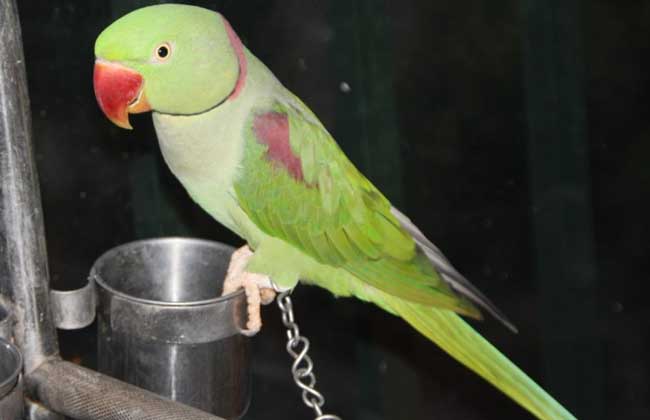
The Alexandrine parakeet is the largest long-tailed parrot in Asia, with a total of 5 subspecies. Its body length ranges from 56 to 62 cm depending on the subspecies, and its weight is 198 to 258 grams. Its distribution range is very wide, and its appearance is somewhat similar to the rose-ringed parakeet, but it is noticeably larger. It has a decent ability to learn to talk, and when kept in captivity it can be trained to learn some tricks. Let us take a look below at how much an Alexandrine parakeet costs!
How much does an Alexandrine parakeet cost?
The price of an Alexandrine parakeet is generally around 800 to 900 yuan each (about 38 cm), and a large great-billed one is around 1200 yuan each. Great-billed ones come in No. 1, No. 2 and No. 3, with the largest No. 1 at around 40 cm, No. 2 at around 30 cm, and No. 3 at around 20 cm. No. 2 is around 600 yuan each, and No. 3 is around 300 to 400 yuan each. The above are prices from relatively limited areas, and prices in other provinces and cities may fluctuate.
What food does the Alexandrine parakeet eat?
The Alexandrine parakeet mostly inhabits various dry and humid places below 900 meters above sea level, including forests, crop areas, mangroves, coconut plantations and other places, and occasionally also moves around in urban suburbs, parks and gardens. It usually moves in small flocks, and gathers in large numbers when food is abundant or when resting at roosting sites. Its natural food includes seeds from the wild and farmland, flowers, tender shoots of flowering trees, nectar, fruits, grains and vegetables. Foraging time is mainly in the morning and evening. In many areas the main food of the Alexandrine parakeet is crops, causing serious losses to farmers.
How should the Alexandrine parakeet be bred?
The breeding season of the Alexandrine parakeet is roughly between November and April. If captive-bred adult birds are purchased for breeding, the difficulty is not high. Provide a sturdy nest box; the higher the position of the nest box the better, and it is advisable for it to be somewhat deep. The Alexandrine parakeet is a very dutiful parent, and after a clutch of chicks is born they usually receive thorough care from the parents. During the breeding period, the parent birds must be provided with sufficient food. Breeding usually begins in February, with a clutch of 3 to 4 eggs, hatching after about 28 days, and the feathers growing in after 7 to 8 weeks. Hand-raised Alexandrine parakeet chicks can become very good pets.
How should the Alexandrine parakeet be kept?
1. The Alexandrine parakeet is very active and has a strong biting force, so it is not suitable to be kept mixed with other varieties of parrots. Maintaining cleanliness and hygiene is very important for the bird's health, so it should be bathed frequently, and in addition it should be dewormed regularly. Newly purchased birds should be kept warm, and must not be placed in an environment below 10°C.
2. The Alexandrine parakeet is not a picky eater. As for feed, seeds (such as sunflower seeds and pumpkin seeds), hard-shelled nuts (such as Bacon nuts, walnuts and hazelnuts), wheat, paddy rice, peanuts and commercially available synthetic pellets can all serve as staple food. In addition, giving some green vegetables, apples, papaya, tomatoes and other fruits and vegetables daily as a supplementary food is also very helpful for its health. If egg powder and dried wheat bran can be given regularly, it is also very helpful for the bird's growth.
3. The correct diet for the Alexandrine parakeet should be based on grains, beans, corn and so on as staple food, with more vegetables and fruits as supplementary food. Foods with higher oil content such as sunflower seeds can only be used as rewards and prizes during playtime. Sex characteristics do not appear until around 2 years of age. The male Alexandrine has a red neck ring on its neck, while the female does not.