How long do lovebirds live? How many years can they generally live?
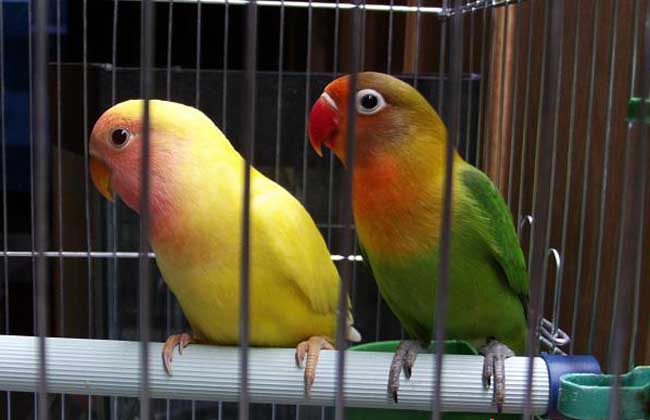
Lovebirds are also known as parakeet lovebirds, love birds, etc. They are relatively precious captive-bred birds with gorgeous feathers and are deeply loved by bird keepers. In China, three types are kept: the black-headed lovebird, the red lovebird and the yellow-headed lovebird. They mainly feed on grass seeds, berries, fruits, young plant shoots and so on on the ground. Now let us take a look at how long lovebirds live!
How long do lovebirds live?
The lifespan of lovebirds is 12 to 15 years, and with good care, lovebirds can occasionally live as long as 20 years.
Can lovebirds talk?
Lovebirds cannot talk. The birds that can generally mimic speech (not only human words, but also cat meows and so on) include the African grey parrot, macaw, cockatoo, crested myna, hill myna and so on. Lovebirds are a small parrot species and cannot mimic speech, but lovebirds can imitate the calls of other birds and animals, as well as sounds they find interesting.
Common types of lovebirds
1. Lilian's lovebird: The Lilian's lovebird is native to Tanzania in Africa, with a body length of about 14 cm. The back, wings, lower abdomen and chest are dark green, the forehead is red, the throat is yellow-orange, the neck and upper chest are pale yellow-orange, the rump is dark blue, the outer tail feathers have blue, green and black feathers, the beak is red, the feet are grey, and there is a bare white eye ring around the eyes.
2. Black-cheeked lovebird: The black-cheeked lovebird is native to southern Africa. Its plumage is mainly green, with a red forehead and head, pale peach face and chest, and blue rump and upper tail. Its colors are relatively vivid.
3. Fischer's lovebird: The Fischer's lovebird is native to central Africa. Its plumage is mainly bright yellow, with a red crown, pink head and cheeks, yellow feet and beak, and a whitish tail. Its colors are vivid.
4. Blue lovebird: The blue lovebird is an improved breed, similar in size to other lovebirds. Its plumage is mainly blue, with a pale black or dark grey head, white or brown neck, chest and upper abdomen, a pale peach-red beak, grey feet, and a white fleshy ring around the eyes. Due to different degrees of improvement, offspring may also show phenomena such as dull plumage, poor blue intensity and poor color quality. At present, the blue black-headed lovebird has the highest price, and a purebred pair can sell for up to over a thousand yuan.
How do you best keep lovebirds?
1. Lovebirds mostly eat hulled millet and like hulled grains, but feeding only millet will leave the parrot undernourished, so a mix of multiple grains must be fed, such as rice, hemp seed, barnyard grass seed, sunflower seeds, red millet, black millet, yellow millet, safflower seed, sorghum and so on. Note that sunflower seeds should not be fed too much; feeding 10 to 20 raw sunflower seeds per day is best.
2. Besides grains, lovebirds should also appropriately eat some clean fruits and vegetables. Fruits should be cut into small pieces for feeding. Also note that the parrot needs calcium supplementation; you can buy some cuttlebone, or mix crushed eggshell into the food, but pay attention to the amount of food. The parrot should not be kept too obese, otherwise it will not breed easily.
3. Pay attention to cage hygiene and clean the parrot's droppings on time. Wood shavings or fine sand can be spread at the bottom of the cage to prevent bacteria and virus infection and reduce parasites. At the same time, pay attention to the cage location; it should be chosen in a quiet, undisturbed place, with no environmental pollution, and attention should be paid to air circulation and freshness. Indoors is not suitable for keeping parrots. Because parrots like to bite the cage, you should also prepare a tooth-grinding stick for the parrot; ordinary wood is fine, to prevent the parrot's hooked beak from growing longer and longer and starting to fight.
4. When young birds are raised to about 6 months old, they reach sexual maturity and can breed, so a wooden box and breeding box should be prepared for the parrot. However, lovebirds do not breed in the hot summer; other seasons are all fine. Generally, the female bird lays 6 to 8 eggs per clutch, and the incubation period is about 19 days.
5. Lovebirds also need drinking water, but note that the water must be changed every day. If conditions permit, you can feed a little nutrient sand. Nutrient sand contains calcium, iron and many trace elements and nutrients, which help strengthen bone firmness, make the feather color bright, and supplement calcium, etc.