Key Technical Points and Detailed Methods for Golden Coin Turtle (Three-striped Box Turtle) Farming
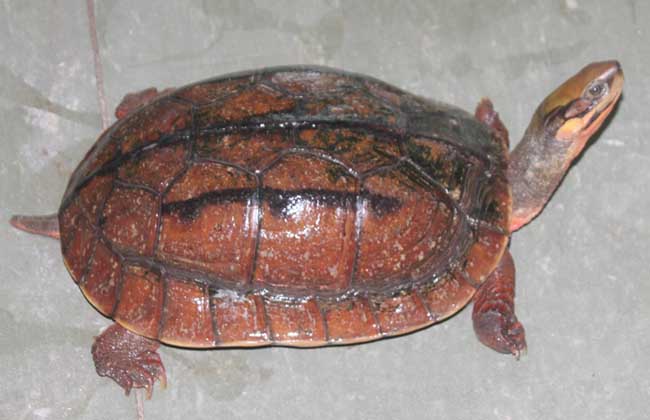
The Golden Coin Turtle, scientifically named Cuora trifasciata (the three-striped box turtle), also known as the red-edged turtle, golden-headed turtle, or red-bellied turtle, is a traditional Chinese medicinal material. Because the Golden Coin Turtle is extremely scarce in resources, sells extremely well on international and domestic markets, and commands a relatively high market price, the economic returns from artificial farming of the Golden Coin Turtle are considerable. The techniques for indoor small-scale farming of the Golden Coin Turtle are introduced below.
Preparation and Disinfection of the Farming Pond
The Golden Coin Turtle farming pond is built indoors, generally a rectangular cement pond with an area of about 1.0 sq m to 10.0 sq m and a wall height of 1.0 m to prevent the Golden Coin Turtles from escaping. The bottom and inner surfaces of the walls are smooth, and one end of the pond bottom (2/3) is sloped at 15 degrees, with a water storage depth of about 35.0 cm at the deep end, and a drainage outlet is installed. After the Golden Coin Turtles are stocked, some shelters are placed irregularly in the pond to simulate the natural environment of the wild, allowing the Golden Coin Turtles to grow in a quiet and comfortable state. Before stocking the Golden Coin Turtles, thoroughly disinfect the farming pond with a bleaching powder aqueous solution at a concentration of 100 mg/L for 12 hours, then discharge the medicated liquid out of the pond and rinse the residual medicated liquid in the farming pond clean with clean water.
Stocking of Hatchlings
Select artificially bred and cultivated Golden Coin Turtle hatchlings with an average body weight of more than 30 g that are lively, healthy, quick to react, and of good physique, and stock them at a density of 3 turtles/sq m to 8 turtles/sq m. The same farming pond is required to be stocked with hatchlings of basically the same size, and stocked all at once, and farmed in the same pond until the adult turtles are ready for market.
Feed Selection and Feeding
The feed for raising Golden Coin Turtles is divided into two major categories: animal-based feed and plant-based feed. For animal-based feed, choose lean pork, animal offal, fish, shrimp, shellfish meat, etc.; for plant-based feed, choose bananas (peeled) and apples, etc. Feeding is mainly based on animal-based feed, with the two types of feed used alternately, and the number of plant-based feed feedings is about 1/7 of the number of animal-based feed feedings. From observing the eating situation of the Golden Coin Turtles, it can be seen that the Golden Coin Turtle most prefers the lean pork of animal-based feed and the banana of plant-based feed. When feeding, the feed should be chopped up. When the indoor temperature is below 25 degrees and above 30 degrees, feed once each at 9 a.m. and 6 p.m. daily. The daily feeding amount accounts for 5% of the Golden Coin Turtle's body weight, and should be adjusted at any time according to the actual eating situation, with each feeding amount being based on finishing the food within 1 hour after feeding. After feeding for 1.5 hours, remove the residual feed and wash and wipe the feeding platform.
Selection of Water Source and Regulation of Water Quality
For Golden Coin Turtle farming, clean river water, reservoir water, well water, or tap water can be selected as the water source, but well water and tap water are best left to sun-expose in an outdoor storage tank for more than 2 days before use. During the Golden Coin Turtle farming process, water quality needs to be regulated by changing the water. When the temperature is relatively suitable, change the water once a day. When the temperature is relatively high in summer and autumn, change the water 2-3 times a day, each time completely changing all the water in the farming pond, and use a rubber hose to spray water to wash the entire farming pond clean; and use a shower method to simulate artificial rainfall to increase the Golden Coin Turtle's appetite. When the temperature is relatively low in winter and spring, change the water once every 2-3 days, with the water change amount being the same as the entire pond water.
Adjusting Light and Temperature Properly
By artificial means, electric light bulbs are hung above the farming pond to regulate light and temperature. In summer and autumn during the day, use 25 W-40 W electric light bulbs as the light source to improve the lighting conditions of the indoor farming pond; the operation method is to turn on the lights for 8 hours during the day and turn them off at night. If the indoor temperature exceeds 32 degrees, turn on the indoor ceiling fan to lower the indoor temperature. When the morning and evening temperatures in spring and autumn are below 25 degrees, use 40 W-60 W electric light bulbs as a heat source for heating. When the winter temperature is below 15 degrees, switch to 60-100 W electric light bulbs as a heat source, keep the lights on day and night, and keep the variation range at 20 degrees-30 degrees.
Doing a Good Job in Disease Prevention and Control
In order to prevent the Golden Coin Turtle from developing diseases during the farming process, preventive work must be done well. The specific methods are: every 2 weeks, use a 10 mg/L bleaching powder solution or 2% salt water to soak and wash the entire pond and shower the turtle body for 5 minutes-10 minutes to prevent and control common bacterial diseases; use concentrated kelp to soak or shower the turtle body for 5-10 minutes to prevent and control the occurrence of goiter disease in the Golden Coin Turtle. In particular, when it is found that the Golden Coin Turtle's appetite has decreased and its movements are sluggish, soaking the turtle body in concentrated kelp extract for 10 minutes can increase the Golden Coin Turtle's appetite, with very good disease prevention effects. Feed oxytetracycline medicated bait once a week, that is, mix oxytetracycline powder into minced lean pork, with the dosage calculated as adding 1/5 tablet of oxytetracycline per 100 g hatchling. Once a week, place the Golden Coin Turtle in an outdoor dry sand pond (pay attention to preventing escape) to sun its back once; sunning the back at 9 a.m.-10 a.m. when sunlight is plentiful is better; in summer and autumn, sun the back for 20 minutes-30 minutes each time, and in winter and spring, sun the back for 30 minutes-60 minutes each time. Through sunning the back, it not only plays a sterilizing role, but also creates conditions for the vitamin D on the turtle body surface to convert into vitamin D, enhancing the turtle body's disease resistance.