Golden Coin Turtle Pictures: A Complete Collection, High-Definition Live Shots to Enjoy
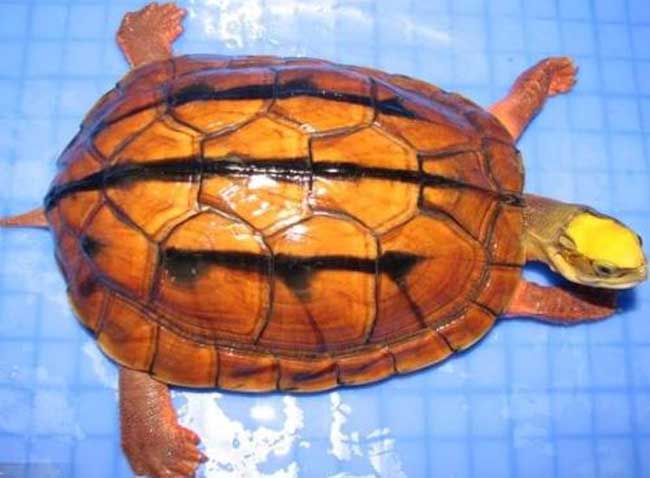
The Golden Coin Turtle is a species in the family Geoemydidae. Its head is smooth and scaleless, the tympanum is distinct and round, the cervical scutes are narrow and elongated, the first vertebral scute is pentagonal, the fifth is fan-shaped, and the remaining 3 are triangular. There are 4 costal scutes on each side and 11 marginal scutes on each side. The carapace is brown with three distinct raised black longitudinal lines, of which the middle one is the most prominent and the longest, so it is also called the "Chuan-Zi-Back Turtle". The plastron is black, and its marginal scutes are tinged with yellow. The carapace and plastron are connected on both sides by ligaments, and the plastron is transversely divided; the plastron is also connected between the pectoral and abdominal scutes by a transverse ligament, so it is also called the "Broken-Plastron Turtle". There are webs between the fingers and toes, and the tail is short and pointed. The firm skin around the edge of the carapace is golden tangerine yellow, so it is also called the "Red-Edged Turtle".
The female's carapace is relatively wide, the tail is thin and short, the base of the tail is thin, the anus is relatively close to the rear edge of the plastron, and the notch formed by the 2 anal scutes of the plastron is relatively shallow. Individuals are usually larger than males. The male's carapace is relatively narrow, the tail is thick and long, the base of the tail is thick, the anus is relatively far from the rear edge of the plastron, and the notch formed by the 2 anal scutes of the plastron is relatively deep.
Each scute of the carapace of a wild Golden Coin Turtle has clear, dense concentric rings, called growth annuli. Each ring represents one year, while the concentric rings of captive-bred turtles are rather blurry and sparse, and the distance between each ring is relatively large.