A Detailed Guide to Selecting Yellow-Margined Box Turtles: Teaching You How to Pick a Good Turtle
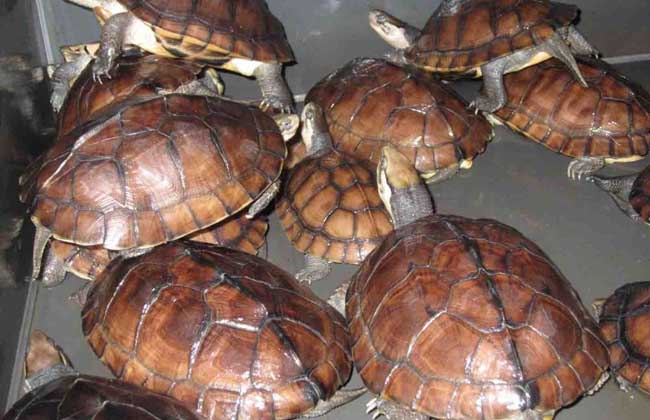
Artificially bred yellow-margined box turtles have the characteristics of relatively fast growth, few diseases, easy farming, small investment, convenient management, and high economic returns, and have gradually developed into an emerging industry for adjusting and optimizing the rural industrial structure and increasing people's income. Buying high-quality yellow-margined box turtles is the key to ensuring that farmers have long-term stable income from turtle farming. Let's take a look below at how to select yellow-margined box turtles!
How to Distinguish Southern and Northern Yellow-Margined Box Turtles
1. Look at shell color: The shell color of southern-strain yellow-margined box turtles is generally yellow, black, or bronze, while the shell color of northern-strain yellow-margined box turtles is generally cyan, green, or yellow-green.
2. Look at head color: The head color of southern-strain yellow-margined box turtles is generally gray-black, yellow, or bronze, and some southern-strain yellow-margined box turtles may also have some small black speckles on the head, commonly known as “plum blossom spots” (but not all southern-strain yellow-margined box turtles have “plum blossom spots” on the head). The head color of northern-strain yellow-margined box turtles is cyan or green, with no small black speckles on the head.
3. Look at the marginal scutes: When viewed from top to bottom, the marginal scutes in the middle of the carapace are generally visible on southern-strain yellow-margined box turtles, while the marginal scutes in the middle of the carapace are generally not visible on northern-strain yellow-margined box turtles.
4. Look at the black patches: The black patches on the plastron of southern-strain yellow-margined box turtles are generally relatively large and clear, while the black patches on the plastron of northern-strain yellow-margined box turtles are generally relatively small (or even absent) and blurry.
5. Look at the eye line: Southern-strain yellow-margined box turtles generally have a black line in the center of the eyeball (the black line may be long or short, dark or light), while northern-strain yellow-margined box turtles generally do not have a black line in the center of the eyeball.
How to Select Yellow-Margined Box Turtle Hatchlings
1. Try to choose yellow-margined box turtle hatchlings with relatively good physique. Choose hatchlings that are lively and active, quick to react, physically sound, and healthy. Overall, the body should be healthy, the body shape should be sound, and the shell shape should be symmetrical and attractive.
2. Then look at the arrangement of the vertebral scutes of the yellow-margined box turtle hatchling. All five vertebral scutes must be neatly arranged; only such yellow-margined box turtle hatchlings will not become deformed after being raised to adulthood.
3. After choosing the shell shape, check whether the body is plump. So-called plumpness can actually be understood as whether the turtle is robust. A plump yellow-margined box turtle indicates that it has stored enough nutrients in its body, which provides enough energy for the turtle to hibernate under severe cold conditions in nature.
How to Select Yellow-Margined Box Turtle Breeding Stock
1. Buy purebred Vietnamese-strain yellow-margined box turtles: Yellow-margined box turtles are divided into Vietnamese-strain yellow-margined box turtles and northern-strain yellow-margined box turtles. The value, price, and farming profit of purebred southern-strain yellow-margined box turtles are all much higher than those of northern-strain or hybrid yellow-margined box turtles. Therefore, when purchasing, you must select purebred Vietnamese-strain turtles accurately, and never buy northern-strain yellow-margined box turtles or hybrid yellow-margined box turtles as Vietnamese-strain yellow-margined box turtles.
2. Buy first-generation Vietnamese-strain yellow-margined box turtles: First-generation yellow-margined box turtles are yellow-margined box turtles hatched from eggs laid by wild yellow-margined box turtle breeding stock (native generation). Second-generation yellow-margined box turtles are hatched from eggs laid by first-generation yellow-margined box turtles. Third-generation yellow-margined box turtles are hatched from eggs laid by second-generation yellow-margined box turtles. The remaining generations of yellow-margined box turtles follow the same pattern. First-generation yellow-margined box turtles have a high degree of population purity, high quality, and a high survival rate, and are the best choice for farmers purchasing breeding stock. Compared with first-generation yellow-margined box turtles, second-, third-, and fourth-generation yellow-margined box turtles have lower population purity and lower quality and are only suitable as commercial turtles. This is because the genetic inheritance of yellow-margined box turtles is inversely proportional to the number of generations; the closer the generation is to the native generation (wild turtle stock), the higher the inheritance of native-generation genes, and the higher the purity and quality of the yellow-margined box turtle.
3. Buy wild-simulated Vietnamese-strain yellow-margined box turtle breeding stock: Only under wild or wild-simulated conditions can yellow-margined box turtles maintain their original natural growth patterns and growth and reproduction functions. Commercial yellow-margined box turtles eat a lot and grow quickly; their original growth patterns and physiological systems are completely disrupted, reproductive function is disordered, and reproductive organs are artificially forced to maturity, directly shortening the egg-laying period and lifespan, and they quickly enter the culling period when they no longer lay eggs. In other words, wild breeding stock and wild-simulated breeding stock have the longest lifespan and egg-laying period and are most suitable for breeding and reproduction, while commercial turtles are not suitable as breeding stock and are only suitable for making soup, cooking, eating, and medicinal use. However, wild yellow-margined box turtle breeding stock is already very scarce at present, so the only option currently available for breeding and reproduction is wild-simulated breeding stock.
4. Buy healthy yellow-margined box turtles: The health of yellow-margined box turtles is the foundation of successful farming. You must choose and buy healthy yellow-margined box turtle breeding stock to ensure the survival rate and success rate of farming. Otherwise, if sick turtles are bought as healthy turtles, it will directly lead to economic losses and undermine the confidence of farmers.
5. Buy yellow-margined box turtles priced per turtle: Under normal circumstances, yellow-margined box turtle breeding stock should be priced by quantity and quality, because the purpose of raising breeding stock is breeding and reproduction, and the indicators reflecting the strength of reproductive function are the quantity and quality of offspring (hatchlings), not weight. Correspondingly, yellow-margined box turtle commercial products (meat turtles) are priced by weight, because the purpose of raising turtle commercial products (meat turtles) is consumption, and the indicator reflecting the strength of the turtle's food-use function is its individual weight. Therefore, for yellow-margined box turtles sold priced by weight, you should guard against sellers selling meat turtles intended for consumption as breeding stock. At the same time, if turtles are sold priced by weight, the seller will overload the yellow-margined box turtles with food or inject them with water (inject liquid into the body) to increase weight, which will ultimately cause the yellow-margined box turtles to die after being bought back.
6. Buy yellow-margined box turtles with a quality guarantee certificate: A quality guarantee certificate is the guarantee of the quality of yellow-margined box turtles. If the seller does not provide a quality guarantee certificate, the quality of the turtles cannot be guaranteed, so do not buy them.
7. Buy yellow-margined box turtles with professional technical services: Professional farming technology is the key to ensuring successful farming and profitability. If the seller cannot provide professional yellow-margined box turtle farming technology, they cannot help the buyer solve the farming technology problems encountered after buying the turtles back, cannot ensure successful farming, and may even lead to losses. Therefore, do not buy yellow-margined box turtles that do not come with supporting professional farming technology.