What do stone frogs eat? A detailed explanation of the stone frog's diet
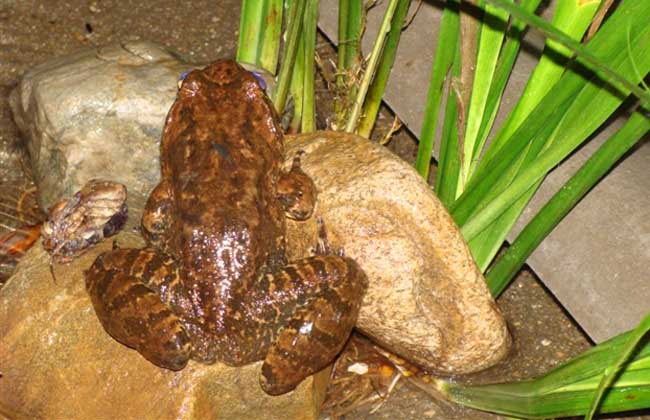
StoneFrogAlso known as stone clam, stone chicken, mountain chicken, stone jelly, flying fish, stone scale, stone toad, stone shrimp toad, stone pit frog, stone luan, etc., it is an amphibian of the order Anura, family Ranidae. It has long been highly regarded for its tender meat, delicious taste, unique nutritional components, and medicinal health value. Let's take a look below at what stone frogs eat!
What do wild stone frogs eat
The newly hatched stone frog tadpoles, still enclosed in the egg membrane, rely on the yolk sac for nutrition for 4 to 5 days. Once the yolk is consumed, they begin to forage. In the young frog stage, their food consists mainly of mosquitoes, small insects, and insect larvae. By the adult frog stage, their food range is very broad. In a dissection study of 47 adult frogs, 57 kinds of food were found in the stomach and intestines, such as insects, centipedes, spiders, millipedes, snails, river clams, shrimp, crabs, miscellaneous fish, loach, as well as earthworms, young snakes, small birds, and more.
What do farmed stone frogs eat
After stone frog tadpoles break out of the egg membrane, they rely on the energy in the egg for the first 3 days to gradually grow. Ten days after birth, the small tadpoles feed on egg yolk, soybean milk, and similar foods. After 20 days of age, they are gradually switched to cooked plant-based and algae-based feed, such as stems and leaves of tuber crops, fruits and leaves of melons, rice, and tender fresh aquatic plants. Young frogs are mainly fed active feed such as small maggots, small yellow mealworms, and small earthworms. Adult frogs mainly eat earthworms, yellow mealworms, maggots, and so on.
Growth habits of the stone frog
1. Living environment: Stone frogs often inhabit the vicinity of clear water pits on shaded hillsides or near waterfalls with stone caves. They like to live in burrows under damp, quiet, dimly lit mountain rock walls close to water sources. Ordinarily, the frog often crouches at the entrance of a stone cave or raises its head above the water surface to breathe and forage. If disturbed, it quickly retreats into a stone cave, under a rock or cliff, or into the water. It has the habit of living in groups and foraging at night. Night is the peak period of activity. It is good at jumping and climbing. Ordinarily its activity is relatively weak and steady. During the peak breeding period, it is frequently active and exhibits behaviors such as calling and amplexus.
2. Feeding habits: Stone frogs prefer to eat moving animals and do not eat dead or motionless food. In the natural state, they like to eat live bait such as earthworms, maggots, grasshoppers, ants, loach, river crabs, and mole crickets. Their taste receptors are well developed and play an important role in their feeding behavior. The sensory cells on the retina are especially sensitive to moving objects; living animals are their feeding targets, while they are insensitive to dead objects and show no feeding behavior. During the tadpole stage, they feed on tender green aquatic algae or soft, delicate animal and plant matter. In artificial rearing, feed such as egg yolk, tofu, barley, rice, and silkworm pupa powder and their compound feeds can be provided. The time of feeding activity is affected by the climate and environment.
3. Hibernation habits: The stone frog is a cold-blooded poikilothermic animal. It has no ability to regulate body temperature or retain heat, and its body temperature changes with the outside temperature. The generally suitable growth temperature is 19-26°C. Spring and autumn are the seasons when it is most frequently active, has the largest food intake, and grows most rapidly. April to June and August to September are the best periods for reproducing offspring. When the water temperature exceeds 30°C, the skin loses a large amount of water through evaporation, making the frog feel uncomfortable, and its feeding activity decreases. When the water temperature drops to 10°C, metabolism becomes very weak, and it enters hibernation, with both eyes tightly closed, not eating or moving, relying on fat bodies to maintain life activities, and not reacting to external stimuli. If the water temperature rises to a suitable level, it will come out and become active again. The hibernation period is about 4 months, and after hibernation its body weight will decrease moderately.
4. Egg-laying and reproduction: Stone frogs generally begin to come into heat in April. The male frog's continuous calls attract female frogs to come and enter amplexus. During amplexus, the male and female frogs press their bellies together and embrace. The male frog uses its forelimbs, which have nuptial pads, to tightly clasp the female frog under the armpits, with its chest and belly pressed tightly against the female's belly. After amplexus, the male frog begins to release sperm, and at the same time the female frog is stimulated and ovulates. Each spawning produces 1000-3000 eggs. The eggs and sperm meet in the water for external fertilization. After the sperm and eggs are fertilized, they form egg masses. The eggs are often laid in shallow water with a gentle current and attach to stones and aquatic plants. The outer gelatinous membrane of the eggs is thick and highly adhesive, sometimes connecting into cords or grape-like clusters about 20 cm long. The eggs are generally 4 mm in diameter, with a maximum of 5 mm.
5. Metamorphosis and development: Frog eggs usually hatch into tadpoles in 8-20 days. Tadpoles like to live in large stone crevices or gravel piles in stream pools. In a suitable environment, they generally undergo growth and metamorphosis into young frogs after 60-75 days.