What are the growth habits of the stone frog? A full guide in one article
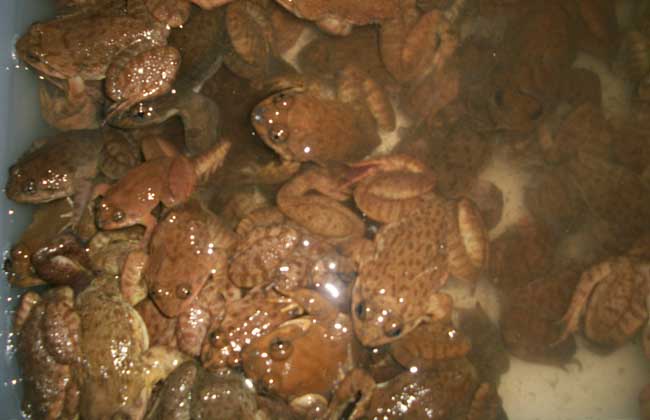
StoneFrogIt often lives beside clear water pools on shaded hillsides or near waterfalls with stone caves, and likes to burrow under damp, quiet, low-light, cool rock walls close to water sources. Normally the frog rests at the entrance of a stone cave or pokes its head above the water to breathe and forage; if disturbed, it quickly dives into the stone cave, under the rocks or rock walls, or into the water. The stone frog has the habit of living in groups and foraging at night, often with several or dozens of stone frogs piled together sharing one spot. In a quiet and suitable environment, it also comes out of its cave to forage during the day, while night is the peak period of activity. It is good at jumping and climbing; normally its activity is weak and steady, but during the peak breeding season it is highly active, with behaviors such as calling and amplexus.
The feeding habits of the stone frog
The stone frog likes to eat moving animals and does not eat dead or motionless food. In the natural state, it likes to eat live prey such as earthworms, maggots, grasshoppers, ants, loaches, river crabs and mole crickets. Its taste receptors are well developed and play an important role in its feeding behavior. The sensory cells on the retina are especially sensitive to moving objects; live animals are its feeding targets, while it is insensitive to dead objects and shows no feeding behavior toward them. During the tadpole stage it feeds on tender green aquatic algae or soft, fine animal and plant matter. In artificial rearing it can be fed egg yolk, tofu, barley, rice, silkworm pupa powder and other baits, as well as their compound feed. The feeding activity time of the stone frog is affected by the climate and environment. Under natural conditions its feeding activity period is from March to November. After Qingming in the lunar calendar a few frogs come out of their caves and begin to feed. From April to June the temperature is suitable and feeding increases. In July and August the temperature is too high, feeding activity decreases, and during the day most hide in caves, coming out to feed gradually in the evening and at night. From September to October the temperature drops from high to low, and the amount of feeding increases relatively again. After November feeding activity gradually decreases. When the outside temperature drops below 10°C, it stops feeding and enters hibernation.
The hibernation habits of the stone frog
The stone frog is a cold-blooded poikilothermic animal; it has no ability to regulate body temperature or retain heat, and its body temperature changes with the outside temperature. Generally speaking, the suitable growth temperature for the stone frog is 19-26°C. Spring and autumn are the seasons when it is most active, eats the most and grows fastest. April to June and August to September are the best periods for reproducing offspring. When the water temperature exceeds 30°C, a large amount of water evaporates from the skin, making it uncomfortable and reducing its feeding activity. When the water temperature drops to 10°C, metabolism becomes very weak and it enters hibernation. During hibernation, both eyes are tightly closed, it neither eats nor moves, and relies on fat bodies to maintain vital activity, showing no response to external stimuli. If the water temperature rises to a suitable level during hibernation, it will come out and become active again. This usually lasts about 4 months, and after hibernation its body weight decreases moderately.
The developmental process of the stone frog
The stone frog generally begins estrus in April. The male frog keeps calling to attract the female frog to come for amplexus. During amplexus, the bellies of the male and female frogs press together as they embrace. The male frog tightly clasps the female frog under the armpits with its forelimbs, which bear nuptial pads, and its chest and belly press closely against the female's belly. After amplexus the male frog begins to release sperm, and at the same time the female frog is stimulated and ovulates, releasing 1000-3000 eggs each time. The eggs and sperm meet in the water for external fertilization, and after fertilization the sperm and eggs form egg masses. The eggs are often laid in gently flowing shallow water, attached to stones and aquatic plants. The outer gelatinous membrane of the eggs is thick and strongly adhesive, sometimes linked into cords or clusters like bunches of grapes, reaching about 20 cm in length. The eggs are generally 4 mm in diameter, with a maximum of 5 mm. The frog eggs usually hatch into tadpoles in 8-20 days. The tadpoles like to live in large stone crevices or gravel piles in stream pools. In a suitable environment, they generally grow and metamorphose into young frogs after 60-75 days.