Stone Frog Breeding Technology Video Tutorial, Detailed Explanation of Scientific Breeding Methods
StoneFrogAlso known as the stone chicken, it is distributed in China's Jiangsu, Zhejiang, Anhui, Jiangxi, Fujian, Guizhou, Guangdong, Guangxi and other provinces. It is a large edible frog in China, with plump and strong legs, delicious meat, and cooling and nourishing properties. It is rich in high protein and vitamins A, B1, B2, C and nicotinic acid, and has high edible value and breeding prospects. Now let us take a look at the stone frog breeding technology video!
Growth Habits of the Stone Frog
The stone frog likes to live in burrows under damp, quiet, dim, cool mountain rock walls near water sources. It has the habits of living in groups and foraging at night. Night is the peak period of activity. At ordinary times its activity is relatively weak and steady. During the peak breeding period, it is frequently active and exhibits behaviors such as croaking and amplexus. It likes to eat live bait such as earthworms, maggots, grasshoppers, ants, loaches, river crabs and mole crickets. It is a cold-blooded poikilothermic animal. When the water temperature drops to 10°C, it enters hibernation, and the hibernation period is about 4 months. After hibernation, its body weight will decrease moderately. Generally, it begins to be in heat in April, and each spawning amount is 1000-3000 eggs. The frog eggs usually hatch into tadpoles in 8-20 days. Tadpoles like to live in large stone crevices or gravel piles in stream pools. In a suitable environment, they generally undergo growth and metamorphosis into young frogs after 60-75 days.
Construction of Stone Frog Breeding Ponds
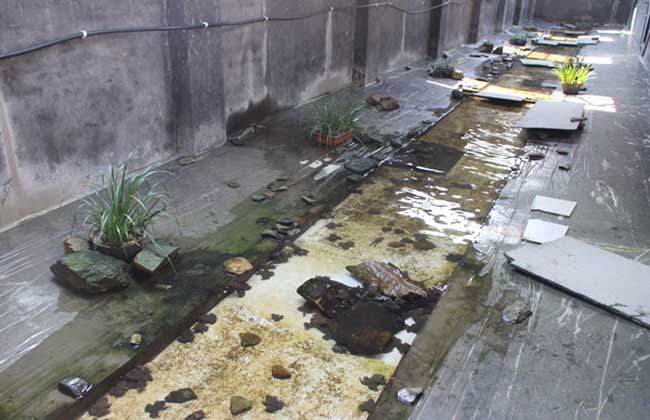
1. Breeding frog pond: The area is generally preferably 4-10 sq m, the pond height is 0.8 m, the water depth in the pond is 0.1-0.15 m, the water-to-land area ratio in the pond is 3:1, and stone caves for resting are provided. The bottom of the pond is paved with relatively large pebbles, the light is dim, and the humidity is maintained at 80%, creating an ideal ecological environment for stone frogs to inhabit, promoting their growth and development, and thereby increasing the spawning rate and fertilization rate.
2. Hatching pond: The area is 1 sq m, the pond height is 0.5 m, the water depth is 15-20 cm, the water quality is fresh, pH 6-8, and it only needs to contain sufficient oxygen. A large oval basin can also be used instead.
3. Tadpole pond: The area is 3-8 sq m, the pond height is 0.8 m, the water depth is 3-10 cm, pH 6-7, the water-to-land ratio is 2:1, and shading is required for rearing. It is best to rear one group of tadpoles of the same size in each pond.
4. Young frog pond: The area is 4-6 sq m, the pond height is 0.8 m, the water depth is generally 10-15 cm, the water-to-land ratio is 2:1, the pond is paved with 3-5 cm small stones, and stone caves are built. The water quality is good, and the pH value is 6-7.5.
5. Other requirements: The shape of various stone frog ponds is preferably rectangular, the pond bottom is slightly sloped, and the drainage hole is at the lowest point so that the pond water can be completely drained. The pond is provided with water surface, land, stone caves, feeding platforms and other objects. A net cover is installed at the upper opening of the pond to prevent frogs from jumping out and escaping and to prevent invasion by harmful organisms. The water inlet pipe is installed on the upper side of the pond, close to the lower part of the net cover. Newly built ponds cannot be used immediately. They must be disinfected with disinfectant (to remove alkalinity) and soaked and washed with water many times before frogs can be raised.
Stone Frog Breeding Technology
1. Selection of breeding frogs: Selecting breeding frogs is the foundation for good artificial breeding. After hibernation and before spring breeding, conduct a comprehensive inspection and classification of adult frogs, and select adult frogs that are relatively large, robust, smooth-skinned, well-developed, free of disabilities, free of damage, and sexually mature to keep for breeding.
2. Cultivation of breeding frogs: Frogs selected for breeding should be fed more intensively before hibernation to make them plump and strong. In winter, when the temperature reaches above 12°C, feeding should be maintained to reduce the consumption of body energy in winter and maintain the growth of stone frogs and good development of gonads.
3. Mating and spawning: Stone frogs usually mate in April. The male-to-female ratio for mating is 1:1. The stocking density of breeding frog ponds is 15-20 frogs per sq m. Breeding frogs generally enter amplexus after 9 p.m. Mating female frogs ovulate from 4-7 a.m. Generally, 300-500 eggs are laid each time. The laid eggs should not be disturbed as much as possible within 1 hour to avoid breaking the egg mass and reducing the hatching rate. Interference should be avoided during mating and spawning of breeding frogs.
4. Artificial hatching: From the beginning of development of fertilized stone frog eggs to the hatching of tadpoles, they are very sensitive to external changes. Throughout the hatching process, technical requirements such as suitable temperature, pollution-free water quality, disinfection of frog eggs, and oxygen enrichment of the hatching pond should be met.
5. Tadpole rearing: Under artificial rearing conditions for stone frogs, after the female frog lays eggs, the eggs can hatch into tadpoles after 10-15 days of artificial hatching. After hatching, small tadpoles usually attach to the bottom of the pond and the egg membranes, move very little, and do not forage. After three days, their activity increases and they begin to forage.
6. Young frog rearing: Young frog feed includes housefly larvae, yellow mealworms, earthworms and other motile feed. In management, attention should be paid to keeping the surroundings of the pond quiet and the light dim. During the day, light-avoidance measures should be taken. The pond water depth is generally 10/15 cm. The water quality requirements are the same as during the tadpole stage. Chlorinated tap water is prohibited. Water changes are determined according to water temperature and water quality changes. At 20-26°C, change the water once a day. When the air temperature exceeds 37°C, keep the water depth at 10-20 cm.
7. Safe overwintering: Tadpoles can overwinter indoors. During overwintering, keep the water depth at 20 cm, use constant flowing water, cover the frog pond, and take insulation and other anti-freezing measures. For young frog hibernation, the water depth is generally about 15 cm, preferably not submerging the caves, and a certain amount of land should be left. In low-temperature and freezing weather, plastic film covering should also be used for insulation and anti-freezing measures. During overwintering, the environment should be kept quiet, natural enemies should be guarded against, and water quality should be prevented from deteriorating.
Stone Frog Disease Prevention and Control Technology
1. Trichodiniasis
[Harm characteristics] Trichodiniasis mainly harms tadpoles. The symptoms are blue-gray spots on the body surface and gill surface, or whitening of the tail. This is formed by the mucus secreted by diseased tadpoles and dead epidermis. This disease is most prevalent from May to August, and mostly occurs in ponds with high density and slow tadpole development. When the parasite parasitizes the gills, it makes breathing difficult, causes floating on the water surface, and then causes mass death.