Key Technical Points for Roe Deer Farming and Daily Feeding Management Methods
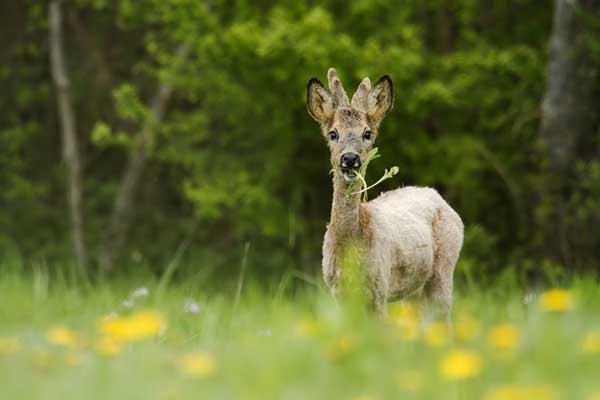
The roe deer, also known as the dwarf deer or wild sheep, belongs to the order Artiodactyla, family Cervidae, and is a herbivorous animal. The roe deer's body is grass-yellow, with white hair below the tail base; male roe deer have antlers, females do not. The roe deer is one of the more economically valuable wild animal species, and also one of the most common wild animals in the forests of Northeast China. It has been listed in the "List of Terrestrial Wild Animals under State Protection that are Beneficial or of Important Economic or Scientific Research Value."
Selecting High-Quality Breeding Roe Deer
The roe deer is a medium-sized animal. Male roe deer have antlers, and a normal adult weight is 50-60 jin. Adult female roe deer weigh about 50 jin. Young roe deer must nurse for more than two months, reach a weight of over 35 jin, have smooth and glossy fur, bright eyes, medium body condition, and be free of disease and disability. Breeding roe deer should be purchased from 3-5 households and mixed to avoid inbreeding.
The ratio of male to female roe deer must be appropriate. Roe deer differ from other animals in that the estrus period is short, generally 24 hours; the herd comes into estrus concentratedly, within a span of less than 20 days, and female roe deer come into estrus only once a year, while some male roe deer have poor sexual function. Therefore, there should not be too few male roe deer. Based on my experience: two females to one male is most suitable, with a high conception rate.
Shyness and Adjustment Problems After Introduction to the Pen
1. Building the Pens
The perimeter wall must not be lower than 2.5 m high; multiple small pens should be built, and the walls of the small pens need only be 1.5 m high. Each small pen should have an area ranging from 6-10 sq m, reserved for mating and kidding, and small pens should have small doors for entry and exit. The overall area of the large pen depends on the number of roe deer, ensuring the roe deer have room to move. A large site means more exercise, less crowding, and less disease. The ground should be paved flat with bricks; cement flooring is not good, as it is hot in summer and cold in winter. There must be drainage ditches in the pen so that rainwater does not accumulate, and there must also be rain shelters to ensure a dry place for lying down and ruminating on rainy days. After the Spring Equinox, separate males and females; after the Autumn Equinox, combine them into a large herd.
2. Solving Shyness and Adjustment Problems
From the old place to the new home, with new people and a new environment, it is inevitable that the timid roe deer will be shy and suffer from adjustment problems. My methods are:
① When shipping the roe deer, put the roe deer's dry droppings into bags in advance and send them along with the vehicle. Before the roe deer come out of the crates, evenly scatter the dry droppings into each rain shelter, so that when the roe deer enter the pen they can smell their own and their fellows' scent, feel secure, and reduce panic-induced collisions.
② Before the roe deer enter the pen, add enough coarse feed in the pen for one night or one day. It is best to add one meal of concentrated feed: no more than one liang of cornmeal per animal, and half a liang of wheat bran and soybean cake meal. Add the second meal of concentrated feed 6-8 hours later, to prevent the bold ones from overeating and getting diarrhea.
③ The water should be boiled, cooled, and then placed in the pen; at minimum, wait three days before switching to well water. Ensure there is water in the pen at all times, and it must be changed once a day.
④ Assign dedicated personnel; let the roe deer quickly become familiar with the keeper's scent, voice, and clothing. Decline visitors to reduce fright.
⑤ If the scale is large, over 50 animals, the large pen must be divided into two, to prevent fright, stampeding, crowding, and injuries from collisions.
⑥ Also, mix preventive medication into the feed in advance; I have a formula here. After three days they are basically normal, and with the above methods, diarrhea from adjustment problems basically will not occur.
Feeding Management
1. Concentrated feed: corn, wheat bran, various bean cakes, ground into coarse meal and mixed with water to the consistency where blowing on it does not scatter the meal dust. The fixed daily amount per animal is three liang of cornmeal, one and a half liang of wheat bran, and one and a half liang of sunflower cake or soybean cake, fed in three portions in the morning, noon, and evening.
2. Coarse feed: In winter, feed leaves from various broadleaf forests (poplar, elm, zha, fruit tree leaves, etc.), grass alfalfa, and weeds, as long as they are not moldy; various stalks (corn, millet, beans, sunflower heads, etc.) are best chopped into sections; do not grind them into grass powder, as stalk skins harm the stomach. In summer, mainly feed green feed (various tree leaves); in addition, various bean vines, corn leaves, various weeds, medicinal herbs, alfalfa grass, and sunflower heads (chopped) are all acceptable; various root tubers, stems, and leaves of vegetable feed are all acceptable (Chinese cabbage, large-head cabbage, rapeseed, lettuce, dandelion, purslane, various radishes, especially carrots, which are best, cut into small pieces and fed in fixed amounts). Vegetable feed is especially important in winter: first, it can supplement water; second, it can increase various vitamins. Salt should be fed in fixed amounts, about 1 level tablespoon for 15 roe deer, once every three days; salt licks may also be hung, but they must be hung where roe deer fawns cannot reach them. When the dog days of summer arrive, add sorghum meal to the herd at just one liang per day for 10 animals, to reduce loose stools.
Estrus and Mating
Female roe deer come into estrus once a year, and successful mating and conception is the key to expanding the herd. The estrus period is around White Dew each year (the Mid-Autumn Festival). Male roe deer must have their antlers sawed off to prevent butting.
Each year, start test-mating on August 25, letting the female roe deer meet the male roe deer one by one once each morning and evening. A female roe deer in estrus does not run or call, and actively approaches the male; otherwise she calls and runs away. A female roe deer in estrus will very obediently wait for the male to mount. When you see the male's penis inserted into the female's perineum and he forcefully arches his back, that is a successful mating. Note that the male roe deer may have the penis exposed early and bent soft and get pressed. Let the male mount at most twice in a row, then they must be separated, and the male must be forbidden from drinking water immediately, which ensures the male's health. It is best to mate again after 6 hours; otherwise the male has no semen and conception will not occur.
Management of Birthing
The feed of pregnant female roe deer must meet their nutritional needs; pregnancy lasts 9 months. One month before kidding and two months after kidding, add millet and oilseeds to the female roe deer's feed (sunflower seeds or hemp seeds are best, stir-fried and ground into meal), with one liang of millet and half a liang of oilseed per animal per day, fed in three portions, to ensure sufficient milk and keep the mother healthy and the fawns plump.
The kidding period is around the Dragon Boat Festival in May, very punctually. Before giving birth, the female roe deer is very restless, unable to lie still, with the milk belly sagging and signs of abdominal pain, and light red mucus can be seen at the vulva; these are signs of impending birth, and she should be isolated in a separate pen. At this time, it must be quiet inside and outside the pen; absolutely do not let people frequently go to the pen to watch, as this will distract and frighten the female roe deer and cause difficult labor. The keeper should observe from farther away; generally, birth is smooth within two hours. As long as both legs emerge together, it is generally a normal birth; if nothing is born after four hours, it may be difficult labor and measures should be taken (cesarean section is best, ensuring the safety of both mother and fawns). Difficult labor is mostly due to a small pen, the female roe deer having no exercise, and a single fawn being too large. Two weeks before kidding, it is good to drive the especially docile pregnant female roe deer up to move around for a while every morning. Generally one litter per year with two fawns, mostly a male and a female; there are also births of three or four, which is rarer; first births may also have just one.