The Magnolia Family: Stately Street Trees
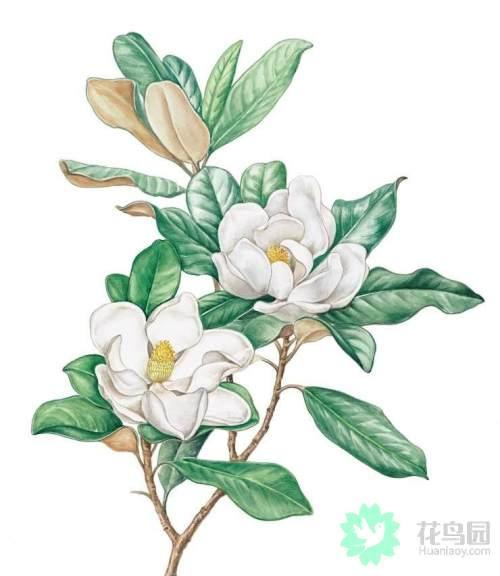
Plant ID
Southern Magnolia (Magnolia grandiflora)
Distribution: Native to North America; widely cultivated in cities south of the Yangtze River basin in China. Southern Magnolia, also known as Lotus Magnolia or Foreign Magnolia, is an ideal street tree due to its height and shade; its flowers are large and beautiful and much loved, and over 150 cultivated strains have been bred to date.
In June in Jiangnan, when misty rain prevails, amid the barely perceptible drizzle, if you happen to look up, the branches of tall roadside trees are densely covered with broad dark green leaves, and in the gaps between leaves and branches, pure white flowers are silently blooming - the Southern Magnolia is a tree all too familiar to southerners, yet northerners are often astonished by it. The magnolia familiar to northerners is the one that bursts into white blossoms all over the tree in spring; compared with the Southern Magnolia, its flowers are smaller and it blooms before leafing out. In addition, common magnolias in China include the revered since ancient times Xinyi (Magnolia biondii) and the hybrid cultivated variety Saucer Magnolia (Magnolia x soulangeana). These trees of the magnolia family have showy, eye-catching blooms and are high-quality trees spread across both north and south China, whether used for street shade or for ornament.
The Name Lotus
The Southern Magnolia that enjoys the name "Lotus Magnolia"
The Southern Magnolia is native to North America. Because of its tall stature, dense leaves, and beautiful and fragrant flowers, it is favored by landscape gardeners. At the same time, the Southern Magnolia is tolerant of smoke and dust and has strong resistance to toxic gases such as sulfides and chlorine, making it especially suitable for planting in cities. Since the Southern Magnolia's flowers are large and pure white, like a lotus emerging from water, elegant and delicate, naming it "Lotus Magnolia" is entirely apt. Although it comes from a foreign land, using the name of the lotus for the magnolia genus has had precedent in China since ancient times - the Qing dynasty book "Hua Jing" records that the magnolia was anciently called Mulan, also known as Mulian, growing in the Lingling valleys and Mount Tai. It is just that whether in terms of flower form or fragrant scent, compared with the magnolias native to China, the Southern Magnolia undoubtedly matches the name lotus even better.
A Verse of Mulan Hua
"Graceful in new makeup, jade-like in radiance, a thousand ranks of white fairies surrounded by snow." In spring, the magnolia's white flowers fill the branches, revered by the ancients, who often praised it in poetry and prose. During the Song dynasty, people gave the magnolia the name "Welcoming Spring"; in Ming dynasty monographs on horticultural flowers and trees, the magnolia is described as "thousands of trunks and tens of thousands of stamens, blooming without leaves, and when at its peak, it can be called a jade tree"; even into the Qing dynasty, there were still poetic lines like "Such tall flowers, whiter than snow, year after year they bloom against the wind," still praising the magnolia's qualities - no matter how dynasties changed or time flew by, the ancients never seemed to lack words of praise for the magnolia. During the High Tang, men of letters and letters even used a famous court tune as a cipai (lyric pattern), with neat rhythm and a low, lingering melody, like a magnolia at dusk swaying in the wind, naming it "Mulan Hua." By the Song dynasty, this tune evolved into the cipai "Jianzi Mulan Hua," with irregular line lengths and changing rhymes, beloved by many ci poets.
The Magnolia Lineage
The White Magnolia that blooms first and leafs out later
Compared with the Southern Magnolia, the magnolias native to China seem to be better known. In early spring, when peaches and apricots break bud and willows put forth new growth, the White Magnolia blooms on the branches, the whole tree white, a scene of spring light - the White Magnolia has long been cultivated across north and south China as an ornamental, except that it blooms first in early spring, and only after the flowers fall do the leaves gradually emerge, unlike the Southern Magnolia, which leafs out first and then blooms. As early as the Spring and Autumn period, there are records of using magnolia in gardens: "Formerly the King of Wu, Helü, planted magnolias here to build palaces" - although its ornamental history is long, the White Magnolia, because of its poor tree shape and difficulty in providing dense shade, is seldom planted as a street tree.