How to Grow Bougainvillea (Paperflower) at Home
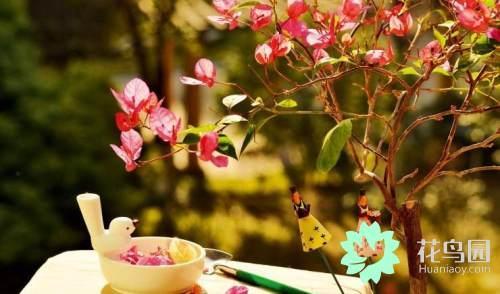
Bougainvillea is a common ornamental plant in the south and the city flower of many cities in South China. If you live in the south, you may already be tired of seeing it, but it actually has more faces than you might imagine, and when grown in a pot it can even become a fresh miniature flowering tree!
The three true flowers of bougainvillea are quite inconspicuous, while the three bracts outside are large and brilliantly colored. This is the 'Gold Heart Two-color' cultivar; not only are there yellow blotches near the midrib of the leaves, but the bracts are also interwoven with white and purple, very beautiful.
Flowers That Are Not Flowers, Stamens That Are Not Stamens
Bougainvillea is also called paperflower and is native to South America. At first glance, it bears purplish-red "flowers" with 3 "petals," and inside them are 3 yellow "stamens." In fact, those "petals" are its bracts, and those "stamens" are the true flowers. Because the flowers are so inconspicuous, bougainvillea uses its bright bracts to attract pollinating insects. There are also double-flowered bracts, which are denser and showier than single-flowered ones. At flower markets you can usually only find the most ordinary red and purple varieties, so it is best to buy other varieties online.
Bougainvillea in various flower colors.
A False Alarm Rescue
Seeing the dazzling array of "little trios" online, I was thrilled and quickly ordered several plants. But when they arrived, I happened to be away from home for those few days, and by the time I got them, I found the young plants drooping one by one, and at a touch, all the leaves fell off! The rescue operation started immediately: first soak them in water overnight, the next day plant them in peat soil mixed with perlite and slow-release fertilizer, then ruthlessly cut off all the flowering branches - although I could not enjoy the flowers for the time being, it would save nutrients and let the plants recover as quickly as possible. Then I put them in a cool, ventilated place and misted them daily to keep the branches moist. Haha! The young plants really did recover one by one and grew new leaves. A month later, when repotting, I was delighted to find the roots had filled the bottom of the pot. Wonderful!
For newly potted young plants, you can first cut off the flowering branches to reduce the loss of water and nutrients, which helps the young plants regain vigor.
Winter Warmth Is Most Important
Most bougainvilleas, away from warm places like Guangzhou and Xiamen, must be protected in winter. So throughout the winter, my bougainvilleas hid inside the enclosed balcony, and the balcony windows were kept tightly closed most of the time. If they were newly bought young plants, they also had to be moved into a warmer indoor room for extra care. Stronger individuals could be given more leeway, and on sunny winter days they could be moved outside to bask in the sun for a while.
In Yunnan during the Spring Festival, even if the large trees have already shed their leaves, bougainvillea still blooms profusely. However, in more northern regions, bougainvillea must spend the winter indoors.
Spring Arrives, Time to Pinch
After a winter of dormancy, spring came, and I moved the plants outside the balcony. After enjoying purely natural sun and rain, the "little trios" all perked up and began growing new shoots vigorously. This is the key moment for shaping the plant's form. Bougainvillea is a "versatile beauty": if you like a flower wall, just let it grow as it pleases and bring out its nature as a vine. But if I want to turn it into a low, small tree, I need to "pinch" it, that is, when a new shoot grows to 6 leaves, pinch off the top 2 and leave 4, which will stimulate the formation of more new leaf buds. Repeating this process afterward will make the branches dense and short, forming a small shrub. You can also remove all the lower branches and keep pinching the top to grow it into a gorgeous "lollipop" shape. With a bit more skill, it can even be pruned into a 30 cm tall Chinese pagoda tree shape, becoming a miniature bonsai for your palm.
After pinching, the branch has already sprouted new buds from the "leaf axils," so one branch will become several, making the plant fuller.
Through pruning, bougainvillea can be shaped into a miniature "flowering tree."
Want Flowers? Control Water First
North of Guangdong and Fujian, bougainvillea's flowering season is in autumn. But the "little trios" have a bit of a "masochistic streak": when water is plentiful, they only grow leaves and do not bloom; they insist on being dried to the point of near death before they feel they must leave offspring before dying, and only then will they bloom abundantly. So if you want to see a profusion of flowers in autumn, you need to start controlling water in advance.
Water control can begin in mid-August. When watering, give only half the usual amount, and after one watering, expose them to full sun until the leaves soften and wilt slightly before watering again. You have to judge this degree yourself. Occasional mistakes are no big deal: if a bit too dry, they will only drop a couple more leaves; if a bit too wet, they will at most bloom a little later. Perfection is always impossible, isn't it?
Different cultivars require different degrees of water control. For example, cultivars such as 'Green Leaf Cherry Blossom' and 'Silver Margin Light Purple' are naturally floriferous, so there is no need to force flowering through water control; while single-flowered cultivars such as 'Big Red' and 'Small Leaf Purple' must be "treated harshly" to get good results. Even if they are sunned down to bare stems, it does not matter, and afterward they will instead bloom all over the tree.
Another thing to note is that fertilization should be stopped during the water-control stage, because the plant is weak at this time and cannot take "heavy tonics."
Blooming Time!
After a round of "harsh treatment," the cool autumn arrived, and bougainvillea began to bloom one after another. From then on, watering and fertilizing should return to normal.
At this time bougainvillea seems to have inexhaustible energy. Starting in early autumn, as long as the minimum temperature does not drop below 5°C, the flowers will keep coming one after another, and may even bloom all the way into spring! In a season when all trees are sparse, bougainvillea will create a world of clustered blooms and vibrant life in your home. On a small tree half a meter tall, flowers and bracts are packed densely, even hiding the green leaves. This is precisely the most beautiful moment of a miniature flowering tree! By spring, although it still blooms, all kinds of flowers are in full bloom then, so its flowers are not so indispensable. It is better to pinch and prune and grow branches, letting it rest and saving its full glory for next autumn!
In the golden autumn of harvest, enjoy to the fullest the surprises that bougainvillea flowering trees bring you!