Detailed Explanation of Lulai Black Pig Breeding Technology and Feeding Management Methods
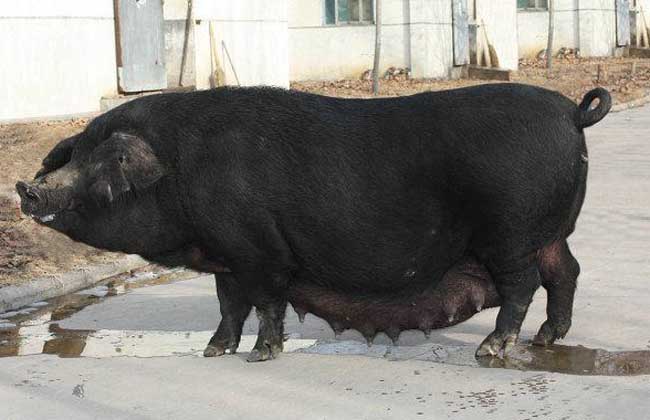
The Lulai black pig originates from Laiwu City, Shandong Province. It has a sturdy physique and a well-proportioned body. Its coat color is black, with relatively stiff brown bristles growing along its back. It has a straight snout, medium-sized ears, a straight back and loin, full hindquarters, and strong limbs. It enjoys moving about, and this habit is what gives it its vigorous constitution. Now let us take a look at Lulai black pig breeding technology together!
Timing of Introducing Breeding Stock
When introducing breeding stock to a newly built farm, you should visit the breeder farms before construction. Generally, based on the number of animals to be introduced, build 1 to 2 sow houses first. After isolation, closure, and disinfection, you can proceed with the introduction. The disadvantage is that it is not conducive to disease prevention, or various equipment and facilities are incomplete, making work inconvenient. The advantage is that you can see returns at least half a year earlier. The introduction should avoid a peak year for pig farming profitability. Introducing stock at such a time leaves little room for selecting breeding pigs, and the prices are relatively high. The offspring bred after introduction will very likely enter the next trough period. When introducing a relatively large number of breeding pigs, it should be done in batches to increase selection intensity and facilitate planned mating, and to balance production as much as possible.
Number of Animals to Introduce
The breeding pigs introduced for Lulai black pigs are generally required to be over 50 kg, and should not be too large. Breeding pigs that are too heavy are very likely to be the ones left over after others have made their picks, and they also affect the immunization plan after introduction. To renew bloodlines, you can introduce a small number of boars and sows, enough to achieve the goal of adding or renewing bloodlines. If it is a newly built farm, do not buy all of them according to the production scale either. The appropriate number to introduce is 1/5 to 1/4 of the farm's total scale. When introducing boars, consider having sufficient bloodlines and numbers to prevent sows from having no suitable boar available when they come into heat.
Feed Formulation
Lulai black pigs are lively and active, yet timid and easily frightened, so farmers should maintain a quiet, dry, and clean rearing environment during feeding. They are mainly fed green forage grass, rice bran, wheat bran, and other feeds. Green forage generally comes from planted pasture grass; farmers can choose species such as cocksfoot and cocksfoot grass. When feeding sows, adding pasture grass allows the use of some feed ingredients that are poor in palatability but low in price in the daily ration. This can reduce feed costs without affecting the sow's feed intake. Feeding sows an appropriate amount of green forage during pregnancy can increase the number of live piglets born and the number surviving to weaning.
Feeding Management
In order to improve feed conversion efficiency and reach market pig standards as quickly as possible, scientific feeding should be implemented. First, feed on a fixed schedule: 4 meals per day, starting at 7 a.m., with one feeding every 4 hours. Second, feed a fixed amount: for pigs weighing over 20 kg, feed 4.5% of their body weight; for pigs within 20 kg, feed 3.5% of their body weight. At the same time, achieve "open in front, restricted in back," that is, after 2 months of age, restrict their activity to encourage fattening, so as to ensure a relatively high meat yield.
In short, in order to carry out Lulai black pig production safely and stably, purebred breeding is necessary. With high-quality, safe, balanced, and nutritionally complete feed as the foundation, strengthened strict disinfection and scientific immune control, creating a good and comfortable environment for the pigs, and carrying out scientific and orderly feeding management, only then can the pig farm's profits be maximized and can there be great prospects in the pig farming business. (Contribution: Rural Notes)