A Complete Analysis of Building Plans for Fragrant Pig Farms
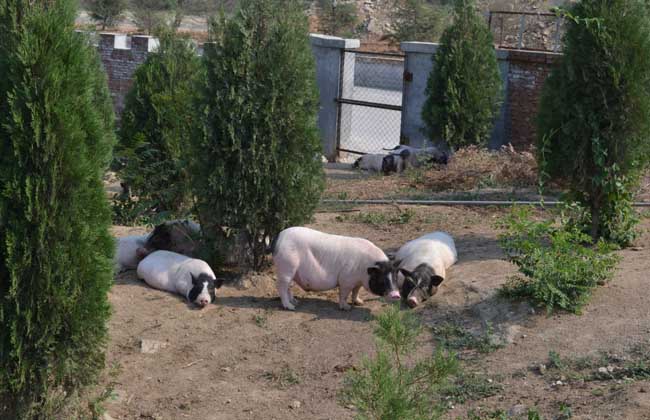
The fragrant pig, also known as the mini pig, matures early and fattens easily, has thin skin and fine bones, tender and juicy meat, and a rich aroma. Suckling pigs have no gamy smell, and even when cooked without any seasoning they give off an appetizing fragrance. They are the best material for processing high-grade meat products and the preferred raw material for roast suckling pig. They are tolerant of coarse feed, suffer few diseases, and are easy to raise, making them suitable for household farming in rural areas. Let us take a look below at the construction plan for a fragrant pig farm!
Construction of a Fragrant Pig Farm
1. Site selection: Site selection for fragrant pigs is roughly the same as for ordinary pig farms, but in order to achieve higher quality requirements, a flat location should be chosen in mountainous and hilly areas according to their living characteristics to build the pig farm, with the area determined by the scale of breeding. The pig farm should be more than 500 m from roads, water sources and living areas. It should face south with its back to the north, be sheltered from the wind and face the sun, have convenient water and electricity connections, an environmentally friendly and pollution-free water source, smooth communications, and convenient transportation with a certain transport capacity.
2. Pig house construction: A passage runs down the middle of the pig house, with pig pens built on both sides, and a sewage drainage ditch built outside the wall of the pig house, so that manure and urine flow out directly through the manure outlets at the sides of the pens. The pig house is generally about 3.2 m high and 7.6-8 m wide, with the length depending on the breeding scale and site, preferably 30 m. The pig house includes a sow room, a piglet room and a growing pig room. Since fragrant pigs are relatively small, the sow room can be designed as 10 sq m per room, the piglet room connected to the sow room needs only about 5 sq m per room, and the growing pig room is 10 sq m per room, with every 5 pigs sharing one pen.
Layout of a Fragrant Pig Farm
1. Production area: The production area is the core area of the farm, mainly consisting of breeding rooms, sow farrowing rooms, growing pig production rooms, fattening pig production rooms, commercial pig rooms awaiting sale, as well as changing rooms and shower rooms for the keepers, ultraviolet disinfection passages, disinfection pools, a veterinary hygiene room, a duty room, and a manure and urine treatment system.
2. Management area: The management area mainly consists of a feed processing workshop, feed warehouse, office, repair workshop, substation, boiler room, pump room, etc.
3. Isolation area: The isolation area should be far from the production area, set downwind of the production area, and preferably in a lower-lying place. It mainly includes a veterinary laboratory, isolation rooms for sick Bama fragrant pigs, a carcass disposal room, etc.
Facilities of a Fragrant Pig Farm
1. Drinking water facilities: Install a water tower and a booster valve at the highest point of the pig farm (high water pressure is good for washing the pens), bring in clean water, and lay pipes running to all parts. Every pig pen is connected to the pipes, with bite-style drinking nipples installed and water valves reserved.
2. Sewage facilities: A sewage drainage ditch is built around the outside of the pig house and connected to the manure and urine outlets of each pig pen. A biogas digester or septic tank is built at the most downwind point of the production area and connected to the sewage drainage ditch, using biological fermentation to treat the manure and urine.
3. Insulation facilities: More than 6 km of thick copper wire is laid throughout the farm (copper wire has good thermal conductivity and is good for fire prevention). Heat-retaining warming lamps are installed in the pig house, preferably 150W and 200W, spaced at a density of 4-6 sq m per lamp, to ensure that the overall temperature inside the pig house stays above 18-22°C in winter.
4. Farrowing bed equipment: A small-scale fragrant pig farm can be equipped with 1-2 sow farrowing beds. The farrowing beds sold on the market are all designed for large pig breeds, and small fragrant pig sows will turn around and jump out once inside, failing to achieve the positioning effect, so the sow section of the farrowing bed must also be sealed off and positioned to a certain extent. Those with the conditions and skills can also make their own farrowing beds according to the situation.
5. Disinfection facilities: A disinfection passage is set up at the main gate of the production area, that is, the ground at the bottom of the gate is designed as a concave shape filled with disinfectant water, and vehicles and people entering and leaving must drive or walk over the water-covered road surface. A disinfection room is set up at the side of the gate, with a disinfection pool at the door, and an electric spray disinfector installed inside. Personnel can enter and leave the production area through the disinfection room; upon entering the disinfection room they must step in disinfectant water, then undergo full-body spray disinfection inside the room before entering the production area. The purpose is to cut off the transmission routes of pathogens and prevent people and vehicles from bringing pathogens into the farm.
Construction of a Fragrant Pig Farm
1. Mating pens for fragrant pigs: The configuration of mating pens for fragrant pigs should take into account facilitating mating and making full use of the fragrant pig house. They are generally single-row fragrant pig houses and can be divided into two rows, front and back, with a mating area in the middle. Their feature is that the pigs can mutually induce estrus, making it easy to detect and check sows in heat.
2. Gestating sow pens: There are many forms of gestating sow pens and various rearing methods; some keep several fragrant pigs in 1 pen, and some keep 1 fragrant pig alone in a pen. Keeping a gestating sow alone in 1 pen can prevent sows from biting and fighting each other, crowding and bumping, and competing for food according to strength, reduce miscarriages in gestating sows, and increase the survival rate of piglets. The pens are made of steel pipes or wood, but the drawbacks are that they use a lot of material, require large construction investment, restrict the sow's activity, and provide little exercise, making leg and hoof diseases likely, and also shortening the sow's useful life.
3. Farrowing sow pens: The farrowing pen is divided into two parts, the farrowing frame and the farrowing bed. The farrowing frame is installed on top of the farrowing bed; the farrowing frame is 1 m long, 0.3 m wide and 0.5 m high. The farrowing bed is 1 m long, 0.8 m wide and 0.2 m above the ground. The mesh at the bottom of the farrowing bed can be woven from iron wire with a mesh size of 0.5 sq cm. The middle part of the farrowing pen is the sow restriction area, and the two sides are piglet activity areas. The front end of the restriction area is provided with a sow feed trough and drinker, and the rear end should be fitted with a horizontal bar to prevent the sow from backing up. At the same time, the piglet activity area should also be equipped with warming devices such as warming boxes, infrared lamps and electric heating floors, as well as feed troughs and drinkers.
4. Piglet nursery pens: Newly weaned fragrant piglets still have imperfect physiological functions and poor adaptability, yet they are in a stage of vigorous growth and development, so they still need a nursery period to provide them with a clean, warm and excellent environment. Nursery pens generally mostly use welded steel-bar mesh beds. A nursery pen is generally 1 m long and 0.8 m wide, with an area of about 0.8 sq m, and the mesh at the bottom is generally preferably 0.5 sq cm. Such a nursery pen can raise about 10 weaned fragrant piglets. Feed troughs and drinkers are then installed at the front and back.
5. Growing and fattening pens: The growing and fattening pens for fragrant pigs can be built in many forms: a relatively high-investment form combining aluminum alloy partitions, concrete floors and metal slatted floors; a form combining metal partitions, concrete floors and water-flushed slatted floors, which is more convenient for maintenance and disinfection; and a relatively low-investment form combining concrete partitions, concrete floors and concrete slats, which is inconvenient to maintain.