Can you recognize these 4 flowers just by looking at their leaves?
BGM:Intro - The xx
- Tasha's Foreword -
In the vast world, there are countless breathtaking wonders of creation: some exquisitely beautiful, some extremely ugly, some utterly bizarre, some strikingly alike.
From humans, to the little grass at humanity's feet, it is all the same.
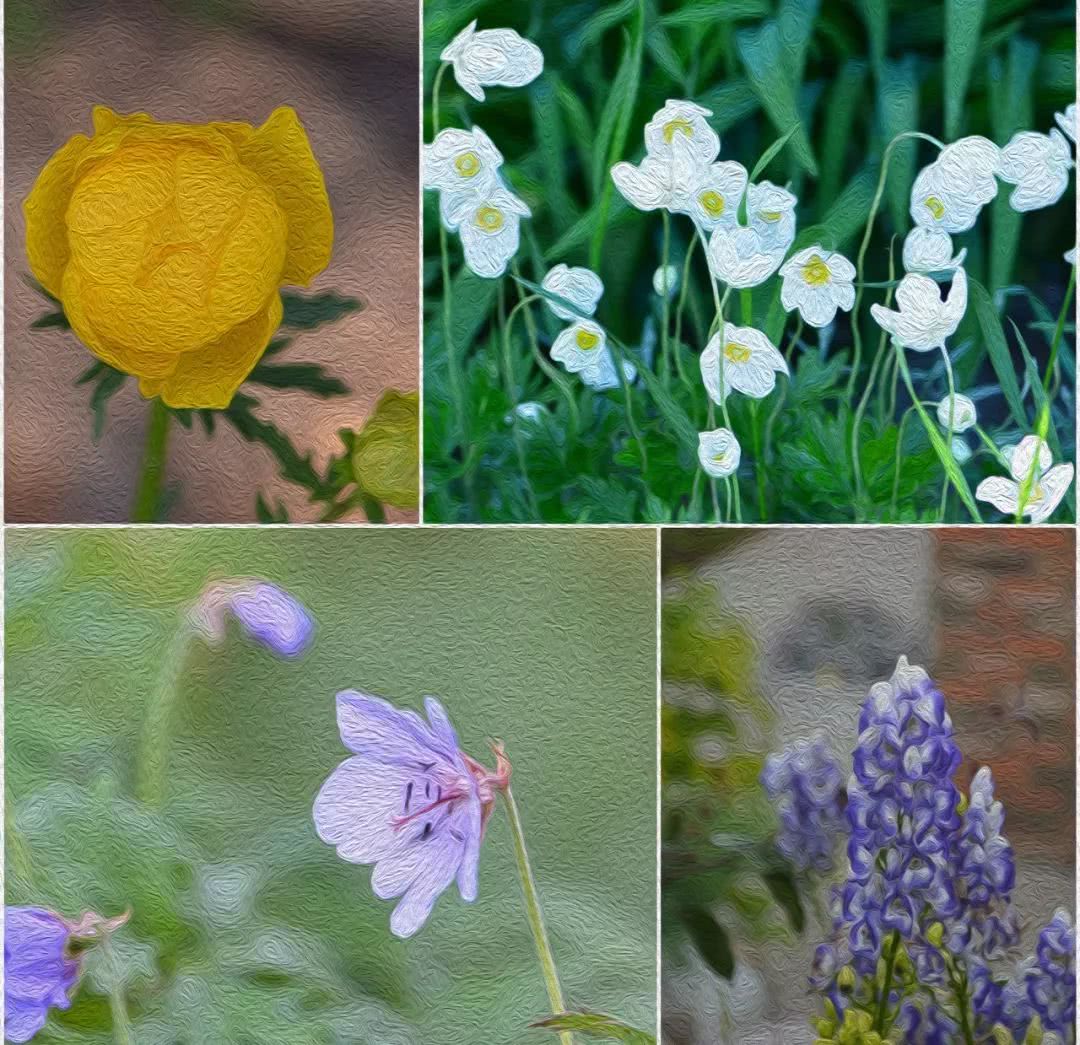
Because of fate, and even more because of attentiveness, Sister Damao brings us 4 kinds of herbaceous flowers. Their blooms are stunning, but their leaf shapes are extremely similar. How can we tell them apart?
- About the Author -
- Main Text Begins -
These 4 kinds of flowers grow in the ground. When they catch the scent of spring from the depths of winter and emerge from the soil, their leaves look very much alike.
At first I thought they were the same kind of flower, and only when each one bloomed did I realize how different they truly are from one another.
This is a magical encounter. I picked their leaves and carefully memorized the names, wanting to share them with everyone, but a gust of wind blew them out of order. I hurried to pick them again and re-sort them.
Just by looking at the leaves, you really cannot tell much difference. If you did not read the captions, would you also be misled into thinking: are they really the same kind of flower?
* Globeflower *
Let me start with this globeflower, also called globe flower, English name: globe flower, Ranunculaceae, cold-hardy (-40 degrees or lower).
When a friend moved to a new home and I went to visit, a yellow flower stood tall out of the tangled weeds. Without any warning, it just appeared, in my world, under my shovel.
I decided to rescue it. My friend was going to tidy up the garden, weed and redo the layout, so she gave it to me.
Its story is no different from other cold-hardy herbaceous flowers: blooms in June, goes dormant and withers in autumn, covered by heavy snow, quietly sprouts in early May, watered twice a week, slowly grows, quietly blooms.
Egg-yolk yellow, standing out strikingly among a sea of green leaves and red flowers.
The leaves are umbrella-shaped, holding up flower after flower on top. The flowers sit atop thick, sturdy stems, looking very grounded.
I really wanted to see what it would look like when all its petals opened, but until it withered, it never removed this veil. The petals stayed tightly wrapped, maintaining a sense of mystery throughout.
I originally thought the globeflower was just this shy, until in the park I saw another patch of golden globeflowers. I truly marveled at the vast world, where surprises are always waiting for you. How could a few simple words ever sum it up?
This is also a type of globeflower. Unlike my egg-yolk yellow globeflower at home that never opens, this globeflower is golden yellow, its petals can open fully, blooming with a brilliant smiling face in the sunlight.
But both are globeflowers. Fellow gardeners, do not overthink it. To make an analogy, it is just like how petunias have various colors and flower shapes.
* Anemone *
Now let me talk about this anemone. It is probably the globeflower's little sister: equally cold-hardy, equally beautiful, sprouting from roots in spring and growing strong, or germinating from self-sown seeds.
Also in Ranunculaceae, so considered relatives. Because of the matching leaves, I had to have it. This is the anemone's leaf:
The anemone and globeflower have similar leaves, but bloom different flowers.
The globeflower blooms above its leaves, supported by strong flower stems; the anemone blooms atop tall leaf stems, swaying in the wind, graceful and elegant.
The elder sister has the elder sister's reliability, the younger sister has the younger sister's charm. This is not so different from our human society.
* Cranesbill *
This is another cold-hardy herbaceous flower at home -- cranesbill. From sprouting and blooming to withering and going dormant, then sprouting again, year after year in cycles.
It shares many similarities with the anemone: similar leaf shape, and flower stems that reach high up. If not for the very different flower shapes, you would really think they were the same family with different flower colors.
On closer inspection, the English name of cranesbill contains "crane," and it belongs to Geraniaceae. As long as sunlight is even, its plant shape forms a regular circle, as if drawn with a compass.
Cranesbill likes water and is not drought-tolerant. In early June it sends up tall flower branches from the base. When blooming, it has a somewhat standout, head-above-the-crowd look. No wonder it is called cranesbill.
Flower colors are fairly diverse. I have seen white, purple, and deep pink.
* Monkshood *
Monkshood, Ranunculaceae, also sprouts from old roots, blooms at the end of July, and its leaves are almost identical to cranesbill's. Just by looking at the leaves, I absolutely cannot tell which is which.
However, monkshood's plant shape differs somewhat from cranesbill's, and it is unlikely to form a regular sphere.
The flower shape is even more unusual. When the flowers first open, they have a very pleasant fragrance, but soon the fragrance disappears.
- Summary -
The leaves of these 4 flowers are not very different. The most obvious differences lie in plant shape, flower shape, flower stems, flower color, and bloom time.
1. Cranesbill's plant shape is a regular circle;
2. Globeflower's flowers sit on the leaves, with thick, sturdy flower stems;
3. Anemone and cranesbill both have tall flower stems; the former's flowers are lustrous white, the latter's colors are rich (white, purple, deep pink);
4. Globeflower, anemone, and cranesbill have the same bloom time, flowering in June; monkshood's bloom time is about 1.5 months later, flowering at the end of July.
Their similarities, besides the leaves, also include similar care methods:
1. Cold-hardy; can be planted in the ground in cold zones, such as the three northeastern provinces, Inner Mongolia, and the great northwest, where they can overwinter without protection;
2. Shade-tolerant, but with sunlight the plant shape will be more symmetrical and the blooms better;
3. Tolerant of poor soil, but with fertilizer they will bloom more and more vibrantly;
4. Not heat-tolerant; if potted, it is best to provide a suitable ambient temperature, such as shading and misting;
5. Not drought-tolerant; in ground-planted, full-sun conditions, water thoroughly once every 2 days.
In the vast world, nothing is too strange: different families, different flower shapes, yet the same leaf shape.
Just like in the vast sea of people, perhaps there is someone so similar to you.
Such fate must be cherished well.
Text and photos: Li Damao
Editor: Nanzhu
If you also like this article