Key Technical Points for Black Pig Farming and Scientific Feeding and Management Methods
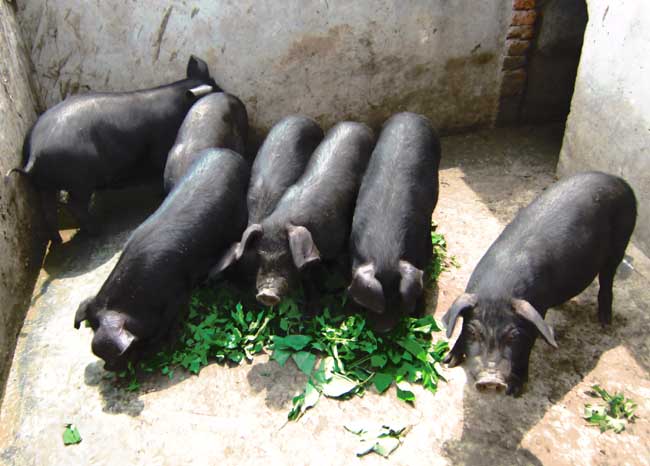
The "complete protein" contained in black pork is better able to help repair human tissues. Eating black pork regularly can provide balanced nutrients, allowing modern people to still obtain minerals, vitamins and protein even while dieting. Let us now take a look at black pig farming techniques!
Characteristics and Traits of Black Pigs
1. Physical Appearance Characteristics
Black pigs have black hair over the entire body, a well-proportioned structure, sturdy limbs, a slightly elongated head shape, and horizontal wrinkles on the forehead (with two deep wrinkles resembling eyebrows). It is precisely because of these two obvious deep wrinkles that local people also call the black pig the "two-eyebrow pig." Black pigs have medium-sized ears that are soft and drooping, fewer skin folds, and rarely have dewlap under the neck. The back and loin are relatively straight, and the belly is large but does not drag on the ground. The hindquarters are relatively weak and slightly higher than the forequarters. Sows average 12.7 teats.
2. Production Performance
Black pigs have long been known as "grass-fat pigs" and perform excellently in fattening performance. Adult boars generally weigh around 117 kg, and adult sows generally weigh around 95 kg. Under standard feeding conditions, live weight can reach around 92 kg at 240 days of age, with an average daily gain of 509 g during the fattening period. Black pig meat is of good quality, bright red in color, tender and juicy, with relatively obvious marbling, good fat quality, white and glossy, crystal clear, and a carcass lean meat rate of around 46%.
Construction of the Pig Farm
The pig farm should be built in an area far from crowds, with high and dry terrain, sheltered from the wind and facing the sun, and with good drainage. The functional divisions of the production area should be clearly defined. Finally, the size of the pig house should be determined according to the scale of raising. The height of the building should generally be above 2.5 m, and appropriate windows should be installed at the front and back of the pig house to ensure lighting and ventilation. In summer, appropriately reduce the stocking density, and in winter, appropriately increase the stocking density. The height of the pen walls should be 0.8-1 m, and feeding troughs and drinking water devices should be installed inside the pens. The concrete floor of the pig house should have a certain slope, a sewage drainage channel should be set outside the pig house, and an open-air pen connected to the inside can also be set up outside the pig house.
Preparation of Farming Feed
For black pigs, feed diversity and palatability should be achieved as much as possible. The main feeds include: corn, wheat, sweet potato, potato, rice grain, wheat bran, etc. In addition, succulent feeds such as vegetable leaves, green grass, and carrots can also be used. Feed formulation can be determined according to actual local conditions.
Selection of Black Pig Breeding Stock
The selection of black pigs should meet the typical breed characteristics and traits. Generally, breeding pigs aged 7-8 months and weighing more than 40 kg are selected for introduction. It is recommended to purchase breeding pigs from regular breeding pig farms. Boars should have sturdy limbs, well-developed and powerful hindquarters, and symmetrical and large testicles. Sows should have sturdy limbs, a straight loin, and a large belly that does not drag on the ground. They should have more than 6 pairs of evenly spaced teats and fully developed reproductive organs.
Feeding and Management of Black Pigs
After introduction, the pigs must be isolated for a period of time, at the latest about one month. Only after the herd is observed to be completely normal can they be mixed into the group. Farmers should thoroughly disinfect the breeding pig house and regulate the temperature inside the house according to weather changes to ensure the emotional stability of the breeding pigs.
Pigs from different pig farms cannot be immediately mixed and raised together after arriving at the farm. They should be grouped and penned according to body weight and pen area, generally 5 to 6 pigs per pen. On the day the breeding pigs are transferred in, feed them little or no feed, and water supply should also be controlled to prevent overeating and overdrinking. In the following days, the amount of feed should be gradually increased. By the 5th to 7th day, the feeding amount should be raised to the normal feeding amount for pigs, that is, 2.5 kg of concentrated feed per pig per day, fed 1 to 2 times daily.
The reference feed formula is:Corn 58%, soybean meal 15%, rice bran 10%, wheat bran 12%, premix 5%。
Adjust the water supply in a timely manner according to the growth of the pigs, and ensure clean and sufficient drinking water. During the isolation and feeding period, pig herds from different sources must have dedicated personnel responsible for them, and cross-entry between houses is strictly prohibited. Carefully observe the performance of each pig multiple times a day and promptly fill in feeding records and herd condition records. Closely observe the temperature, humidity and air quality inside the pig house every day, and adopt reasonable ventilation methods according to external weather conditions to maintain ideal temperature, humidity and air quality inside the house as much as possible. Black pig breeding stock that pass the isolation period can then be mixed and raised together.
1. Feeding and Management of Breeding Boars
During the feeding process of black pig breeding boars, in order to prevent breeding boars from staying together and being prone to mounting each other, fighting and other phenomena, thereby affecting mating quality, breeding boars should be raised in single pens. Feeding breeding boars should focus on balanced nutrition, and the feeding amount should be moderate, so that breeding boars maintain medium body condition year-round. They should not be too fat or too thin, and should maintain a sturdy constitution, abundant energy, strong libido and good semen quality. Feed 2 to 3 kg of concentrated feed per boar per day, fed 2 times daily.
The recommended reference feed formula is: corn 63%, soybean meal 14%, rice bran 11%, wheat bran 7%, premix 5%. The feeding amount should be adjusted up or down according to body condition.
During the mating period, in order to maintain the boar's strong libido and good semen quality, 1 to 2 fresh eggs and an appropriate amount of green vegetable leaves, etc. should be added to the daily feed. An appropriate amount of exercise can enhance the constitution of black pig breeding boars, improve their libido and sperm vitality, so breeding boars need regular daily outdoor exercise. Each exercise session should last 30 to 60 minutes. The exercise time should be based on outdoor temperature conditions; in winter it is best to choose noon, and in summer it is best to choose morning and evening.
2. Estrus Identification
Frequently observing the estrus of black pig breeding sows is also a very important task. Timely mating can improve the conception rate and farrowing rate of black pig breeding sows.
If the sow's vulva is found to be red and swollen, with fluid discharge, and a standing reflex appears, it indicates that the sow is in estrus. At this time, the keeper can press the sow's back with the hand. If the sow stands still, it can be determined that the sow is in estrus.
3. Mating
Before mating, the genital areas of the breeding boar and breeding sow should first be cleaned and wiped to avoid introducing bacteria and dirt into the sow's vagina. When the breeding boar mounts the back of the breeding sow, the keeper needs to observe and, when necessary, provide manual assistance to promote smooth mating. Black pigs are mated by natural mating. The mating ratio of breeding boars to breeding sows is 1:25 to 1:30. The effective mating time is approximately 12 to 36 hours after the onset of estrus. The first mating should be completed within 12 to 16 hours after the standing estrus is detected. In order to improve the conception rate and farrowing rate, a second mating should be carried out 12 hours later.
4. Feeding and Management of Sows During Gestation
If the black pig sow does not show estrus again within 20 to 40 days after mating, it can be preliminarily judged that she is already pregnant. From this time on, she enters the gestation stage.
The gestation period of a sow refers to the period from fertilization of the sow's egg to farrowing. The average gestation period of black pig sows is 113.5 days. The gestation period of black pigs, like that of other breeding pigs, requires careful care. It is necessary both to ensure that the sow has good body condition and to protect the pregnancy and promote the growth and development of the embryos. The feeding management during this period is mainly divided into two stages: early gestation and late gestation.
Early gestation refers to the first 80 to 94 days of pregnancy in black pig sows. During this period, attention should be paid to protecting the pregnancy and reducing factors such as pen mixing that cause fighting. Breeding pigs that are too fat should have their feed restricted, and those too thin should be given supplemental feed. According to body condition, feed 2 to 2.2 kg of concentrated feed per sow per day, fed 2 times daily.
The reference feed formula is the same as that for the non-pregnant period.
Late gestation refers to the 20 to 30 days before farrowing. Late gestation is a period of rapid fetal growth. It is best to use single-pen housing, as this helps protect the pregnancy. In terms of feed, feed 3 to 3.5 kg of concentrated feed per sow per day, and at the same time adjust the feeding amount according to the sow's body condition, feeding 2 times daily.
The reference feed formula is: corn 60%, wheat bran 16%, soybean meal 18%, fish meal 2%, premix 4%. Sows should have feed reduced by about 30% 2 to 3 days before farrowing, and should not be fed 24 hours before farrowing. The sow farrowing room should be kept clean and hygienic. Two to 3 days before farrowing, rinse the empty farrowing room with a high-pressure water gun, disinfect it, open the windows for ventilation, and after it is completely dry, move the sow into the farrowing room. Before moving the sow into the farrowing room, wash the sow first, disinfect her, and then move her into the farrowing room. Place a baffle on top of the piglet warming pen and install warming facilities to prevent newborn piglets from being unable to quickly adapt to the environment and thus developing diseases.
After the sow successfully gives birth to the piglets, it enters the lactation management stage. During this period, in addition to recovering physical strength, the sow must also secrete milk to raise the piglets, so farmers must provide the sow with sufficient nutrition and careful care, so that the piglet management stage can proceed smoothly.
For lactating sows, a complete formula feed for lactating sows can be used. For 3 days after farrowing, feed according to the sow's appetite, gradually increasing the feed. The feed must be kept fresh and palatable. After 3 days, the sow should reach the level of free feeding, with daily feed intake reaching 3.5 to 5.5 kg. Feed should be gradually reduced 3 days before weaning, and feeding should be stopped on the day of weaning.
The reference feed formula is corn 62%, wheat bran 15%, soybean meal 17%, fish meal 2%, premix 4%. If the feeding work for lactating sows is done well, then the piglets' milk supply is guaranteed.
Feeding and Management of Piglets
Pigs from just after birth to weaning are called piglets, generally 21 days to 28 days. Because piglets during this period have poor resistance and incomplete digestive function, etc., farmers need to take careful care of them so that the piglets gradually adapt to the new environment. Generally, each piglet occupies about 0.35 sq m of pen space.
1. Sufficient Colostrum Intake
After birth, piglets should be allowed to take in sufficient colostrum within 10 to 30 minutes. Colostrum is the milk secreted by the sow during the 3-5 days after farrowing. Colostrum is rich in protein, vitamins and immune antibodies, etc. It is beneficial to piglet digestion, can enhance piglets' disease resistance, and promotes the excretion of meconium.
2. Keeping Warm
Piglets within 3 weeks of birth need the temperature of the warming pen to be maintained at around 28 to 30°C, and at weaning it can be lowered to around 21 to 28°C. Warming lamps and warming boxes can be used for warmth.
3. Iron Supplementation
Newborn piglets store relatively little iron in the body, so piglets need iron supplementation within 3 days. Iron dextran injection can be used to prevent and treat iron deficiency anemia in piglets. Generally, at 2 to 3 days of age, deep intramuscular injection is used, 100 to 200 milligrams at a time.
4. Attracting Piglets to Eat
At 3 to 4 days of age, piglets begin to be enticed to eat and given supplemental feed. Special creep feed can be used to attract them to eat, allowing piglets to feed freely. Early supplemental feeding can increase the body weight of weaned piglets and can also avoid phenomena such as decreased feed intake and diarrhea caused by sudden weaning. As age increases, gradually increase the feeding amount.
5. Timely Weaning
Piglets are weaned at 21 to 28 days of age. On the day of weaning, the sow can be removed, and the piglets can remain in the original pen for 3 to 7 days before being transferred to the nursery house, allowing the piglets to have an adaptation process. During this time, piglets are also fed creep feed for free intake. If the number of pigs weaned at one time is limited, they can be raised in the original litter. If there are many litters weaned, they should be placed together according to body weight and size. If a litter of piglets is uniform in size, they can be weaned all at once. If there are a few piglets that are thin and small, they can be placed among unweaned piglets of similar size, and weaned after an extended period.
6. Feeding and Management of Nursery Pigs
Pigs from weaning to 70 days of age are called nursery pigs. Although their adaptation to the environment is stronger than that of newborn piglets, there is still a large gap compared with adult pigs. Therefore, this period mainly involves controlling the pig house environment and appropriate stocking density, reducing stress, and controlling disease. The temperature in the nursery house should be maintained at preferably between 20 and 26°C. The stocking density should be moderate, generally 0.7 sq m per pig. Newly weaned piglets need to be fed creep feed for about 1 week, but they must not be allowed to eat too much, to prevent diarrhea. Then creep feed and piglet feed should be mixed and fed, gradually reducing the proportion of creep feed. After 10 to 14 days, all should be switched to piglet feed, after which they feed freely.
The reference feed formula is:Corn 61%, wheat bran 13%, soybean meal 21%, fish meal 1%, premix 4%。
When black pig piglets reach about 30 kg in body weight at around 70 days of age, individuals with typical breed characteristics, a tall body and a healthy constitution are selected to be retained for breeding and enter the management of the replacement pig stage. Those not used for breeding are transferred to the fattening house for fattening.
Feeding and Management of Replacement Pigs
Replacement pigs are the reserve force of the pig farm. The task of cultivating replacement pigs is to obtain breeding pigs with a sturdy physique, good development, typical breed characteristics and high breeding value. The feeding level of replacement pigs affects the future production performance and breed quality of the pigs. Replacement pigs should be raised separately by sex, with each pig occupying 1.5 to 2 sq m, and the stocking density should not be too high, so that replacement pigs have space for free movement. Replacement pig feed uses complete formula feed for replacement pigs. When replacement boars weigh below 60 kg, feed 2 to 2.5 kg of compound feed per pig per day; when they reach 60 kg, feed 2.5 to 3 kg per pig per day until the end of mating, fed 2 to 3 times daily. Appropriately adjust the feeding amount according to differences in body condition of replacement pigs.
The reference feed formula is:Corn 60%, wheat bran 17%, soybean meal 19%, premix 4%。
Replacement sows are mainly to ensure the full exertion of their excellent reproductive performance. Pig farms with better conditions can raise 4 to 5 pigs per pen, with sufficient space for activity. Under general feeding conditions, replacement sows can also be placed in larger pens, but not more than 10 pigs, to ensure limb development. Replacement sows are fed 1.8 to 2.5 kg of concentrated feed per pig per day, divided into 2 to 3 feedings. Replacement pigs should be allowed to exercise outdoors frequently. Exercise is very important for replacement pigs. Frequent exercise can comprehensively enhance the pig's body functions and accelerate the growth and development of muscles and bones, thereby allowing the endocrine and reproductive systems to develop normally. If conditions permit, grazing methods can be adopted. When black pig replacement pigs reach mating age, they can be mated at the appropriate time.
Feeding and Management of Fattening Pigs
At the nursery pig stage, when selecting replacement pigs, black pigs that cannot be retained for breeding must be transferred to the fattening house for fattening. Black pig fattening pigs generally refer to non-breeding pigs from 70 to 240 days of age. The stocking density of fattening pigs should be moderate, generally about 2 sq m per fattening pig. For black pigs transferred to the fattening house, while not affecting growth, the feeding cost should be reduced as much as possible and they should be marketed early to achieve economic benefits. The feed intake of fattening pigs is the largest at this stage, and feed conversion rate directly affects the economic benefits of the entire pig farm. However, it is not that the cheaper and more money-saving the feed, the better. The key is to ensure feed quality and reasonable formulation, and avoid feeding pigs with a single feed.
The reference feed formula is:Corn 57%, wheat bran 19%, soybean meal 20%, premix 4%. Feed 3 times daily, once each in the morning, noon and evening。
When fattening pigs weigh less than 45 kg, it is the early fattening stage. At this stage, fattening pigs are allowed to feed freely. When fattening pigs weigh more than 45 kg, it is the late fattening stage. In order to prevent excessive fat deposition during this period, fattening pigs can also be fed 80% of their daily ration, or the amount of silage feed can be increased, to control energy intake and improve the lean meat rate of pigs. When black pig fattening pigs reach about 8 months of age and a body weight of more than 90 kg, they can be marketed.
Black pigs have a high reproductive rate, tolerance to coarse feed, and particularly strong disease resistance. Because of their special growth characteristics, their meat quality is very tender. Whether used for cooking or processing ham, it is an excellent ingredient. We believe that this pig breed with distinctive breed characteristics, with proper management and successful marketing, will certainly have very good economic benefits.