What are the living habits and behavioral characteristics of pigs?
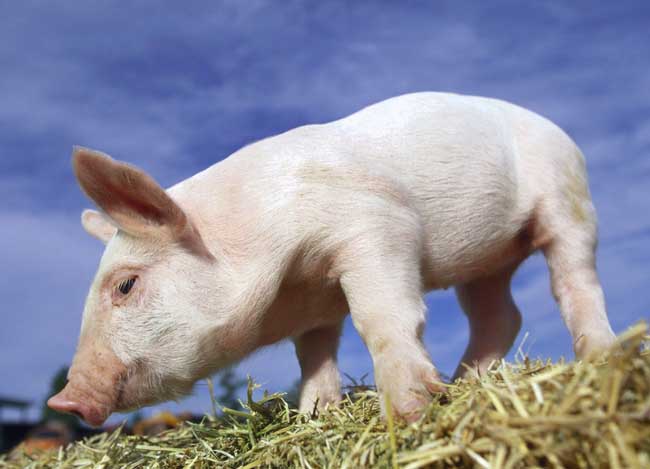
Pigs are omnivorous mammals with stout bodies, short limbs, and relatively long snouts. They are plump-bodied with short legs, docile in temperament, highly adaptable, and fast to reproduce, and come in colors such as black, white, dark red, or black-and-white spotted. Today, the editors of Qiannong Net will take everyone through a look at the living habits and behavioral characteristics of pigs!
Feeding behavior of pigs
The prominent feature of pigs' feeding behavior is that at feeding time, pigs all try to occupy a favorable position at the trough, sometimes stepping their front legs into the trough, so the trough should be fitted with barriers. When pigs eat freely, they feed 6 to 8 times during the day and 4 to 6 times at night, each session lasting 10 to 20 minutes. Pigs' feeding is competitive; group-housed pigs eat faster, eat more, and gain weight faster than individually housed pigs. A pig's feed intake increases with body weight gain, and the feed intake of growing pigs is generally 3.5% to 4.5% of body weight. Piglets fed dry feed drink water 9 to 10 times per day and night, while those fed wet feed drink on average 2 to 3 times. After each feeding of dry feed, they drink water immediately. Pigs fed freely usually alternate between eating and drinking, while under restricted feeding, pigs drink water only after finishing all the feed.
Moreover, pigs are omnivorous animals with a large appetite. The pig's stomach type falls between the simple stomach of carnivores and the complex stomach of ruminants, and it utilizes a wide and varied range of feed. There are no microorganisms in the stomach that break down crude fiber, so the crude fiber content in pig feed should not be too high. When feeding pigs with green and roughage, care should be taken to blend in a certain amount of concentrated feed.
Pigs are also accustomed to rooting in the soil for food, because the structure of the pig's snout is suited to digging. From about one week after birth, they can dig into the soil with the tip of the snout to feed. This is the nature of pigs, so the floor of the pigpen must always be kept clean and dry to avoid causing diarrhea.
Thermoregulatory habits of pigs
The most suitable temperature for growing-finishing pigs is 20 to 24°C. The suitable temperature for piglets is 22 to 32°C. When the ambient temperature is unsuitable, pigs display thermoregulatory behavior to adapt to the ambient temperature.
When the ambient temperature is too high, pigs will voluntarily lie down in manure, urine, or wet places. To help dissipate heat, when lying down they spread their limbs and fully stretch out their bodies, and their breathing speeds up or they pant with open mouths.
When the temperature is too low, pigs curl up their bodies to minimize exposure of the body surface. When standing, they tuck their tails, arch their backs, and draw their limbs in tightly, and they also adopt a compact posture when feeding.
Excretion behavior of pigs
Pigs love cleanliness. Pigs have the habit of defecating in low, damp places and sleeping in high, dry places, and they have the characteristic of frequently maintaining cleanliness. Therefore, pigpen buildings should be able to make use of this habit to keep the area high and dry and clean. Pigs do not defecate or urinate where they eat and sleep, and they show a certain pattern in defecation and urination. Growing pigs generally do not defecate while feeding; about 5 minutes after eating their fill, they begin to excrete once or twice, mostly defecating first and then urinating. They tend to excrete before feeding, mostly urinating first and then defecating. During the interval between two feedings, they only urinate and rarely defecate. At night, they generally defecate two or three times. Pigs are also accustomed to excreting when they just get up to drink water after sleeping or when they rise and lie down. When the pigpen is too small, the stocking density is too high, or the ambient temperature is too low, their excretion habits are easily disturbed and disrupted.
Gregariousness of pigs
Pigs are timid animals that like to live in groups. Pigs from the same litter or from different litters but of the same size should be housed together in the same pigpen. They are accustomed to moving, living, and sleeping in groups. Pairing up is a prominent social activity, and individuals within the group show physical contact and maintain information transmission through hearing. They can get along harmoniously with one another, but they also have competitive habits: the big bully the small, and the strong bully the weak. The larger the group, the more obvious this phenomenon becomes. Those that leave the group and live alone may be suspected of having problems.
Pigs are relatively slow in perceiving colors but are sensitive to smell, so corresponding measures should be taken when fostering piglets. Pigs have a strong memory for eating and drinking, and they easily establish conditioned reflexes to the time, sounds, smells, trough location, and so on related to eating and drinking. Based on these characteristics, corresponding feeding management systems can be formulated, and reasonable behavioral conditioning and training can be carried out, such as feeding at fixed times every day and training pigs in triangular positioning for feeding, lying down, and excretion.
Pigs are somewhat nervous and are easily disturbed, which causes stress. Therefore, breeders must take careful care of the pig herd.
Fighting behavior of pigs
Fighting behavior includes activities of attack, defense, avoidance, and holding a defensive stance. The fighting behavior seen in production is mainly for competing for rank within the group, competing for territory, and competing for food.
Exploratory behavior of pigs
Exploratory behavior includes investigative activities and inspection behavior. Most of pigs' general activities come from exploratory behavior, mostly directed toward objects on the ground, exploring through senses such as looking, listening, smelling, sniffing, gnawing, and rooting, and through exploration they gain understanding of and adaptation to the environment.
Abnormal behavior of pigs
Abnormal behavior refers to behavior beyond the normal range. It focuses on abnormal behavior that causes harm to humans and livestock or brings economic losses. Its occurrence is mostly related to harmful stimuli in the environment where the pigs live. These behaviors are mainly affected by factors such as restricted activity and long-term high-density confinement.