How Do Cows Ruminate? A Complete Explanation of the Process
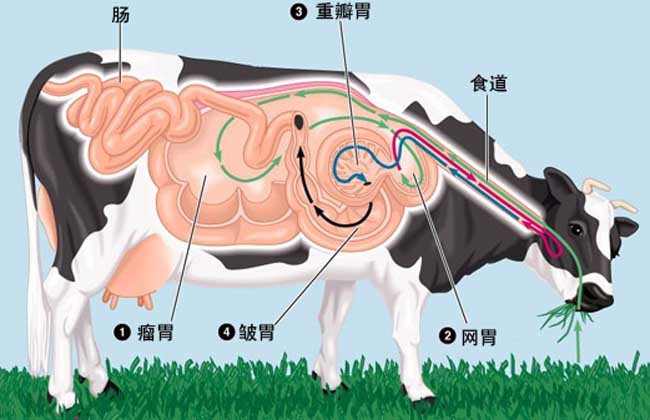
Rumination refers to the activity in which herbivorous animals regurgitate a bolus of food from the rumen back into the mouth before digestion, then re-chew and re-swallow it. It includes four processes: regurgitation, re-chewing, re-mixing with saliva, and re-swallowing. Rumination occurs mainly in some herbivorous animals of the mammalian order Artiodactyla, such as sheep and cows, and below let us take a look at rumination in cows!
When a cow has finished eating forage or is lying down to rest, people will see the cow's mouth continuously chewing the food into a bolus and swallowing it again, each time taking about 1 to 2 minutes, and a cow needs about 6 to 8 hours per day for rumination. Rumination can make large amounts of forage finer and softer, allowing it to pass through the rumen more quickly into the later parts of the digestive tract, so that the cow can consume more forage.
Ruminants generally eat rather hastily, especially coarse forage, and most of it is swallowed into the rumen without being fully chewed. After being soaked and softened in the rumen for a period of time, the food is regurgitated back into the mouth, re-chewed, mixed with saliva again, and re-swallowed into the rumen.
In a healthy herd, 50% of cows are ruminating. When a cow is ill, overly fatigued, or subjected to strong external stimuli, rumination behavior can be weakened or stop completely. Once rumination stops, food remains in the rumen, and the gas produced by fermentation often cannot be expelled, causing rumen bloat.
Cows ruminate because of the special setup of the bovine stomach. The bovine stomach is divided into four parts: the rumen, the reticulum, the omasum, and the abomasum, of which only the abomasum is the part that secretes gastric juice. The volume of the bovine rumen is 100 to 300 liters, accounting for about 80% of the four-part stomach. The rumen contains a large number of microorganisms, including protozoa (mainly ciliates) and bacteria. The rumen itself does not secrete enzymes; all enzymes in the rumen are produced by microorganisms. The fiber in the forage is fermented and decomposed under the action of the enzymes produced by these microorganisms, and most of the resulting lower fatty acids are absorbed by the rumen wall. The reticulum is in front of the rumen, resting against the diaphragm and the liver. The inner wall of the reticulum is honeycomb-shaped, and microbial digestion also takes place in the reticulum.