What Types of Cattle Are There? A Detailed Introduction to Common Breeds
Cattle originated in the Miocene and are a mixed and advanced branch that diverged from the ancient deer-like ancestors. Cattle have many uses: their meat and milk can be eaten, their hides are industrial raw materials, and cattle can also provide draft power and support agricultural production, among other things. The main types of cattle are yellow cattle, water buffalo, yak and wild cattle. Let us take a look below!
Yellow Cattle
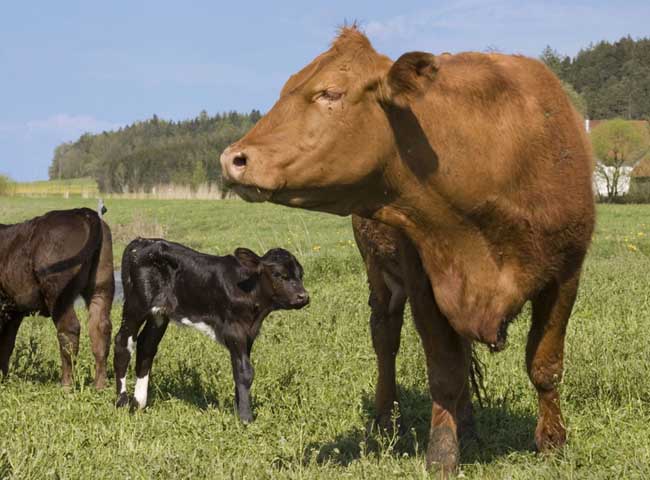
Yellow cattle are an ordinary cattle breed native to China. In China, the number raised ranks first among all large livestock and among cattle. They are raised in almost every part of the country. In farming areas they are mainly used for draft; in semi-farming, semi-pastoral areas they are dual-purpose for draft and milk; and in pastoral areas they are dual-purpose for milk and meat. Their body shape and performance differ due to different natural environments and raising conditions, and they can be divided into 3 major types: northern yellow cattle, central plains yellow cattle and southern yellow cattle. The coat of yellow cattle is most often yellow, which may be how the breed got its name, but there are also red-brown and black ones. The head is slightly heavy, the horns vary in shape, and the base of the horn is round. The constitution is sturdy, the build is compact, the muscles are well developed, the four limbs are strong, and the hooves are solid. There are about 25 breeds of yellow cattle in China. The top five are: Nanyang cattle, Qinchuan cattle, Luxi cattle, Yanbian cattle and Jinnan cattle, collectively known as China's five excellent yellow cattle breeds.
Yellow cattle are mainly yellow and black, with a firm, compact constitution, relatively thick skin, longer coat, sturdy bones, and moderate muscle development; a low, flat withers; a straight back and loin; a relatively deep chest; a relatively long barrel; and short, thick, powerful limbs with clearly visible joints and tendons. The limbs and body are well proportioned.
Yellow cattle have good draft performance, great strength, fast walking speed, agility, tolerance of extreme heat and cold, and are easy to train, among other traits. The maximum pulling force of a healthy ox is 428.2 kg, which is 96% of its body weight. A healthy ox in a two-ox set with a new-style walking plow plows 0.77 mu per hour on first-crop land and 1—1.3 mu per hour on second-crop land. A single ox with a rubber-tired cart loaded with 600—700 kg of chemical fertilizer travels 30—36 km per day, at a speed of 1—1.3 m per second. In the past, most farming households relied on cattle for plowing, hauling and other heavy draft work. Yellow cattle also have fairly good reproductive performance; under grazing management and natural mating, the reproductive survival rate is 59.06%. A cow produces 6—7 calves in her lifetime, and cows with good feeding and management conditions can produce more than 8 calves. They have a very strong ability to maintain pregnancy and rarely miscarry, commonly known as an “iron womb.”
Water Buffalo
The water buffalo, also called the Indian buffalo, is a large even-toed animal with thick skin and extremely underdeveloped sweat glands. When hot, it needs to soak in water to dissipate heat, which is how it got the name water buffalo. Domesticated water buffalo are distributed in Asia, Europe, North Africa and the Americas. Wild water buffalo are active only in Bangladesh, India, Nepal, Bhutan and Thailand. Wild water buffalo inhabit jungles, bamboo groves or reed beds. They like to roll in mud pits to dissipate heat and prevent insect bites.
Water buffalo have a sturdy build and sparse coat, mostly gray-black; horns are thick, large and flat, and curve backward; the skin is thick and the sweat glands are extremely underdeveloped, so when hot they need to soak in water to dissipate heat, which is how they got the name water buffalo; the hooves are large, solid in texture and resistant to soaking, and the knee and fetlock joints move flexibly. Water buffalo have relatively short, small ears, a narrow, long forehead, hair on the dorsal midline facing forward, a back sloping toward the rear and downward, and relatively slender, long horns.
The African buffalo has large, drooping ears, a short, broad head, hair on the dorsal midline facing backward, a straight back, relatively thick, large horns, and a body that is entirely black, brown or reddish-yellow.
Sturdy build, sparse coat, mostly gray-black; horns thick, large and flat, and curving backward; skin thick and sweat glands extremely underdeveloped, so when hot they need to soak in water to dissipate heat, which is how they got the name water buffalo; short legs and large hooves, suitable for plowing; draft power, milk yield and tolerance of coarse feed are all higher than those of yellow cattle; milk fat percentage is about 8%, and the milk fat is white; the meat is relatively coarse.
Yak
The yak is a cattle breed unique to high-cold regions and a herbivorous ruminant livestock. The yak is the mammal that lives at the highest altitude in the world. It is mainly produced in areas of China's Qinghai-Tibet Plateau above 3000 m in elevation. It adapts to high-cold ecological conditions, tolerates coarse feed and hardship, is good at walking steep slopes and dangerous paths, snow mountains and swamps, and can swim across rushing rivers. It is known as the “boat of the plateau.” Every part of the yak is useful. For Tibetan people, it is indispensable for clothing, food, housing, transport, fuel and plowing. People drink yak milk, eat yak meat and burn yak dung. Its hair can be made into clothing or tents, and its hide is a good material for leathermaking. It can be used both for farming and as a transport tool on the plateau. Yaks also have the ability to know the way, are good at walking dangerous paths and swampy ground, and can avoid traps and choose a route, so they can serve as guides for travelers.
The yak has a large head, thick horns, loose, thick skin, a high, long and broad withers, short and upright forelimbs, and hindlimbs shaped like a knife. The lower sides of the body have coarse, long reverse-growing hair, and the tail is short and bears fluffy long hair. A male yak has a coarse, heavy head that is rectangular, a short, thick and deep neck, and relatively large testicles that sit close to the abdomen and do not hang down; a female yak has a long head, large round eyes, a broad forehead, horns, a long, thin neck, small udders shaped like a bowl and saucer, short, small teats, and inconspicuous milk veins.
The yak has a relatively coarse, heavy head, a broad, flat forehead, a slightly concave face, round, spirited eyes, a square, large mouth, thin lips, and in the vast majority of cases horns, with the horn shape folding outward and upward and spreading open, and a large distance between the horns; female yaks' horns are very thin. Both males and females lack a dewlap. The forechest is broad, the chest is deep, the ribs are well sprung, the back and loin are straight, the abdomen is large but not pendulous, and the rump is relatively narrow and sloping. The tail root is low and the tail is short. The four limbs are strong and powerful, the hooves are small and round, the hoof cleft is tight, and the hoof texture is solid. Long hair grows on the forechest, shoulders, chest, abdomen and sides of the body and reaches the ground, and the tail hair grows in a broom-like tuft.
Wild Cattle
Wild cattle are huge in size, with a body length of 200-300 cm, a shoulder height of about 2 m, and a body weight of about 600-1500 kg. The two horns are thick, large and sharp, forming an arc. There is a white patch on the upper forehead. There is a hump like a tumor from the shoulder to the front back. The body hair is mostly brown, dark brown or black, and the hair on the limbs below the knees is white, so it is also called “white socks.”
The Indian bison is also called wild cattle, wild yellow cattle, white-legged bison and so on. It is famous for its enormous body and is the largest-bodied species among present-day cattle. The genus Bison is the only member of the Bovinae subfamily distributed outside Africa and Asia, including two species, the American bison Bison bison and the European bison Bison bonasus. The European bison is rare in number and is now in a semi-wild state. The American bison was once the most numerous large animal in the Americas, but was once almost hunted to extinction and has recovered through protection.
Wild cattle can hybridize with ordinary cattle breeds in the genus Bos, producing heterosis and providing useful genes for breeding new varieties.