Detailed Explanation of Key Technical Points for Efficient Beef Cattle Breeding Management
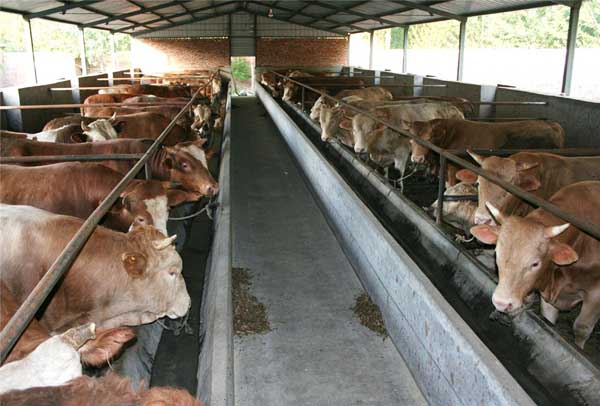
Requirements for Environmental Facilities
The suitable growth temperature for cattle is 10-25°C. Since enclosed indoor tethering is adopted, the barn is required to have good lighting, drainage, ventilation and insulation performance, facilitating disinfection, ventilation and air exchange, regulation of barn temperature and humidity, and fly and rodent control. At the same time, the surroundings are required to be free of noise, water quality and air pollution.
Requirements for Calves Entering the Barn
Select healthy calves aged 5-6 months, weaned, with a body weight of about 200 kg. The hybrid sire should preferably be Angus, Limousin, Charolais, Simmental or Piedmontese. Before entering the barn, in addition to thorough disinfection of the barn, newly purchased calves also need to be sprayed and disinfected on the body surface with a 0.3% peracetic acid solution. For cattle with more lice and mites, spray with a 2% trichlorfon solution for elimination.
Management of Calves During the Adaptation Period After Entering the Barn
The adaptation period is generally 15-20 days. During this period, regulate the cattle's diet, feed some easily digestible forage, and pay attention to observing their feed intake and activity. Start deworming after 7 days, administering Chuxing (ivermectin) at 0.1 g per kg of body weight per head. If there are external parasites, a second administration of trichlorfon at 40 mg per kg of body weight can be given on the 7th day after deworming. Starting from the 5th day after entering the barn, gradually add to each cow's daily ration 30 g of salt, 20-60 g of urea, 40-60 g of monensin, and 2-7 kg of distiller's grains mixed feed (5 parts distiller's grains to 1 part bran). Among these, the distiller's grains, urea and monensin are all increased gradually from small to large amounts, mixed with other rations into a wet feed at feeding time, and drinking water is prohibited within 1.5 hours after eating. If ammoniated feed is available, urea need not be fed, and ammoniated feed or micro-storage feed can be used to gradually replace roughage. Strengthen epidemic prevention for cattle entering the barn, and regularly inject corresponding vaccines.
Feeding and Management During the Fattening Period
The fattening period requires 11-13 months. Before reaching a body weight of 250 kg is early-stage fattening, and from 250 kg onward enters the intensive fattening stage. At this stage, cattle can be given a single injection of "Yizhenfei" (one-shot fattening agent), and after use the meat quality can reach international export standards. It only needs to be administered once. Upon entering the fattening period, the cattle's activity should be restricted with indoor tethering, feeding once each at 6 a.m. and 6 p.m. daily, feeding roughage first and then concentrated feed, with water temperature not lower than 4°C. Reasonably formulate the daily ration according to the nutritional needs of cattle at different growth stages, and feed changes should be made gradually over 2-3 days. Throughout the fattening process, attention should be paid to observing the cattle's feed intake and digestion, so as to promptly discover and quickly solve problems, and try to avoid sudden death phenomena such as acidosis and urea (ammonia) poisoning. If restlessness, eyeball and muscle tremors, foaming at the mouth and other symptoms appear within 1 hour after eating, immediately inject cardiotonic and diuretic drugs, and at the same time use litmus paper to measure the pH of the rumen and urine (normal cattle urine pH is 7.7-8.7). When the urine pH is higher than normal, administer 500 mL of edible vinegar and 500-1000 mL of sugar water by drenching. If the urine is acidic, administer 200 g of baking soda dissolved in 500 mL of water by drenching, along with fluid infusion, stomach lavage, and laxatives.